Arts & Entertainment
A Pacific Incident
Direct Link Between 1904 Incident, Pearl Harbor, and the Deaths of 17 CT Men


The unsuspecting navy ships lay peaceably in their Pacific harbor that winter morning. A world away, the drowsy sailors' commander in chief had been negotiating with Japanese diplomats. But then, with no advance warning, Japan launched the infamous sneak attack. Deadly torpedoes and bombs came out of nowhere, and soon the harbor was a flaming mess of sunken ships. Screaming sailors swam for their lives through fiery, oil-blackened waters. President Roosevelt admired the sneak attack. "I was thoroughly well pleased with the Japanese victory," the President wrote his son.*
Now, while you were reading this, I bet you thought this was a description of the Japanese sneak attack on Pearl Harbor on December 7, 1941.
You'd be wrong.
Find out what's happening in Meridenfor free with the latest updates from Patch.
Maybe you were puzzled by Roosevelt's reaction to the attack? That's because the Roosevelt referenced is Teddy, not FDR. The incident described is the Japanese sneak attack upon the Russians at Port Arthur on February 8, 1904. This incident triggered the Russo-Japanese War in 1904-05, a war in which a much smaller nation defeated a much larger nation—the Japanese defeated the Russians. This war featured the largest land battles—involving hundreds of thousands of men—the world had ever seen. These battles dwarfed Gettysburg. At the Battle of Mukden in February/March of 1905, the largest land battle in modern warfare, the Japanese killed 97,000 Russians. At the naval Battle of Tsushima, the Japanese lost 600 while killing 6,000 Russians in, you guessed it, the largest naval battle in modern warfare. Teddy Roosevelt gushed about Tsushima: "Neither Trafalgar nor the Spanish Armada was as complete and overwhelming."*
Yet who studies the Russo-Japanese War?
Find out what's happening in Meridenfor free with the latest updates from Patch.
The Treaty of Portsmouth (New Hampshire) of August 23, 1905, mediated by the friend of the Japanese—one Theodore Roosevelt—marked the end of the war. For his actions in securing the treaty, TR received the Nobel Peace Prize for 1906. Like canny poker players, the Japanese folded their hand at the right time and got the victory. Wisely, the Japanese signed a peace treaty before the Russians were able to bring to bear their overwhelming logistical advantage in men and material. Over the long haul the Russians would have won, just as they did against the Germans in WWII. The Russo-Japanese War changed Japanese history. Intense national pride over the victory swept the country. Monuments to the war sprung up everywhere. It was the desire to repeat this kind of victory that drove the decision to attack Pearl Harbor 37 years later. Pearl Harbor was the 2nd coming of the attack on Port Arthur in 1904.
I've read a lot of military history but had never before realized the connection between the Russo-Japanese War and Pearl Harbor until I found the above quotation and historical analogy in chapter three of "Flyboys" (2003) written by James Bradley, author of "Flags of Our Fathers." It is a good book and makes you wonder had anyone studied that war and the Japanese tactics, whether the Pearl Harbor attack could have been averted.
The parallels between the two incidents are remarkable. Connecticut lost 17 of its young men during the Pearl Harbor attack 69 years ago this week-- 13 members of the US Navy and four personnel from the US Army Air Corps. Ten of these men were on the battleship USS Arizona; one was from the battleship USS Nevada; another was onboard the battleship USS California; the other was a naval flyer from the aircraft carrier USS Enterprise. Two of the AAC casualties were stationed at Hickam Field; the other two were serving at Wheeler Field. The USS California and the USS Arizona were sunk in Battleship Row. The California was salvaged and returned to duty in the Pacific. The Nevada was the only battleship in Battleship Row to get underway that fatal morning, but it also suffered extensive damage. Nevertheless, it was repaired and participated in the invasions of Normandy, Iwo Jima, and Okinawa, using one of the gun turrets salvaged from the ill-fated Arizona.
Seaman 1st Class John K. Lunita of Collinsville, Connecticut was one of 62 sailors who perished on the Nevada. Engineer Thomas James Reeves of Thomaston, Connecticut was one of the 100 men killed on the California.
The Arizona was beyond repair. Its wreckage remains at Pearl and forms the center of the famous memorial there. In total 2,403 American military personnel died as a result of the attack on Pearl Harbor; 1,177 of those casualties—nearly half—were serving on the Arizona; ten were young men from Connecticut.
The violent, sudden deaths of these 17 Connecticut men and the other 2,386 who were killed by Japanese aircraft on December 7, 1941 galvanized the American public for war. The roots of this catastrophe, however, go back to the Russo-Japanese War of 1904. The Battle of Port Arthur, a source of tremendous pride for the Japanese, was the paradigm for the attack at Pearl Harbor. One leading American military figure well understood Japanese history—General Billy Mitchell—the "father" of the US Air Force. Mitchell died 5 years before the Pearl Harbor attack, a couple of years after the publication of the book "Mitchell: Pioneer of Air Power." In that book Mitchell was quoted as saying, "The Japanese never declare war before attacking." He said that in 1932. Who was listening?
* James Bradley "Flyboys" ( NY: Little Brown, 2003), 47.
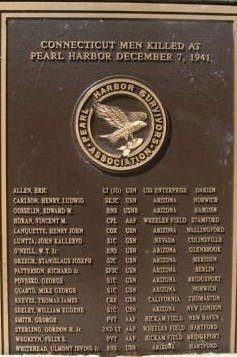
Connecticut Men Killed At Pearl Harbor December 7, 1941
Allen, Eric Lt. (JG) USN USS Enterprise Darien
Carlson, Henry Ludwig SK3C USN Arizona Norwich
Gosselin, Edward W. Ens USNR Arizona Hamden
Horan, Vincent M. Cpl AAF Wheeler Field Stamford
Lanquette, Henry John Cox USN Arizona Wallingford
Lunita, John Kallervo SIC USN Nevada Collinsville
O'Neill, W.T., Jr. Ens USN Arizona Glenbrook
Orzech, Stanislaus Joseph S2C USN Arizona Meriden
Patterson, Richard Jr. Sf3C USN Arizona Berlin
Povesko, George S1C USN Arizona Bridgeport
Quarto, Mike George S1C USN Arizona Norwich
Reeves, Thomas James CRE USN California Thomaston
Seeley, William Eugene S1C USN Arizona New London
Smith, George Pvt AAF Hickam Field New Haven
Sterling, Gordon H., Jr. 2nd Lt AAF Wheeler Field Hartford
Wegrzyn, Felix S. Pvt AAF Hickam Field Bridgeport
Whitehead, Ulmont Irving, Jr. Ens USN Arizona Hartford
"Ah! never shall the land forget /How gushed the life-blood of her brave ." ~William Cullen Bryant