Community Corner
Thursday Sept. 11th Commodore MacDonough Wins The War Of 1812
Thomas MacDonough's 200th anniversary of Battle of Lake Champlain in Plattsburgh.


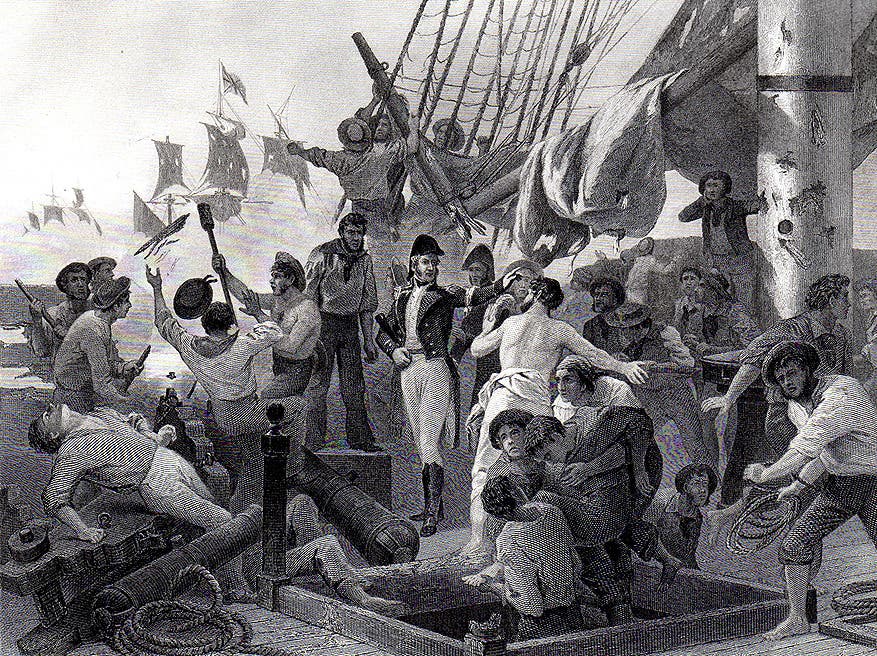
September 11th is the 200th anniversary of Battle of Lake Champlain in Plattsburgh.
Thomas MacDonough - Early Life:
When Thomas MacDonough’s elder brother James, a midshipman in the US Navy, returned home having lost a leg during the Quasi-War with France, MacDonough started a career at sea and he applied for a midshipman’s warrant with the aid of Senator Henry Latimer. This was granted on February 5, 1800.
Thomas MacDonough - Going to Sea:
During the First Barbary War MacDonough received a thorough nautical education from Captain Alexander Murray and then received orders to join USS Philadelphia in 1803. While taking leave on shore that fall, MacDonough was not aboard the Philadelphia when it grounded on an uncharted reef in Tripoli harbor and was captured on October 31.
Without a ship, MacDonough was soon reassigned to the sloop USS Enterprise serving under Lieutenant Stephen Decatur. Concerned that the Philadelphia would be salvaged by the Tripolitans, Lt.Decatur was to sneak into Tripoli harbor on the Intrepid, to storm the ship, and setting it ablaze if it could not be saved. Familiar with Philadelphia’s layout, MacDonough volunteered for the raid and played a key role. Moving forward, Decatur and his men succeeded in burning Philadelphia on February 16, 1804. A stunning success, the raid was termed the “the most bold and daring act of the Age” by British Vice Admiral Lord Horatio Nelson.
Thomas MacDonough - Peacetime:
Promoted to lieutenant for his part in the raid, MacDonough returned the United States in 1806, and aided Captain Isaac Hull in overseeing the construction of gunboats at Middletown, CT. Completing his assignment with Hull, MacDonough received his first command in the sloop of war USS Wasp. Initially operating in the waters around Britain, Wasp spent much 1808 off the United States enforcing the Embargo Act. Departing Wasp, MacDonough spent part of 1809 aboard USS Essex before leaving the frigate to direct gunboat construction at Middletown.
Thomas MacDonough - The War of 1812 Begins:
After his marriage with Lucy Ann Shaler he returning to active duty shortly before the beginning of the War of 1812 in June 1812, MacDonough initially received a posting to the Constellation. He was soon ordered to take command of US naval forces on Lake Champlain that October. Arriving at Burlington, VT, his command was sufficient to control the lake. Promoted to master commandant on July 24, MacDonough began a large shipbuilding effort at Otter Creek, VT. They produced the corvette USS Saratoga, the sloop of war USS Eagle, the schooner USS Ticonderoga, and several gunboats by late spring 1814. Completing his vessels, MacDonough shifted his squadron of fourteen warships across the lake to Plattsburgh.
Thomas MacDonough - The Battle of Plattsburgh:
As Confiance neared completion, British forces led by Lieutenant General Sir George Prévost marched south, and with Captain George Downie’s British naval forces planned attacking Plattsburgh . To oppose this effort, badly outnumbered American forces, commanded by Brigadier General Alexander Macomb, assumed a defensive position near Plattsburgh. They were supported by MacDonough who arrayed his fleet in Plattsburgh Bay.
Consulting with Downie, Prévost intended to attack the American lines on September 10 in concert with a naval effort against MacDonough in the bay. Hampered by unfavorable winds, Downie was unable to move forward on the desired date and was forced to delay a day. On September 11, the British fleet rounded Cumberland Head at 9:00 AM and approached MacDonough’s position. As the Battle of Plattsburgh began, Downie laid Confiance next to MacDonough’s flagship, Saratoga. As the two flagships hammered each other, the other vessels began engaging. There was now a hushed, expectant moment like the stillness which precedes the storm. Macdonough, whose manly courage was supported by a childlike faith, knelt on the deck of the flagship with his officers around him and repeated the following prayer: “Stir up Thy strength, O Lord, and come and help us, for Thou givest not always the battle to the strong, but canst save many or few....through Jesus Christ, our Lord.”
The battle turned when MacDonough was able to pivot the battered Saratoga using spring lines and brought his undamaged portside guns to bear. In succession, he was able to capture Confiance as well as the brig HMS Linnet. Having gained the upper hand, the Americans succeeded in capturing the entire British squadron. For his efforts at Plattsburgh, MacDonough was hailed as hero and received a promotion to captain as well as a Congressional Gold Medal. In addition, both New York and Vermont presented him with generous grants of land.
Thomas MacDonough - Later Career:
After remaining on the lake into 1815, MacDonough took command of the Portsmouth Navy Yard on July 1 where he relieved Hull. Returning to sea three years later, he joined the Mediterranean Squadron as captain of HMS Guerriere. During his time abroad, MacDonough contracted tuberculosis in April 1818. Due to health issues, he returned to the United States. MacDonough requested sea duty and received command of USS Constitution in 1824. Sailing for the Mediterranean, MacDonough’s tenure aboard the frigate proved brief as he was forced to relieve himself of command due to the tuberculosis health issues on October 14, 1825. Sailing for home, he died off Gibraltar on November 10. MacDonough’s body was returned to the United States where it was buried in Middletown, CT next to his wife, Lucy Ann Shaler MacDonough.