Politics & Government
Little Bridge 2629 to Bring Big Inconvenience
Replacement in 2014 means a pesky detour … but not for long.
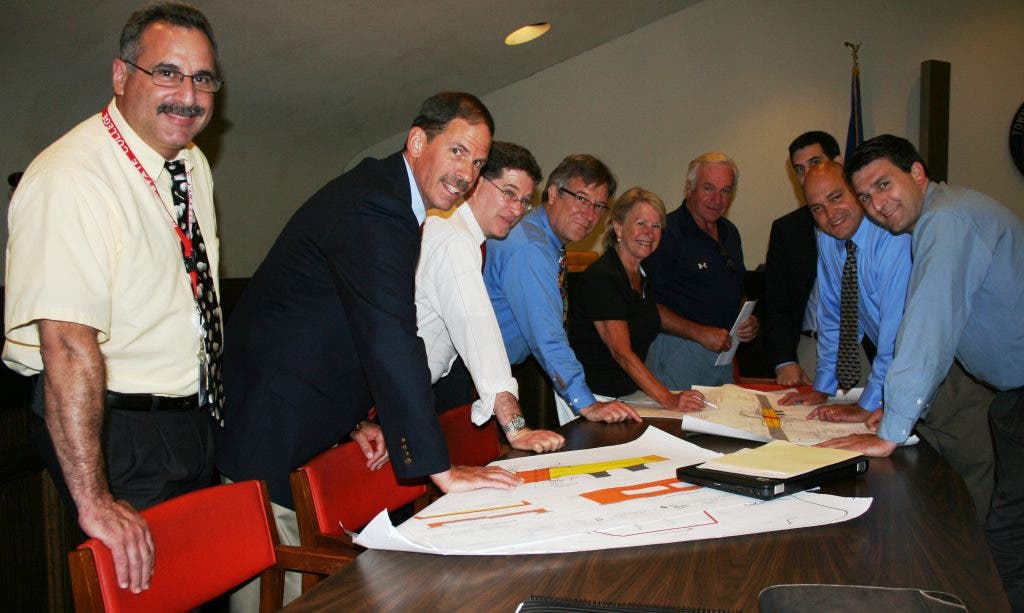


"The bridge is a 'Must Do'," said David A.Cutler, project manager for the Connecticut Department of Transportation. (ConnDOT) "It won’t collapse tomorrow, but we need to do this bridge!"
"Not during the school year," said Patrick O'Hara, vice chair of Monroe’s Planning and Zoning Commission. "There are schools on Route 111. It would cause major problems."
It’s just a little bridge, hardly noticeable when Monroe residents drive over it, barely 12-feet in length, and the width of two lanes. It bridges a small stream, Beardsley Brook, completely hidden from passersby by thick summer foliage, protected by the Town’s Plan of Conservation and Development and the state’s Department of Environmental Protection. But it’s there, just north of Big Y and south of the Goodwill store on Route 111. Built in 1914, it lies downstream from the forgotten remains of Monroe’s historic Beardsley Sawmill.
Find out what's happening in Monroefor free with the latest updates from Patch.
It’s a bridge in trouble. It needs to be replaced due to the poor condition of its superstructure — crumbling stone masonry abutments. The ConnDOT proposes that it be replaced with a six-foot-wide and a 12-foot-wide box culvert carrying two 12' wide travel lanes and two 5' wide shoulders for a new curb-to-curb width of 34 feet — 11 feet wider than the existing road.
The ConnDOT would like to begin construction in spring of 2014 assuming acceptance of the project, availability of funding and receipt of any required right-of-way and environmental permits. The estimated cost, some $1.8 million, would be funded with Federal and State funds.
Find out what's happening in Monroefor free with the latest updates from Patch.
The project sounds simple. So why did ConnDOT personnel call a public informational meeting Wednesday night at Town Hall and bring half a dozen engineers and project specialists?
According to Scott A. Hill, manger of bridges and facilities for the ConnDOT, public information meetings are procedure when construction will impact a town.
First Selectman Steve Vavrek said, "Residents and business owners needed to have the opportunity to learn what the bridge project will mean to them. Monroe is, after all, their town. They pay taxes here, and the bridge replacement will require a major inconvenience."
The team of engineers, designers and project managers prefer to close down Route 111 for four to six weeks and replace the bridge. It would require less cost and ensure the safety of construction workers. Other plans would take six months of constructions and traffic congestion.
In the preferred plan motorists would follow one-way detours. The detour would re-route Southbound traffic to the west of Route 111- onto Church Street (near Town Hall) to Elm Street to Cross Hill Road. Northbound traffic would be re-routed to the east of Route 111 — right on Cross Hill Road to Moose Hill Road to Route 111 near Town Hall.
Cutler admitted that detouring nearly 8,000 cars each way through residential areas on a daily basis was a negative. But it was the better option.
Traffic signals may be warranted and compensation for extra police and wear and tear on local roads considered.
O'Hara was concerned with the detours impact on Monroe's Volunteer Fire Department and the Goodwill Industries retail store. Cutler said that a checklist is used for all projects to ensure minimal impact in the community.
Four Monroe property owners will be impacted by the bridge replacement: Leonard Lee and Barbara Ross, and Laura Blakely on the downstream side of the bridge and Aquarion Water Company and John and Ketiann Bennett on the Big Y side of the road.
Ross whose property at 556 on Route 111 abuts the project was most concerned with safety issues once it was completed. Her driveway according to the plans would spill out onto Route 111 at a sharp right angle. Pulling in and out into traffic concerned her. "Would my driveway have to be moved," she asked.
According to Cutler, only minor changes would occur.
"We work hard," he said, "to minimize our footprint of disturbance." The path of the stream, however "would be changed slightly to minimize erosion to the bank." The new culverts would allow both wildlife and fish to pass unscathed under the road.
Derrick P. Ireland, a representative from the Office of Rights of Way at ConnDOT, laid out the facts. "Easements are anticipated. The state will make an offer to buy the (needed) land. If an agreement cannot be reached, the state will take it by Eminent domain." The plans showed very little private land involved.
All businesses on Route 111 would be accessible during the bridge replacement. However, reaching them, for those north of Beardsley Brook would be roundabout via detours. Signs would be installed saying that the stores were open for business at both detours.
Steven Schapiro, a member of Monroe’s Economic Development Commission, asked if there were other Monroe Bridges on Route 111 that needed repair. According to Cutler, bridges on state roads are examined every two years. He did not know the answer offhand, but quickly offered to retrieve the information if he could get a bridge number.
As for bridge 2629 replacement will begin sometime in 2014 after an 8-inch gas main, AT&T and various overhead wires are relocated.
There will be no cost to the town, and the structure will support the widening of Route 111 if Monroe residents ever decide to make the road four lanes, said Cutler.