Community Corner
Blessing of the Easter Food at St. Hedwig Church
Polish-Americans and I headed to St. Hedwig Church for the annual Blessing of Easter Food.


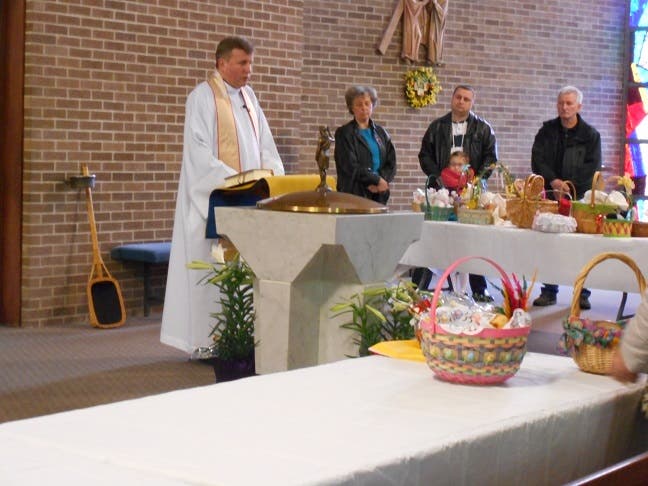


Pictured: Father Eugene offered the annual Blessing of the Easter Food at St. Hedwig on Holy Saturday
All photos by Nancy Sasso Janis
Local Catholic churches offer an annual Blessing of Easter Food on Holy Saturday. I have packed my basket of whatever items I plan to bring to Easter dinner and brought it to church to have it blessed by the priest. The ceremony is brief and not particularly well-attended.
Find out what's happening in Naugatuckfor free with the latest updates from Patch.
At St. Hedwig Catholic Church, the parish offers two sessions of the Blessing of Easter Food to accommodate as many of the faithful as possible. The Polish-Americans appreciate this blessing more than most, and they have plenty of traditions to go along with it. The first time I attended, I discovered that the blessing is done completely in Polish (although the priest did translate one portion for those who spoke “only English”), and I realized that my usual collection of foods was not quite right. So a few years back I did some research on www.polishtraditions.net.
This blessing is a tradition dear to the hearts of many Polish families. As a token of their gratitude to God for all his gifts, they have the food of their table sanctified with the hope that spring will also be blessed by God’s goodness and mercy. Baskets containing a sampling of Easter foods are brought to church in a basket lined with white linen or a lace napkin and decorated with sprigs of boxwood, the typical Easter evergreen. The blessed foods include eggs, sausage (kielbasa) or ham, paschal lamb (made of butter, cake or even plaster), horseradish or pepper, salt, bread, vinegar and wine.
Find out what's happening in Naugatuckfor free with the latest updates from Patch.
Strictly speaking, pisanki refers only to Easter eggs decorated with the molten-wax technique. Various regions of Poland have developed designs of their own, which include floral and geometric patterns, typical Easter motifs like the Lamb, Cross and pussy willows, the greeting “Wesolego Allelujah,” or simply “Allelujah” and the current year.
Many American Poles design eggs with the names of their friends written on them and exchange them during Easter visits.
After Mass on Easter Sunday, families head home to feast on foods that they have not eaten much of during Lent. Cold dishes predominate like ham, kielbasa, roast meats, pasztat (pate), hard-boiled eggs in various sauces, salads, beet and horseradish relish, followed by holiday cakes like babka.
Before Easter breakfast begins, members of the family share wedges of blessed Easter eggs and exchange best wishes in much the same way as oplatek is shared on Christmas Eve.
This year I headed to St. Hedwig with an Americanized basket of the traditional food. I brought my contributions to my family’s Easter dinner, purchased at the very American Stew Leonard’s, as well as some of the foods mentioned above. My basket was the largest because I didn’t exactly bring a “sampling” of my items. Nor was it anywhere near as lovely as those of the ones prepared by the Polish-speaking people in the crowd of parishoners that gathered for the noon ceremony.
Rev. Eugene Kotlinski, C.M., Pastor of St. Hedwig and St. Mary Church in Naugatuck, entered and the faithful went to the back of the church to stand near their basket on the tables set up in the open area at the rear of the church. The priest welcomed us in Polish and recited the blessing in his native tongue, and then repeated the entire blessing in English. This was especially appreciated by me, since my Polish is limited to the word for grandmother “babcia,” taught to me by former Mayor Joan Taf. This year I was the only one who took photos during the blessing as the aroma of homemade kielbasa filled the church.