Community Corner
New London History, Hiding
Williams Memorial Park Historic District is small, but many stories are contained within its boundaries.
Some historic districts announce themselves with decorative signs; some are so obvious they don’t need to. Occasionally they are so big that they
make up whole downtowns, and passing through them is like having your own personal time machine. And then there are the historic districts that aren’t large, or marked, or self-evident. They don’t look particularly historic at first (or fifth) glance, and they don’t really seem like districts so much as hodge-podges of random buildings.
The first kind, of course, can transport you to another time with no effort on your part. But the other kind have their own perverse appeal. Their history is a bit of a secret, reserved for those obsessed or bored enough to bother looking up lists of historic districts.
Historic District is one of these. Even the descriptive marker, the first hint that this isn’t just another bit of green space, refers to the Hempstead Historic District. Sneaky!
Find out what's happening in New Londonfor free with the latest updates from Patch.
The park itself is recognizable for its granite obelisk, located near the corner of Broad and Hempstead, commemorating Connecticut soldiers who fought in the Civil War. But the record of this land is much older - and richer - than that. Starting in 1793 it was the city’s Second Burial Ground. It was then at the far edge of town, where no buildings had been constructed. Later, it simultaneously served as a quarry.
In 1885 New London mayor Charles Augustus Williams had the idea to turn the four-acre graveyard into a park. The land was surveyed (by Frederick Law Olmsted!) and plans were made to close the quarry and move the bodies to .
Find out what's happening in New Londonfor free with the latest updates from Patch.
But the district did not begin with the creation of the park. Development there began decades earlier, in the 1830s and 40s. The people who lived in the first houses that began to spring up there included “a sailmaker, blacksmiths, a boat-builder, a printer, and a machinist” along with those working in trades such as “ostler, waiter, and seaman.” (What the heck was an ostler, you ask? Someone who worked in a stable.) But not all the residents of the district were regular 19th century Joes.
The aforementioned Mayor Charles Augustus Williams was the son of Thomas W. Williams, to whom New London’s success as a whaling port is largely attributed. The elder Williams trained and went into business with Henry P. Haven, who in turn did the same for Richard Chappell. The families of these three men were connected both professionally and personally, and the vast sums their whaling and other enterprises brought in created a lasting presence all over the city, not least in the neighborhood around Hempstead and Broad.
The grand homes they built there were joined in 1870 by the imposing Gothic Revival , which replaced an earlier building that had burned down. All three families were closely associated with the church. The spire of the massive stone building, which reaches high above the park and surrounding houses, was a gift from the firm of Williams and Haven.
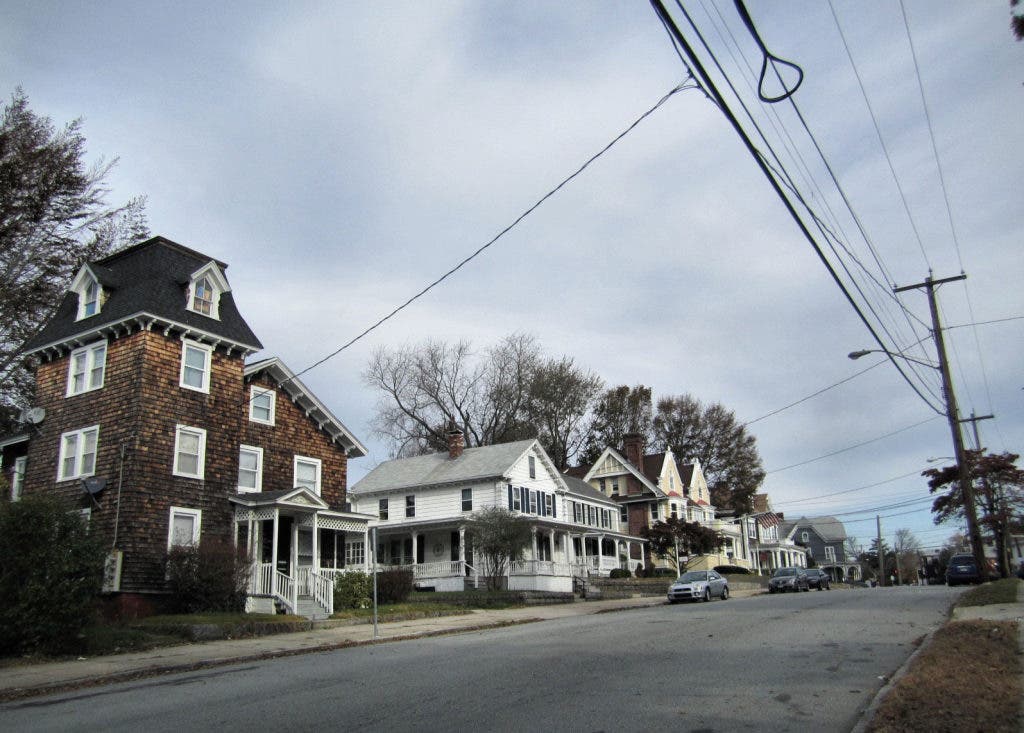
The houses along the park are mostly offices today, but you can see - if you squint and imagine - how spectacular they must have been when inhabited by single families. Architecturally they range from the expected Greek Revival and Italianate to square towers with mansard roofs, Gothic Revival windows, and features I don’t think I’d heard of before I read about this neighborhood, like Stick-style porches. There are also copper gargoyles, which I have never noticed but now intend to seek out, and the only remaining brick Queen Anne home in New London.
The Williams Memorial Park Historic District covers just eight acres. But if someone who knew nothing of the New London could see only this small area, and could pause a minute there, imagining, they would see that this was once a prosperous, prominent city, and that the legacy of that era is not forgotten.