
I’m probably more likely to read plaques and signs and the bases of statues than most people, but sometimes I intentionally avoid them. Especially in places like New London, where pretty much everything is of at least some historical significance; if you stopped to examine every bit of information, you’d never make it down the street. Plus, there is always more. What if you read the plaque and it’s interesting, something you never knew before, and it makes you want to know the rest of the story, and that leads you somewhere else? Basically you can never get anything else done ever again.
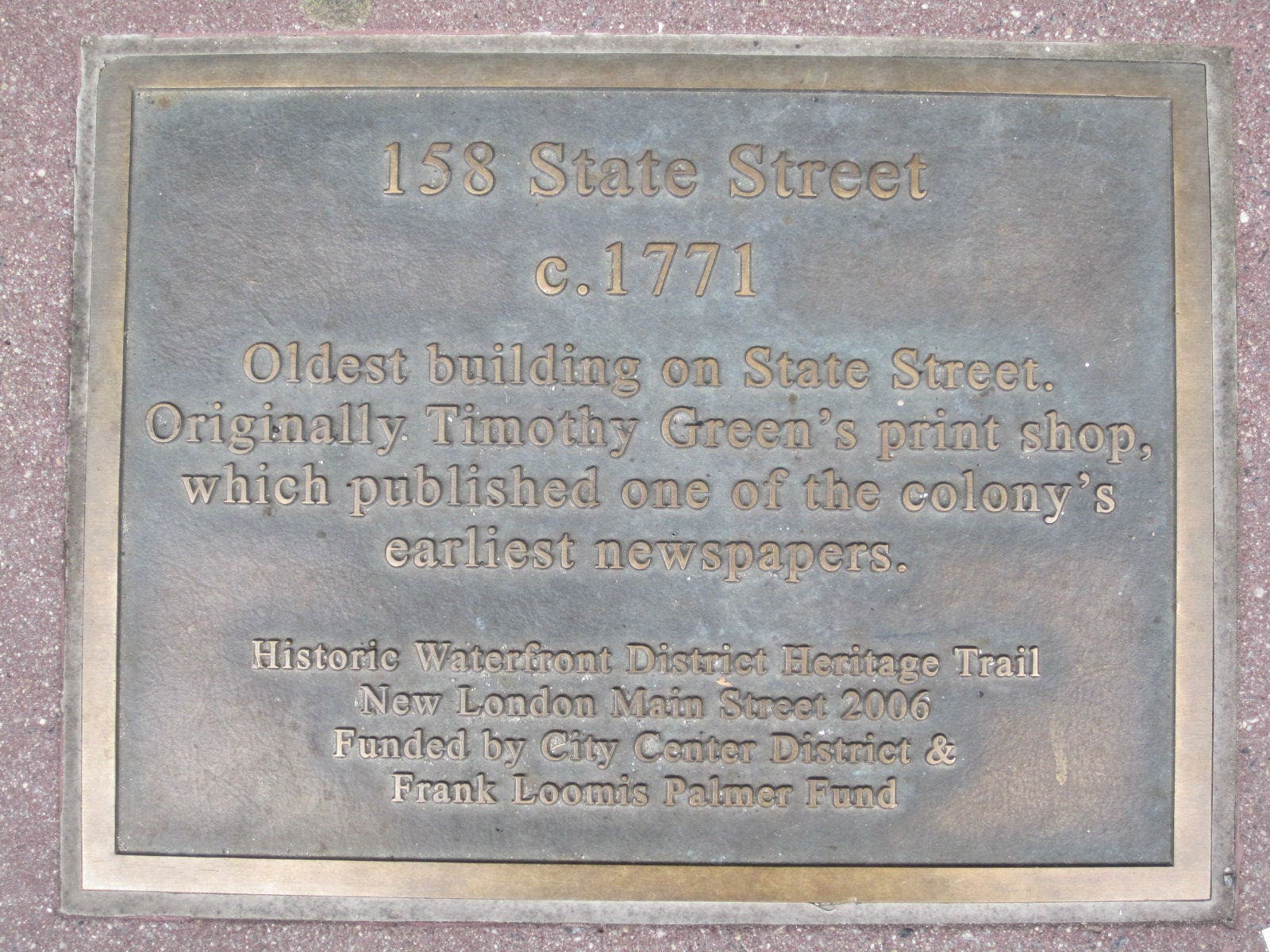
And so far that has been my attitude toward the metal squares in downtown new London’s sidewalks. Until, for some reason, I read one of them. It said:
158 State Street
Find out what's happening in New Londonfor free with the latest updates from Patch.
c. 1771
Oldest building on State Street.
Find out what's happening in New Londonfor free with the latest updates from Patch.
Originally Timothy Green’s print shop,
which published one of the colony’s
earliest newspapers.
Now that I’d gone and read the thing, and looked up at the building - pale blue and indeed very old-looking, wedged between two much larger brick edifices which had diverted my attention away from it for years - it was too late.
Timothy Green came from a large family of printers - 15 to 20 of them, depending on the source - who dominated the industry for years. This was the third Timothy Green from that family to run a printing press in New London. Because they did so much, and because their name is on everything, they get most of the attention.
But I’m usually more interested in the guy who doesn’t get on the plaque, so I skipped over the Greens and started reading about the first printer in New London (and Connecticut). His name was Thomas Short, and his shop was just a room in his house, location unknown. He was invited here in 1709, after Governor Gurdon Saltonstall and the General Assembly decided that what they had been doing - sending all the Colony’s printing to Boston - was no longer a convenient plan. The first documents Short printed were an act of the General Assembly authorizing the production of paper money to pay for a British attack on Quebec, and a broadside announcing a day of fasting and prayer for the success of that endeavor. But most of what he published sounds insufferably dull. One example, the first book ever printed in the colony of Connecticut, was called The Saybrook Platform of Church Discipline.
Aside from the lack of exciting new reading material, there was also a dearth of paper. There were no paper mills in America until 1691; until that time all paper was imported from England. Paper-making technology spread slowly through the colonies, with Connecticut getting its first mill in 1766, but the British did not appreciate this competition, and limited both American production and imports. During the Revolutionary War, the importing of paper and cloth was banned.
Thomas Short did not live long enough to see paper mills or to begin publishing more entertaining things, like the newspaper the second of the Timothy Greens started in 1725. He died at age 30 in 1712. His wife Elizabeth then ran the press for a little while. In 1714, Timothy Green (the first one) moved to New London to take over.
And, of course, there is more, a heap of those little scraps that bring history to life. For example, in that expedition to Canada, the only man to actually encounter the enemy was New Londoner William Crocker, though about 90 of Connecticut’s 350 soldiers died of illness during the campaign. Also, one home on Green Street, possibly moved there from Green’s Alley, was said to belong to the mistress of Timothy Green. (Exactly which Timothy Green, I do not know.) And then there’s Elizabeth Short, who was remarried to Solomon Coit but died less than a year later. Her young children from her marriage to Thomas, named Katherine and Charles, returned to Boston. But when Charles grew up he became a mariner, and moved to New London once again.
The moral of this little story is, don’t read plaques. Unless you have time to follow where they lead.