

I’ve been feeding wild birds for years in my backyard in Newtown. I’ve listened to so many different opinions on the appropriate feeding time, equipment and food, I decided it was time to consult with some local experts on the right stuff.
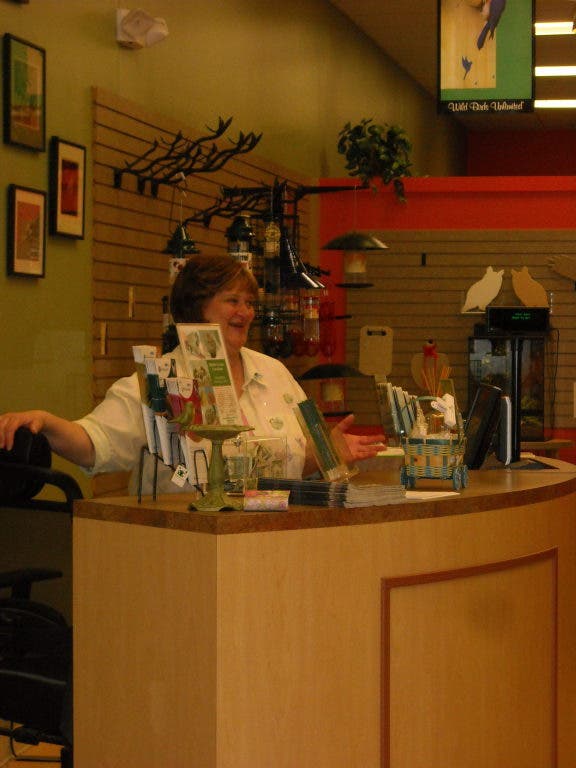
I first turned to Margaret Robbins, owner of Wild Birds Unlimited, a wild bird feed and supply store located on Federal Road in Brookfield. Robbins has been birding since childhood and as an adult spent seven and ½ years as manager of the Greenwich Audubon Society wild bird shop honing her skills and absorbing years of birding knowledge.
When she retired about five years ago, the opportunity to open a Wild Birds Unlimited franchise came along and it was a perfect match.
Find out what's happening in Newtownfor free with the latest updates from Patch.
With a constant stream of customers buying feeders and seed mixes, I asked Robbins what questions she’s asked on a regular basis.
“The most frequent question from customers is whether feeding wild birds makes them dependant on the seed from feeders,” says Robbins. “In fact, wild birds only get about 25-percent from feeders and the rest is foraged naturally.”
Find out what's happening in Newtownfor free with the latest updates from Patch.
Feeding wild birds does not inhibit their natural tendencies to forage naturally. That’s just another common myth, according to Robbins.
In fact, studies done by the Cornell University Department of Ornithology have shown that wild birds have more, and healthier, broods if supplementary food is available. And, when the weather is bad, wild birds have a better chance of survival when their diet is supplemented by feeders.
If you buy commercially packaged wild bird seed, it doesn’t necessarily mean you’re increasing the wild bird survival rate. According to Robbins, “Commercially packaged seed is filled with cheap grains, wheat, barley, and red and yellow millet. These are seeds and grains that most wild birds will not eat at all. It’s just a waste of money.”
And, Robbins adds, “Bird seed has a specific shelf life. Safflower, striped sun flower, peanuts and white millet last about six months. After that they lose their nutritional value and the birds won’t eat it. Thistle seed only lasts three months on the shelf.”
“I had a customer who ordered sunflower seeds online,” Ryan continued, “When they arrived the seeds were so old and dried they literally disintegrated when pressed. Not only is this a waste of money, but it's not providing any nutritional value for the birds. In fact, they won’t eat it and it’s possibly harmful to the environment.”
I checked several commercially packaged wild bird seed bags sold locally and found some of the bags dated “good through November of 2012” -- way past their appropriate shelf life, according to Robbins.
The biggest complaint from Robbins’ customers is how to keep the acrobats of nature, squirrels, out of the feeders. Anyone who has feeders can attest to the fact that squirrels can balance, twist, hang upside down and do amazing contortions while consuming all the seeds in the feeder at one time.
Robbins suggests that you set up a pole feeder at least 5’-6’ high and at least 15 feet away from any trees or branches. The pole must have a squirrel baffle preventing them from climbing the pole. If that isn’t possible try squirrel-proof feeders that are weighted and close off the feeder’s openings with the squirrel’s weight.
I next visited with Renee Baade, Newtown’s own bird expert, to see how she and what she feeds her backyard visitors. Having traveled all over the world “birding,” leading local bird walks, participating in bird identification and seasonal counts for various local and national bird organizations, Baade is a wealth of knowledge on bird feeding, behavior and nesting.
Baade feeds her wild birds all year without issue and uses many different types of feeders to attract the widest variety of backyard birds.
"Both platform and tube feeders work well for the larger birds and thistle feeders for the smaller birds like finches," said Baade.
She also throws seed on the ground for the ground feeders -- and chipmunks. Several chipmunks were happily munching on sunflower seeds under the feeders.
Baade prepares her own hummingbird nectar using just sugar and water with no food coloring.
"I have been doing this for years: one cup of water to ¼ cup of granulated sugar, boiled and then cooled. It works perfectly and is much cheaper than prepared hummingbird nectar," she said.
While walking through Baade’s backyard and visiting her various feeders, Baade explained that she buys her bird seed in bulk and mixes her own combinations. She keeps all her seeds stored in metal, not plastic containers to prevent moisture from developing which will cause the seed to mold quickly.
Also, keeping all your seed in a sealed container in the garage or outdoors will control seed moths, a birder’s nemesis, from invading your food stuffs.
Cleaning feeders regularly and changing hummingbird nectar frequently is extremely important as wild birds can become ill from moldy seed. Fortunately, they usually won’t consume it. If birds are not eating the seed in your feeders, it may be old, moldy or just filler seed. Keep an eye on what they eat and how much so you can gauge what seeds work best for your visitors.
Birding is a wonderful, easy and relaxing hobby. When you set your feeders up be sure they’re visible from a comfortable chair inside. Fill your feeder, grab your binoculars and your birding field guide, sit back and watch Mother Nature do her work -- with a littler help from you.
Editor's note: The Department of Environmental Protection as bears also are looking for food sources.