Upcoming Programs
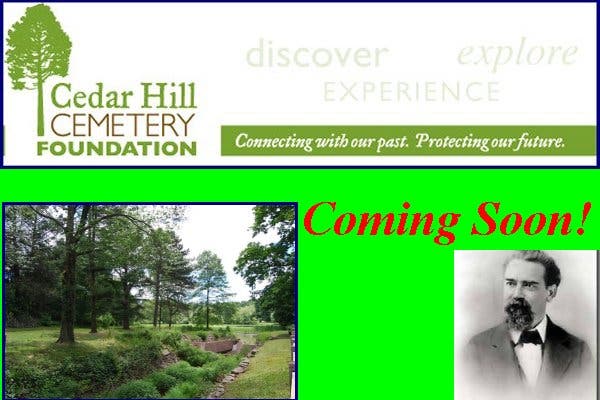
Cedar Hill Cemetery Foundation, in collaboration with Bushnell Park Foundation, will present a series of programs highlighting Jacob Weidenmann’s significant contribution to the capitol city.
Discover Jacob Weidenmann’s Hartford, including a lecture and guided tours of Bushnell Park, Butler-McCook Garden, Institute of Living and Cedar Hill Cemetery, will be held in April and May. Stay tuned for details.


Find out what's happening in Rocky Hillfor free with the latest updates from Patch.
Notable of the Month -
Jacob Weidenmann
Find out what's happening in Rocky Hillfor free with the latest updates from Patch.
In the 19th century, Jacob Weidenmann, Cedar Hill Cemetery’s landscape architect and first superintendent, was in the forefront of his profession. An innovator in the field, Weidenmann was known for excellent design and brilliant solutions to complex engineering and architectural challenges. Besides Cedar Hill, his Hartford commissions included Bushnell Park and the gardens at the Butler-McCook House. Read more about Jacob Weidenmann Below:
Jacob Weidenmann (1829 – 1893)
Born in Switzerland in 1829, Jacob Weidenmann trained in Europe as an architect, horticulturist, botanist and engineer before

Cedar Hill Cemetery’s landscape architect and first superintendent
immigrating to the United States in 1856. Around 1860, he came to Hartford where he designed Bushnell Park, the first publicly-funded municipal park in the nation. In 1863, Weidenmann was commissioned to design Hartford’s American rural Cedar Hill Cemetery and to serve as its first superintendent.
In 1870, Weidenmann published his first book, Beautifying Country Homes. He then moved to New York where he often collaborated with Frederick Law Olmsted. It was Weidenmann’s work at Cedar Hill and his study of existing rural cemeteries that led to the eventual publication of Modern Cemeteries in 1888 in which he communicates his principles of landscaping memorial grounds.
In addition to designing many estates, park and campuses, Weidenmann’s commissions included the grounds at the Institute of Living in Hartford, Connecticut and the capital grounds in DesMoines, Iowa.
The man who once remarked, “my destiny is to work for the grave diggers,” died on February 6, 1893 and was buried in a quiet corner at Cedar Hill Cemetery, one of his most important projects. Weidenmann urged the establishment of a professional school to raise landscape architecture “to proper standing in science and art.” Today, Harvard University awards the Jacob Weidenmann prize to the student who has shown outstanding ability in landscape design, a fitting recognition of Weidenmann’s accomplishments and his commitment to his chosen profession.
References:
Birnbaum, Charles A. and Robin Karson, eds. Pioneers of American Landscape Design. New York: McGraw-Hill, Inc., 2000.
Have a news tip? Email Bill Maune. You can also post your own news, events and announcements on Patch by following these directions. Curious about how our new commenting platform, Disqus, works? Learn more about it here and start interacting with your neighbors on Patch.