Neighbor News
Patriot’s Story – Sergeant William Brown and the ‘Forlorn Hope’ troops
Sgt William Brown of Stamford received the Badge of Merit from Gen. Washington on May 3, 1783

The Sarah Riggs Humphreys-Mary Silliman Chapter of the National Society Daughters of the American Revolution celebrates America 250! In anticipation of the July 4, 2026, 250th Anniversary of the signing of the Declaration of Independence by the 13 Colonies the DAR wishes to remind people of three of the Connecticut brave young men who were awarded the first military medal for non-commissioned officers.
General George Washington created the Badge for Military Merit on 7 Aug 1782, later known as The Purple Heart. These “Honorary Badges of distinction are to be conferred on the veteran Non- commissioned officers and soldiers of the army, who have served more than three years with bravery, fidelity and good conduct…” The badge was to be presented to soldiers for “any singularly meritorious action”.
This article will highlight Sergeant William Brown, who met the criteria for the Badge of Military Merit by his gallantry, conduct and courage in the line of battle.
Find out what's happening in Shelton-Derbyfor free with the latest updates from Patch.
Sergeant William Brown received the Badge of Military Merit on 3 May 1783 for his service in the storming of Stony Point, NY on the night of 15 Jul 1779 and for leading the troops attacking Redoubt 10 in Yorktown, VA on 14 Oct 1781. In each of these combat situations, the troops were called “Forlorn Hope” troops because they were not expected to succeed nor to come back alive.
William Brown was the youngest of the non-commissioned soldiers to receive the Badge of Military Merit. He had just turned 16 when he enlisted in the 5th CT Regiment and was 18 when he led the Forlorn Troops at the storming of Stony Point. He was 20 when he led a group of soldiers to prepare the way for the attack on Redoubt 10 in Yorktown, VA.
Find out what's happening in Shelton-Derbyfor free with the latest updates from Patch.
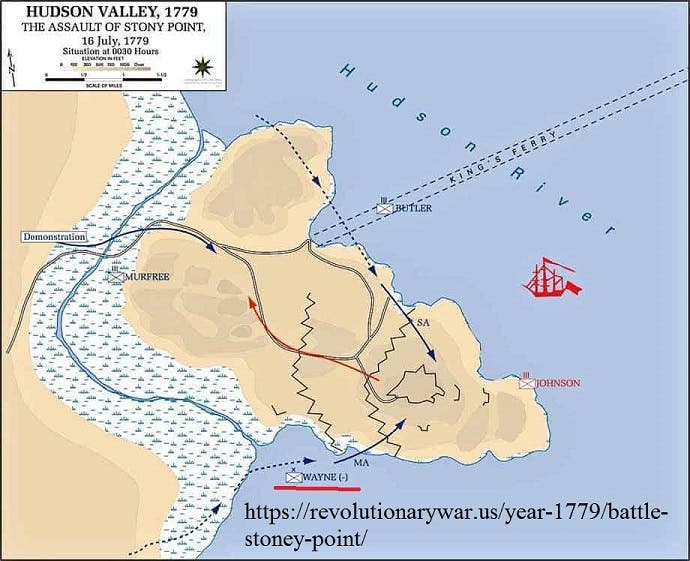
Stony Point is near New York City and was a ferry crossing on the Hudson River. It was a used to transport supplies and trade from New England to the rest of the colonies. (West Point is only 12 miles north of Stony Point.) In May 1779, as a ploy to draw General Washington out in the open, the British Commander in Chief Sir Henry Clinton sailed up the Hudson with 6,000 British troops and captured the small garrisons of Stony Point on the west side of the River and Verplanck’s Point on the east side. General Washington, however, stayed at his headquarters in New Windsor, NY.
It was for this reason that Clinton left behind a small contingent of 600 soldiers at Stony Point and sailed back down the Hudson to dispatch his troops to the Connecticut coast (the burning of Fairfield and Danbury in 1779 is another story).
General Washington wanted to take back Stony Point to secure the American’s position along the Hudson. The storming of Stony Point was accomplished by a midnight bayonet charge on 16 Jul 1779. General Washington put General Anthony Wayne in charge of the attack with about 1200 hand-picked men forming three columns. They attacked “with fixed Bayonets and Muskets unloaded” and took the British by surprise. William Brown was chosen the Standard Bearer of the “Forlorn Hope” troops.
The main column, led by General Wayne, attacked by moving over the southern part of the marshland and scrambling up the point. General Washington told the men to pin pieces of white paper to their hats so they could identify themselves as Americans from the British once they were inside the fort. After this battle, West Point was secured upstream and provided the Continental troops control of the Hudson River Valley.
Bayonets and muskets unloaded were again used in the assault on British Redoubt 10 at Yorktown on the night of 14 Oct 1781. Sergeant William Brown was chosen to lead a small group in a ‘forlorn hope’ to surprise the British in a night time raid using bayonets. Their mission was to overtake Redoubt 10 one of two key strongholds protecting the British inner defense line at Yorktown. Instead of cutting down the barriers of sharp sticks surrounding Redoubt 10, Sergeant Brown led his troops through the barrier in a hand-to-hand battle into the fortification. This allowed Lt. Col. Alexander Hamilton to follow up the advantage created by Sergeant Brown and his men. This assault was not what the British expected and the Americans were able to take Redoubt 10 in less than half an hour. Five days later Cornwallis surrendered his army to General Washington. Brown was wounded in the attack.
William Brown (DAR Ancestor #A015927) was born 12 Feb 1761 in Stamford, Fairfield Co, CT and died 22 Oct 1804 in Hamilton Co, OH. He married Ruth Hanford in 1784. The family went west to Ohio. In Columbia, Ohio William Brown served in the militia, surveyed and built roads, organized a school in Columbia (he had 9 children to educate) and was a respected member of the community.
The DAR is a women’s service organization dedicated to historic preservation, education and patriotism. Any woman over 18 who can prove lineal descent to an ancestor who served in the American Revolution is a prospective member. For more information on the DAR visit http://www.sarahriggshumphreysDAR.org
The National Society of the Daughters of the American Revolution asks everyone to celebrate the 250th Birthday of the United States of America and the Patriots that achieved American Independence. For more information visit https://honoringourpatriots.dar.org/
Sources: