Neighbor News
The Ratification of the United States Constitution
The United States Constitution was signed Sept 17, 1787 and it was ratified on June 21, 1788.
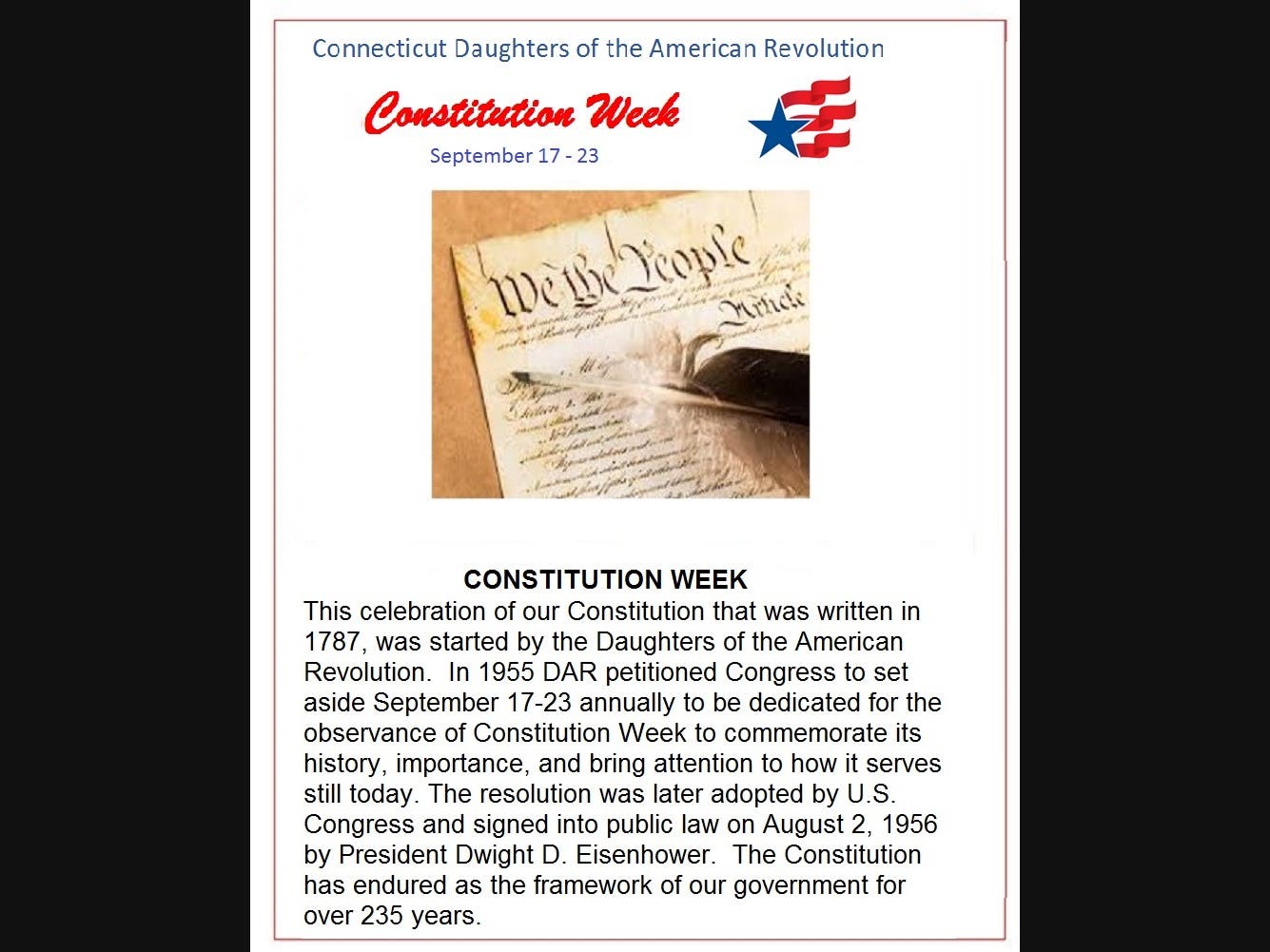


The Sarah Riggs Humphreys-Mary Silliman Chapter of the National Society Daughters of the American Revolution celebrates America 250! In anticipation of the July 4, 2026, 250th Anniversary of the signing of the Declaration of Independence by the 13 Colonies, the DAR wishes to remind people The United States Constitution was ratified June 21, 1788.
On September 17, 1787 the Constitutional Convention delegates met for the last time to formally sign the Constitution. The convention adjourned at 4 o’clock in the afternoon. The Liberty Bell rang to announce the signing of the Constitution. The Market Street printers, John Dunlap and David Claypoole, worked overtime on the final imprint of the six-page Constitution so that copies would leave Philadelphia on the morning stage. Now, the debate over the form of government was going to the states for ratification.
Ratification meant that nine states were needed for ratification. The states had six months to meet and vote on the proposed Constitution. Delaware was the first state to ratify the Constitution on December 7, 1787 and New Hampshire was the ninth state to accept the Constitution on June 21, 1788. Ratification meant that officially the government under the Articles of Confederation was ended and a new government under the United States Constitution began. The last state, Rhode Island, ratified the Constitution on May 29, 1790.
Find out what's happening in Shelton-Derbyfor free with the latest updates from Patch.
The states and the dates of ratification are listed below:
Delaware: December 7, 1787
Find out what's happening in Shelton-Derbyfor free with the latest updates from Patch.
Pennsylvania: December 12, 1787
New Jersey: December 18, 1787
Georgia: January 2, 1788
Connecticut: January 9, 1788
Massachusetts: February 6, 1788
Maryland: April 28, 1788
South Carolina: May 23, 1788
New Hampshire: June 21, 1788 (With this state’s ratification, the Constitution became legal.)
Virginia: June 25, 1788
New York: July 26, 1788
North Carolina: November 21, 1789
Rhode Island: May 29, 1790 (Rhode Island did not hold a Constitutional Convention.)
Throughout the ratification process, Federalists, who supported the Constitution, and Anti-Federalists, those who were opposed, waged their views which were printed and reprinted in newspapers across the country. Prior to the signing of the Constitution, the delegates debated about protecting the rights of the citizens. Three of the delegates (George Mason and Edmund Randolph of VA and Elbridge Gerry of MA) did not sign because there were no provisions for protecting the rights of the citizens.
The Anti-Federalists were afraid of the power of a central government: states’ sovereignty was reduced and there was no bill of rights to guarantee individual liberties such as freedom of speech or freedom of religion.
The Federalists counterattacked. In late 1787 Alexander Hamilton, John Jay and James Madison published the first of a series of essays now known as the Federalist Papers. Hamilton wrote most of the 85 essays and examined the weaknesses of the Articles of Confederation and the need for an energetic national government.
By January 9, 1788 five of the nine states had approved the Constitution - Delaware, Pennsylvania, New Jersey, Georgia, and Connecticut. Massachusetts, New York, and Virginia were crucial to ratification.
On February 6 Massachusetts ratified the Constitution when the Federalists agreed to recommend a list of amendments amounting to a bill of rights. The bill of rights was a victory for the anti-Federalists and six more states ratified in 1788. Thomas Jefferson, generally in favor of the new government, wrote to Madison that a bill of rights was “what the people are entitled to against every government on earth”.
Madison became convinced that a bill of rights would have positive effects and, as a new representative from Virginia to the First Federal Congress, as established by the new Constitution, persuaded the House to enact 17 amendments. The list was later reduced to 12 in the Senate. By October 2, 1789, President Washington sent each state a copy of the 12 amendments adopted by Congress. By December 15, 1791, three-fourths of the states ratified 10 amendments (Articles 3-12) we call the “Bill of Rights”.
The Bill of Rights gave the citizens confidence in the new government and contain many of our most valued freedoms.
The DAR is a non-profit women's service organization dedicated to historic preservation, education and patriotism. Any woman over 18 who can prove lineal descent to an ancestor who served in the American Revolution is a prospective member. For more information on the DAR visit http://www.sarahriggshumphreysDAR.org
The National Society of the Daughters of the American Revolution asks everyone to celebrate the 250th Birthday of the United States of America and the Patriots that achieved American Independence. For more information visit https://honoringourpatriots.dar.org/