Neighbor News
The Signing of the United States Constitution
The United States Constitution was signed at 4:00 p.m. in Philadelphia on September 17, 1787. The Liberty Bell rang to announce the signing.
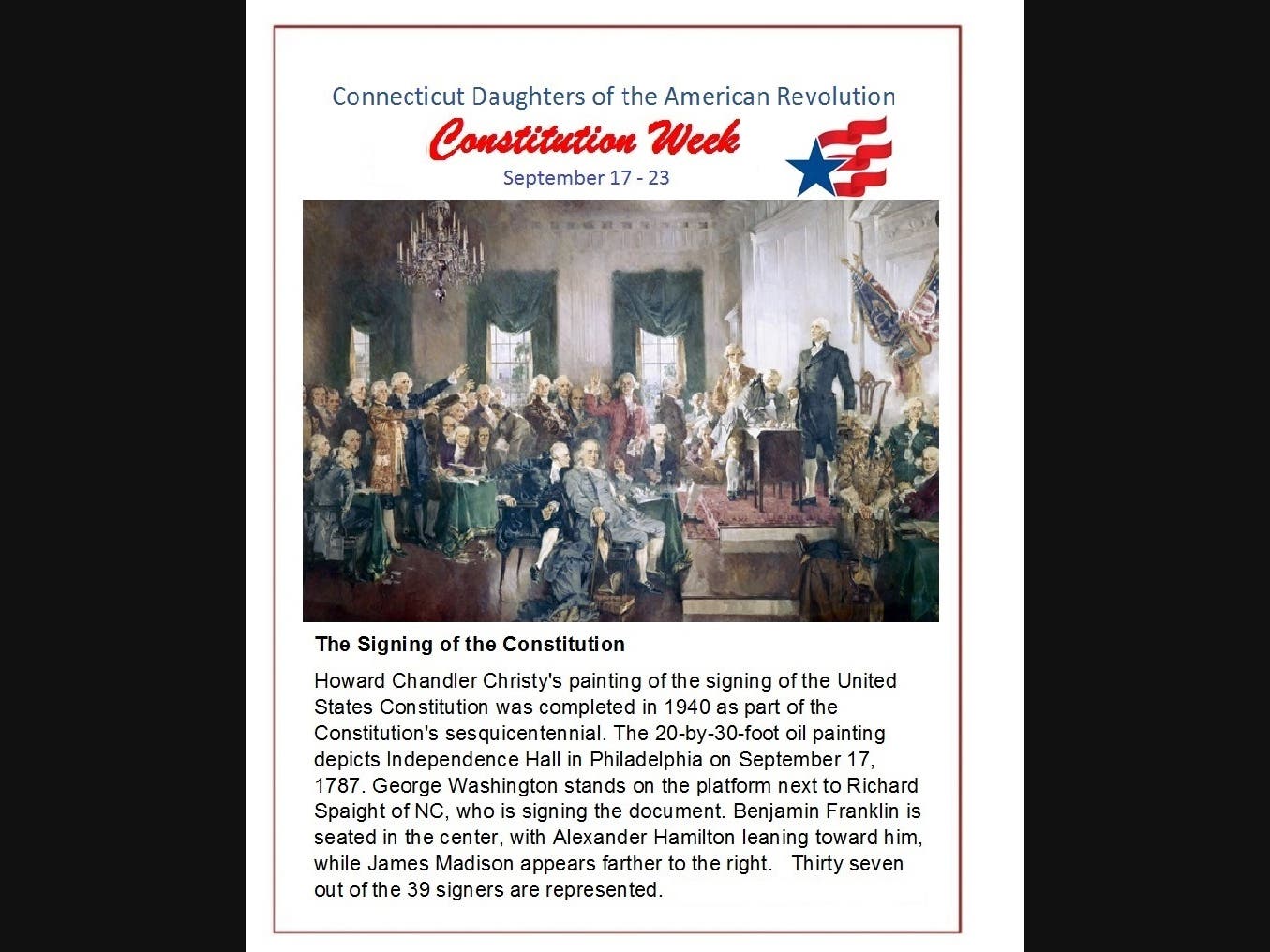


The Sarah Riggs Humphreys-Mary Silliman Chapter of the National Society Daughters of the American Revolution celebrates America 250! In anticipation of the July 4, 2026, 250th Anniversary of the signing of the Declaration of Independence by the 13 Colonies, the DAR wishes to remind people The United States Constitution was signed on September 17, 1787 two hundred thirty five years ago.
The 2nd Continental Congress delegates found that the Articles of Confederation proved ineffective in governing the 13 states. The Articles contained few central powers and lacked executive and judicial branches of government. As the Revolutionary War continued, the central government had no uniform economic system in place. The states issued their own currency, some quarreled over land boundaries, and some levied duties on goods from other states. Also states established their own trade and navigation laws. The Continental Congress approved a plan to hold a convention in Philadelphia to revise the Articles of Confederation on February 21, 1781 to address these issues.
All except Rhode Island responded to the invitation to send delegates. Twelve states appointed 70 delegates to the Constitutional Convention. Fifty-five delegates attended the Constitutional Convention to amend the Articles of Confederation but created a new Constitution instead. George Washington was elected President of the Convention and opened the proceedings each morning at ten o’clock. The Convention worked as a committee with Nathaniel Gorham taking over as chair after the session was called to order and at 4:00 Washington would adjourn the session. The delegates kept their deliberations secret so that each could speak their mind and give true opinions. The delegates could change their minds on a previously made vote. Each state had one vote no matter how many delegates they had. The majority ruled and, if there was a tie, the vote wouldn’t count. The delegates ranged in age from twenty-six year old Jonathan Dayton (New Jersey) to Benjamin Franklin (Pennsylvania), aged 81, who was so infirm that he had to be carried to sessions in a sedan chair.
Find out what's happening in Shelton-Derbyfor free with the latest updates from Patch.
James Madison took notes every day and recorded every major speech. Connecticut delegates Oliver Ellsworth, William Samuel Johnson and Roger Sherman played a key role in the framing of the Constitution. A List of the Framers of the Constitution is attached.
The Constitution was written in four months. The Virginia plan proposed a government with three parts – the Executive, Legislative, and Judiciary. The Legislative branch would be two chambers, a Senate and a House of Representatives. The large and small states squabbled over how to elect the representatives for the two chambers and, at times, many thought the small states might just get up and go home.
Find out what's happening in Shelton-Derbyfor free with the latest updates from Patch.
Large states favored representation by population, while small states argued for equal representation by State. On July 12, 1787 Connecticut delegates, Roger Sherman and Oliver Ellsworth, proposed the Connecticut Compromise which established a two-house legislature. The House of Representatives (lower house) would have proportional representation while the Senate (upper house) would have equal representation. All revenue measures would originate in the lower house.
The issue of Slavery was central to the debates over commerce and representation. As part of the Connecticut Compromise, Ellsworth and Sherman proposed that the representation for the lower house be based on the number of free persons and three-fifths (60%) of “all other persons” while the Senate was based on equal representation. The compromise meant that every five enslaved people would be counted as three individuals in terms of representation. On July 16, 1787, the convention adopted the “Three-Fifths Compromise” by a one-vote margin. It wasn’t until March 1807 that President Thomas Jefferson signed a bill abolishing the trade of enslaved people, which took effect on January 1, 1808.
The issue of State vs. Federal Powers was also on the agenda. Many delegates feared a strong federal government would oppress the citizens while other delegates believed the federal government should be able to overrule state laws. As a compromise, specific responsibilities were given to the federal government while all other functions went to the states.
The delegates clashed over who would head the Executive Branch. The colonies had fought a war against tyranny and were suspicious of executive power. The delegates felt a president was necessary but they couldn’t agree how he should be elected to office. Some delegates thought the president should be popularly elected while others feared the electorate wouldn’t be informed enough to make that decision. The compromise resulted in the Electoral College as the method of selecting the president. The Electoral College is made up of electors roughly proportional to population and the citizens actually vote for electors bound to a particular candidate who then votes for the president. The delegates believed George Washington would be the first president and they trusted him to define the office.
A new section of the Constitution was the Supreme Court which would be responsible for interpreting the laws found in the Constitution.
Commerce was a key to a stable government. The northern states were more industrialized and produced finished goods while the southern states were more agricultural and imported many finished goods. The northern states wanted tariffs to protect them from foreign competition. As a compromise tariffs would be allowed on imports from foreign countries and not exports from the United States. Interstate commerce would be regulated by the federal government. Legislation relating to commerce required two-thirds majority in the Senate to pass.
A Committee of Detail consisting of Nathaniel Gorham, John Rutledge, Edmund Randolph, James Wilson, and Oliver Ellsworth was appointed to draft the constitution. On Monday August 6, 1787, the convention accepted the first draft of the Constitution.
On September 8 the convention turned the Constitution over to a Committee of Style and Arrangement. Gouverneur Morris, one of the five members of the Committee of Style, was the chief architect. The Committee took 23 articles and consolidated them into seven concise articles.
On September 12, 1787 the Constitution was presented to the convention. The delegates read each section and although some articles had close votes, it was clear that the work of the convention in the summer of 1787 was reaching its end. On September 15 the roll of states was called on the Constitution and every delegation voted “Aye”.
On September 17 the members met for the last time to formally sign the Constitution. The convention adjourned at 4 o’clock in the afternoon. The Liberty Bell rang to announce the drafting of the Constitution.
Not all of the 55 delegates were there to sign, and three did not sign because there were no provisions for protecting the rights of the citizens (George Mason and Edmund Randolph of Virginia and Elbridge Gerry of Massachusetts). The other 39 signed.
While the weary delegates shared a farewell dinner at City Tavern, the Market Street printers, John Dunlap and David Claypoole, worked overtime on the final imprint of the six-page Constitution so that copies would leave Philadelphia on the morning stage. Now, the debate over the form of government was going to the states for ratification.
The DAR is a non-profit women's service organization dedicated to historic preservation, education and patriotism. Any woman over 18 who can prove lineal descent to an ancestor who served in the American Revolution is a prospective member. For more information on the DAR visit http://www.sarahriggshumphreysDAR.org
The National Society of the Daughters of the American Revolution asks everyone to celebrate the 250th Birthday of the United States of America and the Patriots that achieved American Independence. For more information visit https://honoringourpatriots.dar.org/