Politics & Government
South Windsor Town Council Discusses 63-20 Corporation Legalities
In a discussion with two testy exchanges, the council decides it needs additional details on the rink/recreation complex/pool project.


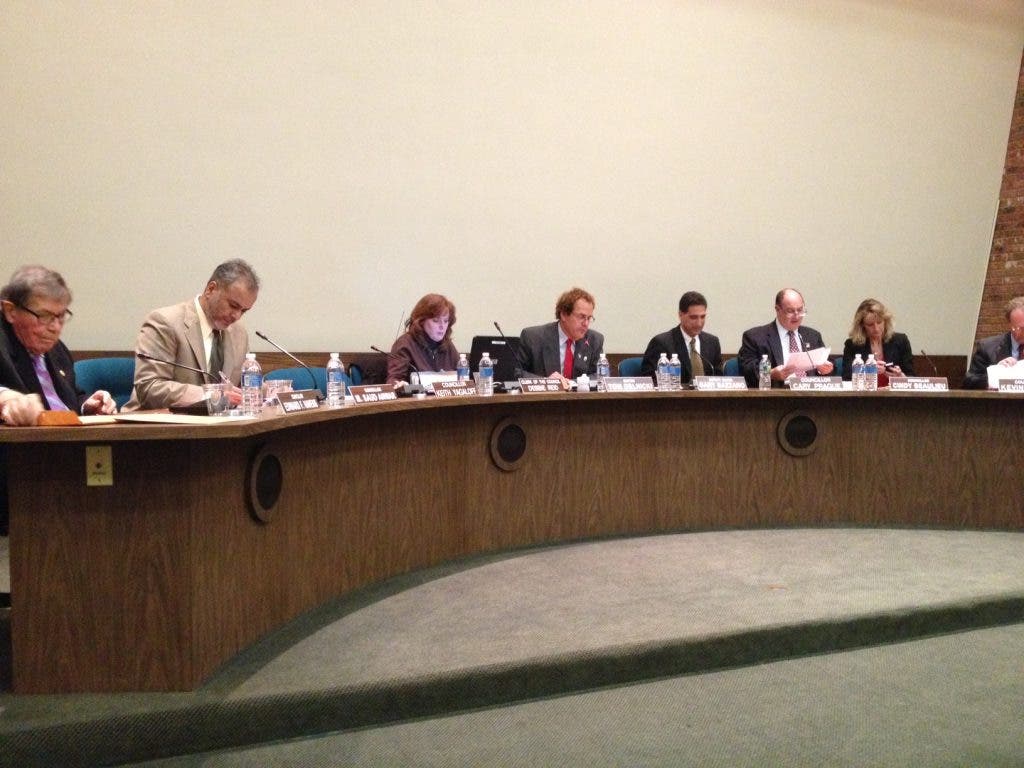
A lengthy discussion on 63-20 corporations at the South Windsor Town Council meeting Monday evening yielded little in terms of action taken, but did result in some somewhat testy moments involving town officials.
The discussion, which took up about two hours of the council’s four-hour work session/regular meeting, was centered primarily on the legalities of 63-20 corporations, which are mechanisms in which not-for-profit entities are used as vehicles to finance the construction of public buildings, including hospitals, courthouses and schools. Such entities are traditionally used to avoid statutory debt limitations and other restrictions, as well as take advantage of private-public partnerships.
The topic came up as a result of a proposed $10.5 million rink/recreation complex/pool project that would be built, at least in part, through the use of a 63-20 corporation.
The 63-20 corporation would build at least part of the project through issuing tax exempt bond, while leasing the complex to the town annually at a set rate. There would be no need to go out for a referendum, and the town would not be incurring any long-term debt.
It is unclear who would be heading up the 63-20 corporation, though attorney Kent Mawhinney in a presentation in October said that he represented the group that would take the lead.
Town Attorney Dwight Johnson answered questions from town councilors on the issue, specifically the legalities of 63-20 corporations and other issues, such as whether prevailing wage would have to be paid should the project move forward.
Johnson said that it was “within the powers of the municipal corporation” to enter into an arrangement with a 63-20 corporation, and the town would be under no obligation to pay for the bonds issued by the entity. Any risk the town incurred would be with respect to the lease it has with the 63-20 corporation.
Town Councilor Cindy Beaulieu said that she learned that the council and the members of the public learned that 63-20 corporations are “one more tool in the tool belt” for the town to use in the event that it wants to move forward on projects such as these.
But while the town would not be required to meet the obligations of the bond, Town Manager Matthew Galligan and Johnson, responding to a question by Town Councilor Saud Anwar, said that it would be unlikely the 63-20 corporation would be able to issue bonds if it did not have a credit-worthy tenant with a multi-year lease in place.
Anwar said that the project would have to make sense in terms of financial viability before the town entertained the notion of entering into such an arrangement.
“A 63-20 corporation is dangerous if a project is not fiscally or financially viable,” Anwar said. “It is your tax dollars at risk.”
On a blog on Patch, Anwar said that he did not support the project for various reasons, including what he believed were projections that could cost the town up to $1 million a year.
Other councilors, however, said that they would not be so quick to judge the project until they got specific numbers from Dan Marsh, the town’s consultant.
Councilor Keith Yagaloff said that he couldn’t make a determination on the project because he did not have enough information, though he said that for a project of this scope, transparency was critical.
Yagaloff said that he needed to know the total cost to the town before he reached any decision on the project.
“I have zero additional data other than the preliminary data” provided to the council by the developer, Yagaloff said.
Deputy Mayor Gary Bazzano agreed.
“I don’t know the numbers, folks,” Bazzano said. “Until we have everything, we can’t make an educated decision we need to make. We are a bit of a ways from the numbers.”
Galligan said that a public/private partnership may not necessarily mean that the town would fund the entire $10.5 million project through a lease. Specifically, Galligan said that he has been approached by at least one developer who would be interested in building the skating rink portion of the project through private funds. The town could, theoretically, then fund the pool and basketball courts through the use of a 63-20 corporation.
Galligan said that he would know more if the town went out to requests for proposals to get a handle on how much everything, or a portion of what the town wanted - such as the pool - would cost.
The meeting took a somewhat more contentious turn, however, when Anwar made references that the project was developed in part by town staff in meetings that were not reported to the town council.
Galligan took exception to Anwar’s line of inquiry.
“I don’t hold secret meetings,” Galligan said. “I’m being accused of something here and lets get it straight.”
Galligan said that he has an open-door policy and that he had a meeting with a developer that, when discussions went to the rink/recreation center/pool proposal, he informed the developer to take it to the Town Council. Galligan said that he then went on vacation for two weeks.
“I don’t like being accused of secret meetings when I don’t have secret meetings,” Galligan said.
When Anwar continued to press the issue later in the meeting, Councilor Kevin McCann interrupted, “I think that’s completely inappropriate.”
Mayor Tom Delnicki ultimately polled councilors to see if there was even interest in moving forward from that point. The council decided - with Ed Havens abstaining - that it wanted additional details from Galligan on the project once they became available.
Get more local news delivered straight to your inbox. Sign up for free Patch newsletters and alerts.