Neighbor News
Likeness & Legacy - Portraits From the SM&NC's Permanent Collection
Exhibition Review by Lynn Villency Cohen

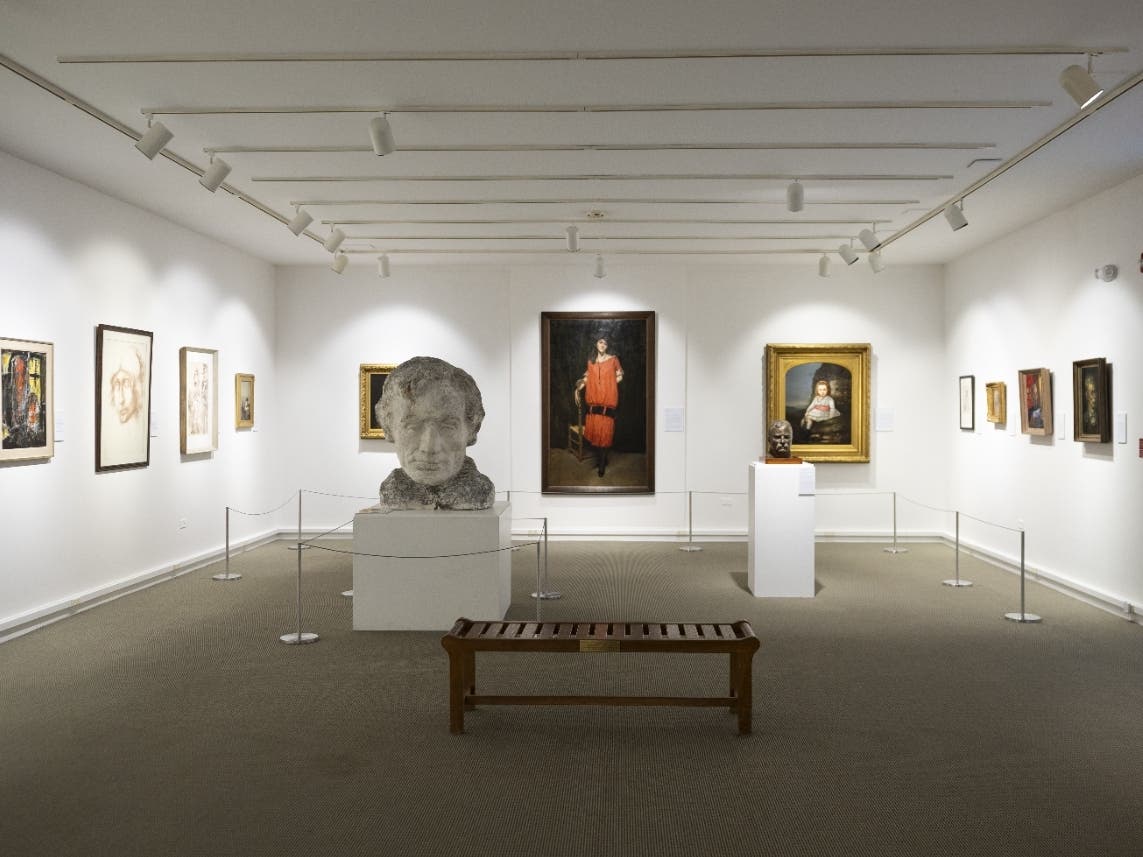


Among the aims of the Stamford Museum’s curatorial department is to assemble exhibitions around particular categories and themes of art. You may have visited the Museum’s print collection exhibition or the miniature collection show or perhaps the aptly named “giant” paintings from the Museum’s permanent collection. The three room gallery space in the Bendel mansion, may be an optimal way of viewing a highly selective showing of works from the permanent collection - which numbers 20,000 objects - allowing an audience a laser like focus on a key aspect of the Museum’s collection whether it be portraits, landscapes, oversized paintings or miniature works. Here in the current exhibit the talk is portraits: “Likeness & Legacy Portraits form the SM&NC Permanent Collection” (March 27 -May 25, 2026).
The actual notion of portraiture has taken on new meaning over the past twenty years with the advent of camera phones, ever ubiquitous in our daily lives; with the snapped “selfie” the newest form of portrait. The portrait whether painted, drawn, sculpted, or digitally rendered has become deeply enmeshed in our 21st century digital technological revolution.
Along with this technological whirlwind, portraits have been elevated to a new level as high fashion statements and accoutrements in home decor. Just peruse homes in magazines or those offered for sale - no doubt you will spot painted portraits in living areas of luxe city apartments, modern, high tech and historic homes.
Find out what's happening in Stamfordfor free with the latest updates from Patch.
It is an understatement that Americans have become more image obsessed over the past few decades; and that image has permeated all aspects of our culture. Image drives business, art and politics; suffice to say that there is no one who uses self image more than our current President who understands its messaging power as a tool to shape, enhance, and manipulate the viewer. One could simply say that painted portraits have not suffered a downturn!
With that, let’s take a quick shuttle back in time to visit the evolution of portraiture in our country. Beginning with roaming limner artists who painted early 18th century colonial families; this was followed by such towering figures of American portrait painting - John Singleton Copley, John Trumbull, Charles Willson Peale - whose painted portraits of American Presidents, important generals, and men of government in the late 18th century are celebrated landmark works. These paintings symbolized the growing power of a new nation.
Find out what's happening in Stamfordfor free with the latest updates from Patch.
By the 19th century, as America developed and expanded to a country of agrarian and industrial strength, we see landscapes and genre scenes proliferating in American art as portrait painting assumed a lesser role. Genre painting refers to works depicting every day American life such as of families gathered at home in domestic scenes or of groups of people gathering at the town square or perhaps the town post office.
By the late nineteenth century as America steamrolled its way into the Industrial Revolution we see the newly wealthy business and industrial classes commissioning portraits of their own families and of themselves. The upper crust in Boston, Philadelphia and New York coveted hallmark portraits to convey status and importance in society; and during this time, one’s sees a proliferation of portraits of beautifully attired women, some surrounded by their young doting children; and newly wealthy male industrialists as well as celebrity artistic figures. Portrait painters such as John Singer Sargent, Cecilia Beaux, and Thomas Eakins were in high demand for these type of commissions.
We see this in the Stamford Museum exhibit with two works in particular - John Singer Sargent’s portrait of JP Wolff from 1890, a compelling painting from the gilded age period piece placed front and center in the gallery that greets the incoming visitor. Sargent depicts the famed violinist Johannes Wolff as a bearded, mustached gentleman in perfectly attired black coat over a creamy white elegant tuxedo shirt. In this three quarter painting, the sitter’s gaze conveys self importance with a bit of haughtiness; hardly unusual for portraits of the time period.
Perhaps a comparable companion period piece to this work is John E. Bird’s monumental 1915 portrait of a young Eleanor Sachs. This massive full length painting of the sitter grabs one’s attention for its size alone; it is quite the center piece of the Leonhardt gallery room. Eleanor Sachs who hails from a wealthy Boston family is shown in relaxed form and nonchalant expression, standing upright against a wooden chair and dark background. It is not simply striking for its size but also for the painter’s use of color that dazzles the viewer. Eleanor shines resplendent in a blazing red silk jumper with creamy white embroidered lace collar.
In between the war years of the 20th century, we see a more nuanced and free form presentation of the traditional portrait in America as everyday people were depicted by artists in a way that captured their unique personalities. You will see this throughout the exhibit with works by Milton Avery, Guy Pene de Bois, Max Weber and others that are part of the Herman & Rebecca Shulman art collection. The Shulmans, who settled on Haviland Road Stamford in the 1940’s, collected the work of these urban realists and gifted their collection to the Stamford Museum in the 1960s; a collection of predominantly American paintings and drawings by Milton Avery, Guy Pene du Bois, Max Weber, Alfred Maurer, and Raphael Soyer. To this day the Shulman collection is central to the museum’s paintings collection.
One such work in the exhibit by Guy Pene de Bois “Waiter!” (1910), a small cabinet sized painting is a humorous gem. The corpulent tuxedoed male figure is depicted in exaggerated expression, shouting for a waiter’s attention, along with his female companion seated at the table in an oversized hat. Pene de Bois does not have to do much more to show us his how he feels about New York’s “superior” upper crust. The expression and demeanor of the man speaks for itself.
After World War II with America becoming a national power and modern art ushered into our lives, we see a freer portrait style appearing alongside the traditional painted portrait. The exhibit highlights the freestyle and the traditional with its inclusion of several portraits of former Stamford Museum executive directors.
Barnaby Ruhe’s colorful, free style 2006 portrait of Melissa Mulrooney painted on site at the Museum’s 70th anniversary “Otter Ball” is a swirl of blazing bright color applied with quick brushstrokes capturing the inherent energy of the sitter. Compare this to the more traditional portrait as seen in painter Paul Nonay’s formally posed Ernest Luhde who headed the museum from 1937 to 1965. Here we see Luhde portrayed in subdued brown and green palette as a serious, studious academic dressed in suit and tie.
What are some of the questions one may ask when perusing the exhibition. Was this a commissioned portrait? How is the sitter depicted? What aspect of their personality is captured? What clues are offered by the artist as to the status or importance of the sitter as you look at the clothing, their expression, and where the sitter is placed?
How is color used? Is it subdued or is it bright and luxurious? How does color influence the viewer’s understanding and overall reaction to the work? Is the portrait painting a static and stationary depiction or does it offer expressive movement and emotion? And perhaps most importantly how do you as the viewer react to the portrait?
The exhibit would not be complete without the inclusion of perhaps one of the most celebrated artists who lived in Stamford - Gutzon Borglum -whose voluminous output of sculpture looms large in the history of public commissions. Borglum who is best known as the principal sculptor of Mount Rushmore and Stone Mountain, and was associated with many commissioned public sculptures, began his career as a painter. After studying in Paris and strongly influenced by Auguste Rodin, Borglum turned to sculpture full time. From 1910 to 1920 the sculptor lived on Wire Mill Road, Stamford where he built a home and studio and accumulated acres of land naming it “Borgland.” The Stamford Museum has one of the largest repositories of his work.
While Borglum’s genius is well recognized in sculpture, it is a work from his early career as a painter and draftsman in the exhibit, “I Have Piped into You”, a 1902 charcoal and pastel on paper that is perhaps most moving. Here Borglum uses muted pastels; and with his deft handling of the woman’s twisting body and delicate placement of her hands, it all conveys a beautiful, poetic expressiveness. I was equally taken by the tiny gouache rendition of a young girl by George Constant whose features are almost stretched and flattened to the ends of the canvas, echoing works by Picasso and Matisse who incorporated motifs of African sculpture and masks. The smaller size works should not be overlooked!
Each painting, drawing or sculpture has a story to tell - one of these story telling elements is provenance or the history of ownership of the work and how the work came to the Stamford Museum’s collection. This year marks the Museum’s landmark 90th birthday since its 1936 founding, and many of the paintings were gifted over the past fifty years when the Museum moved to the Henri Bendel property in 1955 from its previous Courtland Park location where at times art work was hung outdoors with gallery space limited.
Certainly what towers above these factual details is the actual quality of the portraits themselves; their ability to convey interest in the personality of the sitter; as well as the stories related to their creation, some fascinating and some mundane. The exhibition is designed to enhance your understanding and interest in portraiture; to learn about the artistic connections the works have to the Stamford Museum; and to the history of Stamford as a whole. And with a touch of charm, it does just that.
Lynn Villency Cohen is a member of the Board of the Stamford Museum & Nature Center