Community Corner
Save the Sound Launches Unified Water Study of Long Island Sound In Niantic River
"Sound Sleuths" are set to fill data gaps with a new coordinated water testing program.


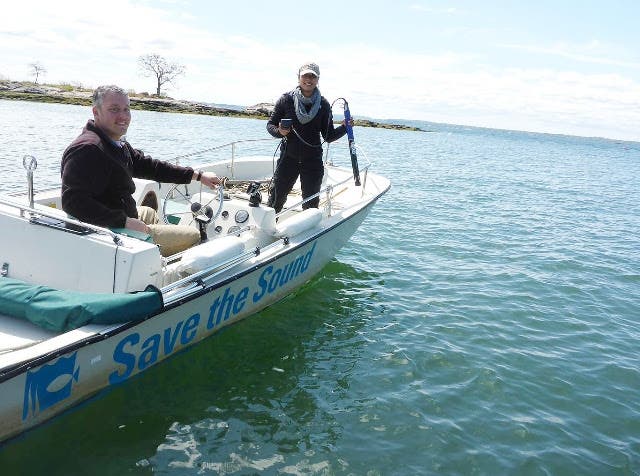
MAMARONECK, NY — Save the Sound has launched a groundbreaking water testing program that will dramatically increase available data on the health of Long Island Sound. The bi-state non-profit organization already issues a closely watched “report card” on the health of the estuary, according to a release.
The Unified Water Study: Long Island Sound Embayment Research will test water conditions in the Sound’s bays and harbors.
More than a decade of federally funded monitoring of the open Sound has documented the destructive impact of nitrogen pollution—including algae blooms, red tides, loss of tidal marshes, and fish die-offs—and the incremental improvements brought about by wastewater treatment plant upgrades.
Find out what's happening in The Lymesfor free with the latest updates from Patch.
However, recent scientific research by Professor Jamie Vaudrey of the University of Connecticut and others has shown that conditions in the bays and harbors –where much of the public comes into contact with the Sound – can be different from conditions in the open waters. More testing on bays and harbors is needed to judge the effect of nitrogen on these inlets and what action is still needed to restore them to vibrant life.
To answer these questions, Save the Sound led a collaborative process to design the Unified Water Study to rapidly and cost-effectively gather comparable data that will establish the relative health of each bay and harbor. To reach as many locations as possible, Save the Sound is training a wide variety of groups in the study methods.
Find out what's happening in The Lymesfor free with the latest updates from Patch.
These “Sound Sleuths” include citizens, scientists, environmentalists and municipalities. Their findings will be published in future report cards and used to help direct restoration funding to the most stressed locations.
“With federal funding of clean water programs facing an uncertain future, restoration of Long Island Sound is in our hands," Save the Sound Director Tracy Brown said in a release. "Teams of Sound Sleuths will investigate the conditions of our bays and harbors, and offer data that can lead to restoration. Save the Sound is honored to lead these groups in this effort and we’re confident the results will provide a valuable roadmap to aid in the protection of Long Island Sound for future generations.”
The Unified Water Study will be conducted in twenty-four locations on the Sound ranging from Queens, New York, to Stonington, Connecticut. There are twelve groups participating in this inaugural season, with more preparing to join the study in 2018.
The trained corps of Sound Sleuths will be out on the water at dawn twice a month from May through October measuring dissolved oxygen, chlorophyll a, temperature, salinity, macrophytes (aquatic plants and seaweeds) and water clarity.
Science Advisors for the study are Jamie Vaudrey and Jason Krumholz. Coordination is provided by Peter Linderoth of Save the Sound.
Additional guidance has been provided by members of the Long Island Sound Study, New York State Department of Environmental Conservation and Connecticut Department of Energy and Environmental Protection.
2017 test locations include:
Connecticut
Darien Harbor
Inner Norwalk Harbor, Outer Norwalk Harbor
Housatonic River
Niantic River
Mystic River, Mystic Harbor, Wequetequock Cove
New York
Mamaroneck Harbor
Little Neck Bay, Queens
Hempstead Harbor
Oyster Bay, Cold Spring Harbor, Mill Neck Creek
Huntington & Northport Bays; Lloyd, Huntington, Centerport & Northport Harbors
East Bay, Mill River, Parsonage Cove, Jones Creek (all South Shore of Long Island)
Image courtesy Laura McMillan
Get more local news delivered straight to your inbox. Sign up for free Patch newsletters and alerts.