Community Corner
WWII-Era School Project Now Part of Connecticut Town's Archives
A school project about World War II is now part of Vernon's historical archives.


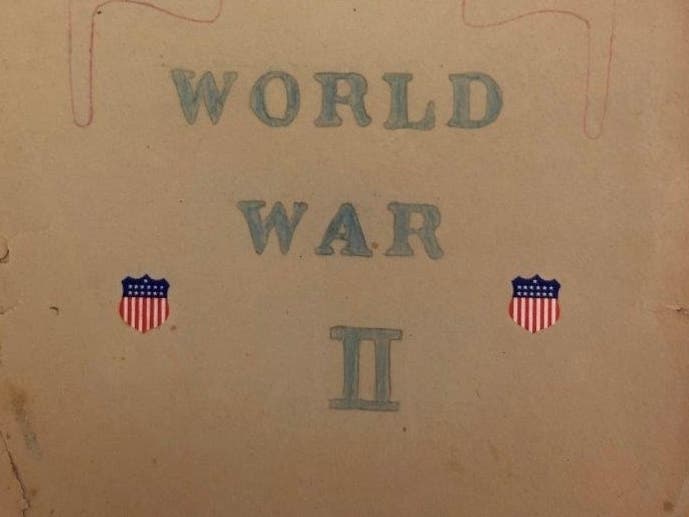
VERNON, CT — A 1945 student history project about the town during World War II is about to become part of the collection at the Vernon Historical Society.
Mary LaChapelle was an eighth-grader at St. Bernard School in the Rockville section of Vernon in 1945. She was the oldest of 13 children and lived with her family on Phoenix Street. She said knew she was living in a historic time as World War II raged in the Pacific and Europe. Residents sensed the Allies were close to victory, she said.
LaChapelle said she saw "a community focused on winning the war," and, a year earlier, created a history project about America and entered it in a contest, in which she won a town prize. She tweaked the project, called it, "My Town's Participation in World War II," and entered the contest again."
Find out what's happening in Vernonfor free with the latest updates from Patch.
"I loved doing stuff like that," she said. "It was very interesting to learn about the community and what was happening."
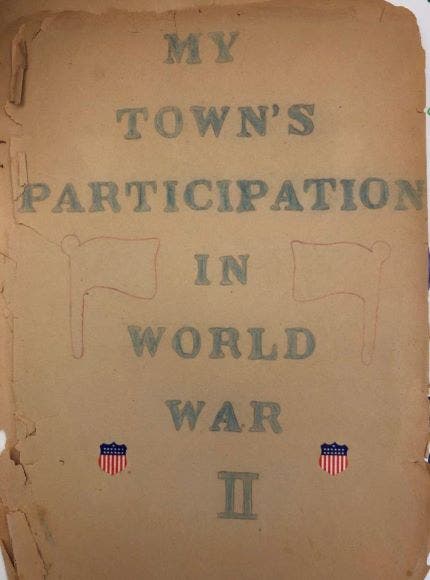
A school project is now a town archive. (Town of Vernon)
Find out what's happening in Vernonfor free with the latest updates from Patch.
LaChapelle wrote about what she saw happening in Vernon. She clipped newspaper stories about the 4-H Club, the Red Cross and her classmates at St. Bernard collecting milkweed. The floss found in milkweed was naturally buoyant and was used to fill life jackets for sailors.
She said she also wrote about her neighbors "praying for peace."
The new project won a state prize.
The history project wound up in an attic, where its pages dried and crumbled a little over the years. Once day, LaChapelle's daughter spotted the project and took a loot at it. LaChapelle then revisited it 75 years after she made it.
"It was interesting, looking back and thinking about all those years ago, what was happening," she said.
The family eventually presented it to Vernon Mayor Daniel Champagne.
Champagne called it "a valuable and fascinating glimpse into Vernon's past" and plans to turn it over to the Vernon Historical Society.
"The history contained in these pages is fascinating," Champagne said. "Being able to touch a piece of fabric produced in a Rockville mill so long ago is something special. This book represents a tremendous part of our community’s history."
Vernon Historical Society Director Jean Luddy said she is looking forward to adding the projec to the society’s collection. She called it a valuable source of historical information and said it is lucky that LaChapelle's daughter thought to save it.
"This a great example of a primary source, something that was created at the time by someone in the moment," Luddy said. "It shows us how people on the home front perceived things and shows us how people in the mills were contributing to the war effort."
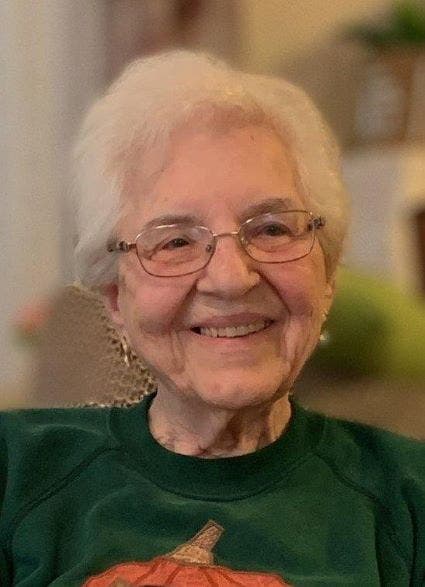
Mary LaChapelle Bendoraitis. (Town of Vernon)
La Chapelle, now 89 and living in Harwinton, said she part of that.
"I would also stay after school a lot and take the Connecticut Company bus home to Vernon," she said. "I also went around and I visited every factory in town to find out what they were making and a lot of them gave me samples.”
She also recorded the terrible toll the war took, pasting into her book newspaper clippings about the young soldiers, sailors, airmen and Marines who were wounded, killed and declared missing in action.
LaChapelle graduated from Rockville High School in 1949, married the following
year to become Mary L. Bendoraitis. She and her husband moved to Torrington, then back to Vernon when he went off to serve during the Korean War. She eventually ended up in Harwinton, and worked at The Torrington Company, a world-class bearing manufacturer, as an
inspector.
She lost her first husband in 1997 and later remarried, becoming Mary L.
Bendoraitis Mazzochi.
"One doesn’t have to be a professional historian to create something important and of value," Luddy said. "Mary's eighth grade project is valuable by itself, but is made all the more interesting by the pieces of fabric and parachute cord she was able to gather from the mills. It’s so important that someone thought to save this. It's going to get more valuable with time as we
look back. And to think she did this as an eighth grader. It's just wonderful."
Get more local news delivered straight to your inbox. Sign up for free Patch newsletters and alerts.