Community Corner
The Mill On the Seal
A whole bunch of history is contained within the little circle that is Waterford's town seal.
Waterford’s town seal is ubiquitous and unobtrusive. You could see it, technically, countless times before really seeing it. I really saw it by accident, when its little mill building and water wheel happened to catch my eye. Was there a historic mill somewhere in Waterford, I wondered, a tourist attraction craftily hidden away? A quick search indicated that there wasn’t. So how did the mill get on the seal? Was it a real structure once?
I looked at the seal again, this time on purpose. Inside a circular border of text (Agriculture – Industry – Prosperity – Waterford - Oct 1801 - Connecticut) I first saw the wheel, the stream, and the small wooden house. When I looked closer I saw that there were two oxen and a person (a girl, I imagined, because of her rather girly hat) leading them. There was also a flock of tiny sheep behind a wooden fence, and a small boy fishing in the aforementioned stream. A tree grew in the center, and behind it there were fluffy clouds in the sky and a rolling landscape stretching out beyond. The scene was a bit twee: early New England rendered like a cartoon.
And then I found there was a good reason for this. The seal was created in 1946 by Waterford resident Martin Branner, who drew the comic strip “Winnie Winkle.” It was first published in 1920 and widely syndicated. It won the National Cartoonist Society’s Humor Strip award in 1958. Branner, originally from New York, had also been a vaudeville dancer and served in WWI.
Find out what's happening in Waterfordfor free with the latest updates from Patch.
The gristmill in Branner’s drawing was indeed real. Built in 1732, it was called the Jordan Mill, and it was located on what, in typical early New England style, became Mill Lane. Town residents would bring their corn there to be ground into meal, and they were not to be “hindered from washing their sheep at the aforsd place as formerly.” The mill burned down many times and was frequently rebuilt as something else; the original wooden gristmill eventually became a brick factory that produced tweeds and submarine equipment.
But there were other mills in Waterford, and not all of them ground grain. There were sawmills; fulling mills, which produced woolen cloth; and turning mills, where wooden handles were turned on lathes. Later, immigrants opened textile and paper mills, and with technology learned back in the United Kingdom they manufactured goods like satinet fabric and manila paper.
Find out what's happening in Waterfordfor free with the latest updates from Patch.
No one knows exactly how many mills Waterford had in the early days. Many references to them exist, but the casual tone with which townspeople refer to what they know well (“where the sawmill formerly stood” may have been the 18th and 19th century version of “over there past the Dunkin’ Donuts”) does not lend itself to a precise count.
Today there are remnants of that time everywhere, as modest as the girl on the seal, hiding her face with her broad-brimmed hat. A millstone was a circular slab of rock long before it was the name of a nuclear power plant. Then there’s Oil Mill road (the oil was ground from flax- and cottonseed), and Jordan Mill Pond.
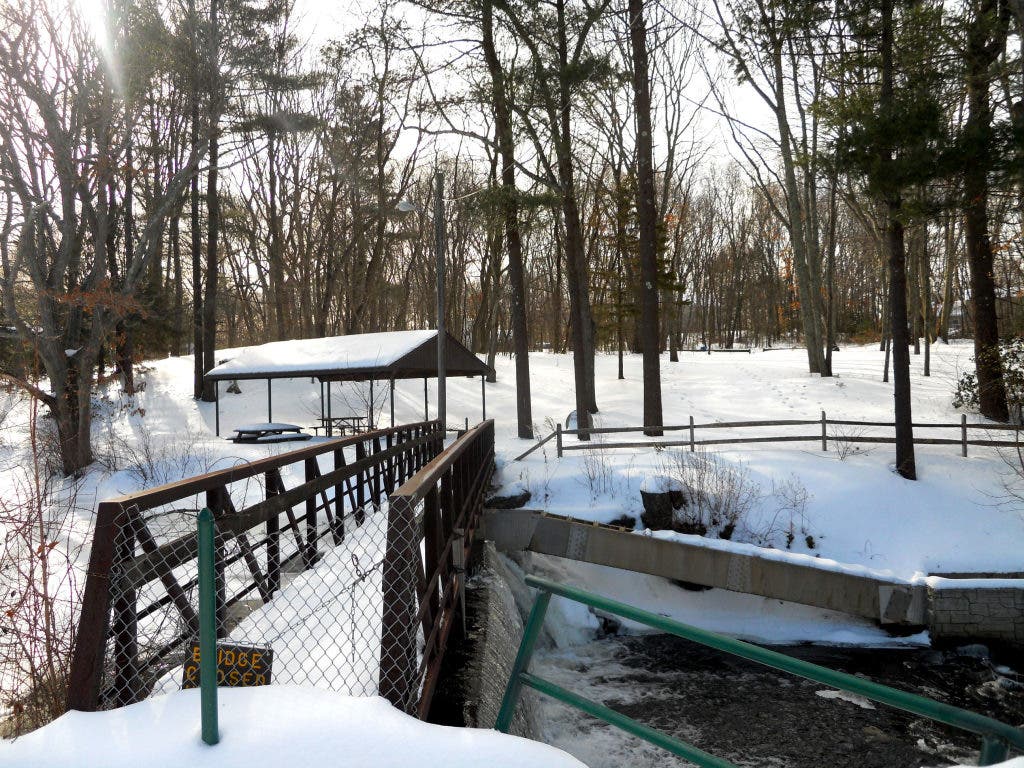
And of course, Mill Lane. I drove down it when the town was half-buried in snow, to see what was left of the Jordan Mill site. The road terminated at the brick building that was the mill's last incarnation and its icy parking lot, with signs indicating that parking was reserved for mill business only. Across the water Jordan Mill Park, with its picnic area and trees, seemed frozen solid. The little bridge across the dam was closed and fenced off for good measure. But the water fell, rushing, as it must have when the locals came here to grind their corn. I watched it for a minute, then I got into my warm car and drove back into the present day.