Community Corner
West Hartford Native Featured In Webster Virus Responder Tribute
A West Hartford native and Manchester Community College graduate is featured in a photo exhibit honoring coronavirus front line workers.


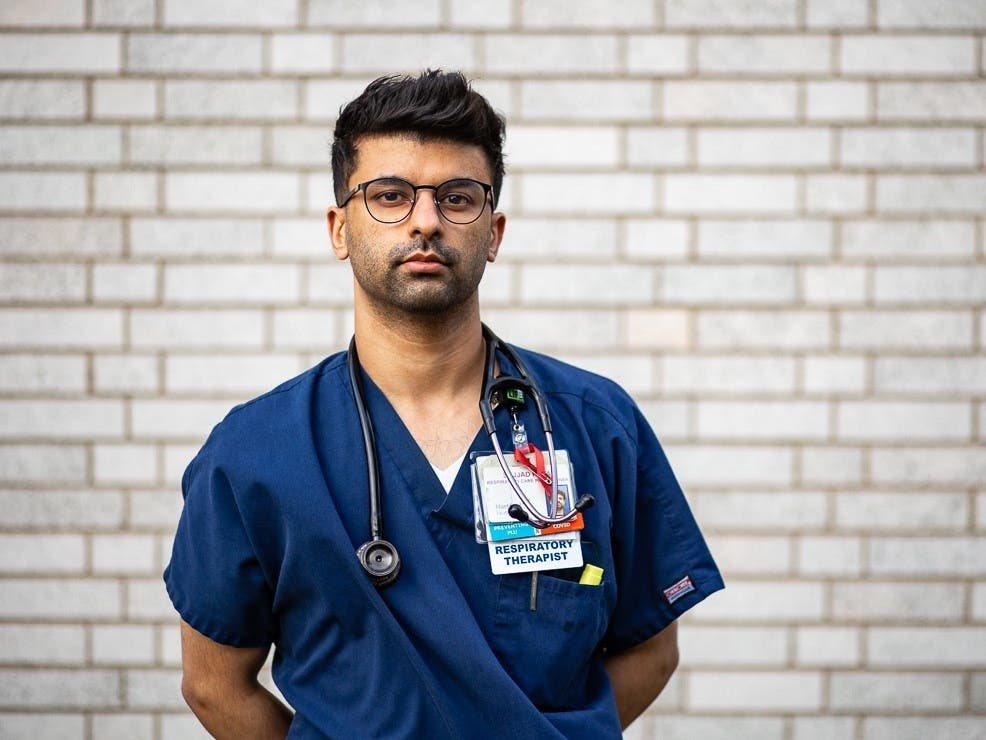
WEST HARTFORD, CT — A West Hartford native and Manchester Community College graduate is to be featured in a photo exhibit honoring coronavirus front line workers.
Sajjad Raza clearly remembers the day the pandemic "became real" in the medical intensive care unit where he was working. The 2016 graduate of the Manchester Community College Respiratory Care program has served as the MICU core respiratory therapist at Hartford Hospital since 2019 and began just months before there pandemic intensified.
"Pulmonary attending physicians use our ICU, and we took those (virus) patients first until the number increased and we couldn’t handle the overflow,” Raza said. "We didn’t anticipate what it would be like. By day 15 or 16, I couldn’t keep track of how many patients we had seen."
Find out what's happening in West Hartfordfor free with the latest updates from Patch.
Raza and his personal experience helping to battle the pandemic will be featured as part of a photography exhibit entitled “The Front Line Project” by West Hartford-based photographer Ginny Kemp, opening on Sept. 23 at the Noah Webster House and West Hartford Historical Society. His photo and written testimony along with those of other local featured essential workers will be archived at the Noah Webster House.
His MCC education, including clinical rotations that included Brigham and Women’s Hospital in Boston, prepared him not only with technical knowledge and training on equipment, but also in bedside manner, according to Raza.
Find out what's happening in West Hartfordfor free with the latest updates from Patch.
He credits especially Respiratory Care Professors Nancy Laroche-Shovak and Kerry McNiven with providing "understanding and compassion" about where patients and families are coming from — a perspective that helped as the pandemic mounted.
"They taught that the patients we care for are the same people we encounter in the supermarket. They just have different needs at the time," he said.
Raza recounted that as the isolation of patients increased because of the need to keep distance and the prohibition of visitors, he and the rest of the hospital staff became more than professional caregivers.
"We hadn’t anticipated how it would affect our relationships and roles," he said. "We facilitated video chats with family, procured devices such as cell phones and tablets to do this — and when we ran out of devices, we stepped in for loved ones at bedside to fill the emptiness."
Raza also organized opportunities for the staff to deal in a constructive way with what he realized was a "PTSD-inducing phase." He organized walks and other activities to give people a chance to talk out their stress, and he provided pep talks to staff as "compassion fatigue" began to set in among them.
When he was approached to participate in "The Front Line Project" exhibit, he was humbled.
"I was honored when one of the Hartford Hospital attending physicians nominated me to be part of it and introduced me to Ginny Kemp," he said. "Throughout the pandemic, I realized that I’m part of something much greater than myself. While the photo is of me, I don't have the words to express how fortunate I am, and what it means to live and work alongside such inspiring and determined individuals. I hope the lesson we’ve learned about doing what’s best for others, even though it may pose a minor inconvenience for ourselves, continues into the future."
See more about the exhibit here.
Get more local news delivered straight to your inbox. Sign up for free Patch newsletters and alerts.