Health & Fitness
COVID-19 Breakthrough Cases: When, and What, To Expect
A study by the Yale New Haven Health System has become a template for what the vaccinated can expect in their battle against COVID-19.


CONNECTICUT — The death of former U.S. Secretary of State Colin Powell from COVID-19 complications last week came as a shock to many Americans who have not been following the rise of breakthrough cases throughout the world.
Those paying attention know that cases of COVID-19 among those who have been fully vaccinated against the disease for at least two weeks — so-called "breakthrough" cases — are on the rise, but still rare among the general population. Breakthrough case fatalities are more rare still, but multiple factors can contribute, and Powell had a full dance card of those.
A study by researchers at the Yale New Haven Health System, published in The Lancet, has become a template for what the vaccinated can expect in their battle against the disease they thought they had whipped back when they got their second jab.
Find out what's happening in Wiltonfor free with the latest updates from Patch.
The scientists studied 969 patients who had received at least one dose of a COVID-19 vaccine at the time of admission to a hospital. Among these patients, 103 had received a partial vaccine course, 15 had received a complete course, and 54 were fully vaccinated.
Among the fully vaccinated cohort, 25 (46 percent) patients were asymptomatic. That is, had they not been tested for the coronavirus, they would never have suspected they had contracted it. Four of the subjects (7 percent) exhibited mild symptoms, 11 (20 percent) had moderate disease, and 14 (26 percent) exhibited had severe or critical illness.
Find out what's happening in Wiltonfor free with the latest updates from Patch.
Here's the kicker: Pre-existing comorbidities in the 14 patients with severe or critical illness included overweight, cardiovascular disease, lung disease, malignancy, type 2 diabetes, and use of an immunosuppressive agent. Among those with severe or critical illness, the median age was 80.5 years. Four of 14 patients required intensive care, one required mechanical ventilation, and three succumbed to the illness.
Powell, who was being treated at Walter Reed Medical Hospital, had been diagnosed with multiple myeloma prior to contracting COVID-19. He was 84.
Nationwide, as of last week, 10,857 fully vaccinated people have died as a result of the virus, up from 7,718 the previous week. Eighty-five percent of them have been age 65 or older, according to the Centers for Disease Control and Prevention.
Of the 2,388,272 persons who have completed their vaccine series, 0.7 percent of Connecticut’s fully vaccinated persons have contracted the virus, up 0.06 percent from last week's report from the Department of Public Health.
One hundred and fifty COVID-19 related deaths have occurred among the 16,760 fully vaccinated persons confirmed with COVID-19. These deaths represent 12.3 percent of all COVID-19 deaths since Feb. 9, 2021, up 0.3 percent from last week's data drop from the state Department of Public Health.
Fourteen residents have died from COVID-19 over the past seven days, down from last week's report of 38 deaths. It's the lowest number of weekly COVID-19 deaths reported by the state since the middle of August.
Coronavirus-associated deaths have been on the decline across the country since Sept. 16, mirroring Connecticut's own arc. The current 7-day moving average of daily new cases (73,079) decreased 15.1 percent compared with the previous 7-day moving average (86,046). A total of 45,149,234 COVID-19 cases have been reported as of October 20, according to the Centers for Disease Control and Prevention.
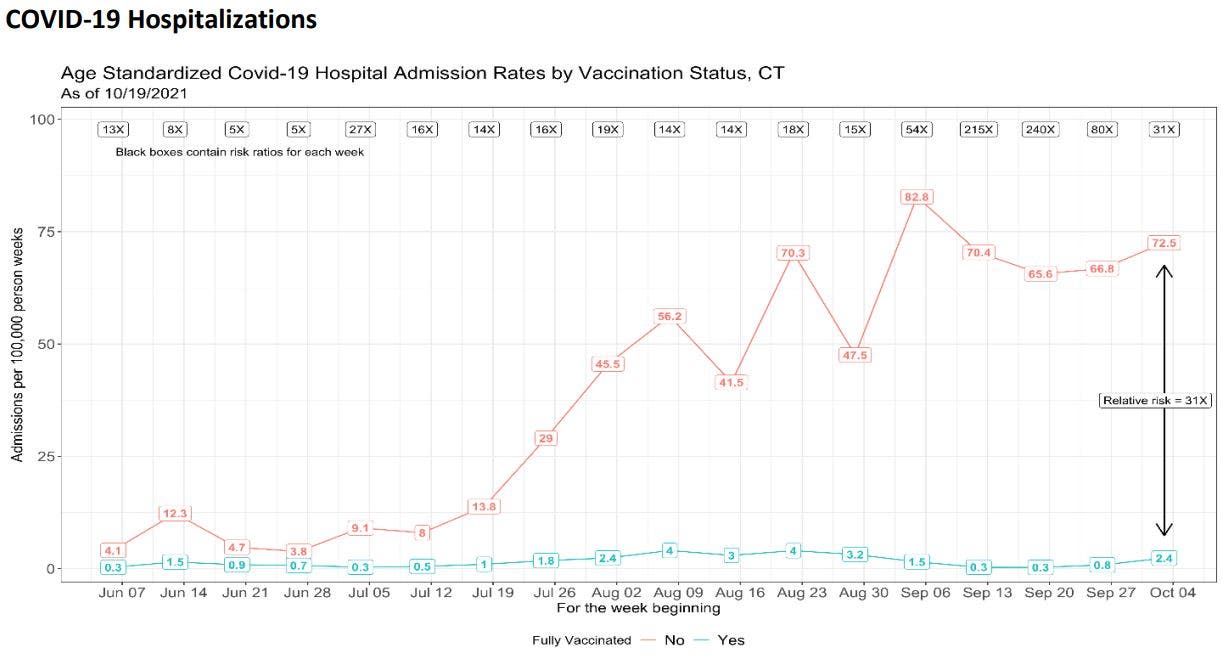
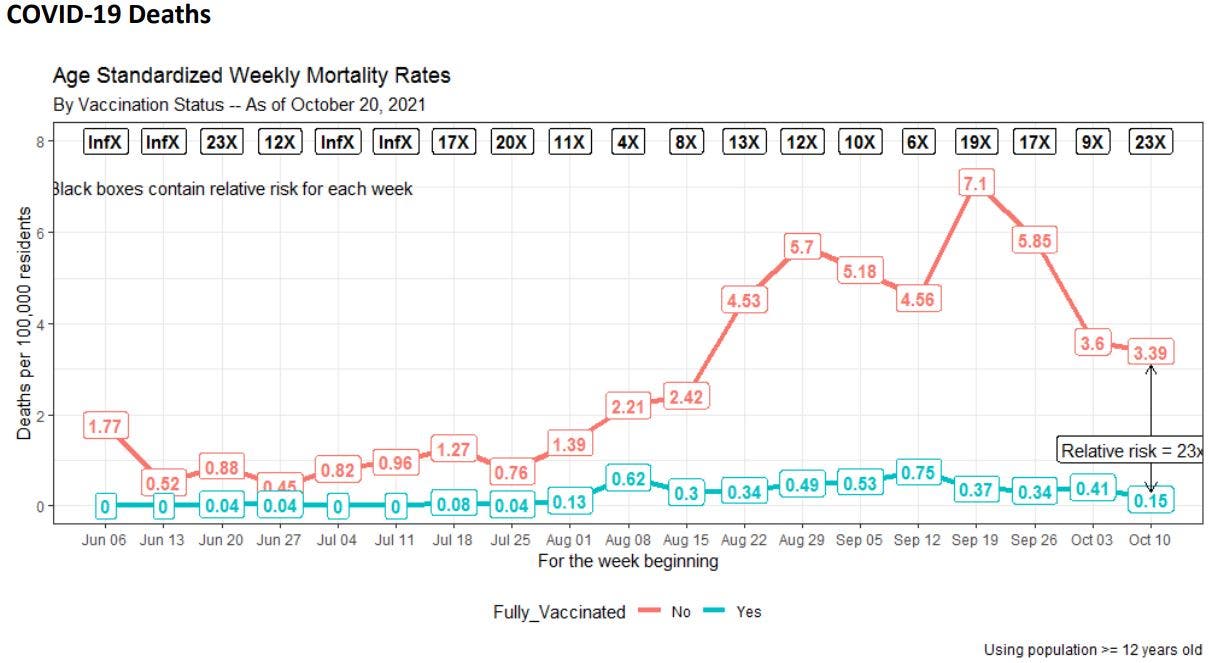
The latest data show unvaccinated residents have an 23-times higher risk of dying from the coronavirus, compared to the vaccinated. Their risk of hospitalization is 31 times greater.
According to the latest weekly release of statewide data from DPH, 2,387,601 residents out of 3,105,947 eligible people have been fully vaccinated, yielding a 77 percent vaccination rate statewide. Looking at the total population of 3,575,074, Connecticut's vaccination rate is 70.2 percent, the third highest in the U.S., behind Vermont and Rhode Island, according to the Mayo Clinic.
Predictably, residents in the eastern area of the state, with the highest coronavirus infection rates, are also least likely to be fully-vaccinated against COVID-19, according to the data released by DPH.
Mansfield remains the outlier, still with less than 37 percent of its population fully vaccinated. Of all Connecticut municipalities, only Canaan has fully vaccinated all its residents.
As of Thursday, those residents fully vaccinated against COVID-19 include more than 95 percent of those over the age of 65, 91 percent of those between 55-64 (up 1 percent from lat week), 82 percent of those between 45-54, 82 percent of those between 35-44, 75 percent of those between 25-34, 70 percent of those between 18-24, 80 percent of those between 16-17, and 70 percent of those between 12-15 (up 1 percent). Except where noted, there has been no percentage increase in the number vaccinated in each age tier since last week.
The reticence among Connecticut residents to be vaccinated can best be illustrated in the graph above, which shows the progress toward full vaccination for each age tier from the start of their eligibility has begun to level off.
With 453 cases confirmed overnight, out of 25,260 tests reported, the daily coronavirus positivity rate reported Friday afternoon was 1.79 percent, up from 1.67 percent on Thursday.
Hospitalizations dropped 13 beds, in the latest data. As of Friday, there are 211 residents being treated for the virus inside Connecticut hospitals.
Most of those hospitalized (68) are in Hartford County.
See Also: 22 State Workers Who Refused Vaccination Or Testing Fired: UPDATE
Get more local news delivered straight to your inbox. Sign up for free Patch newsletters and alerts.