Business & Tech
New Robots with Bacteria Brains May Impact Healthcare and Agriculture
A Wilton man helped develop a model showing how bacteria can control behavior of a robot, potentially impacting healthcare and agriculture.


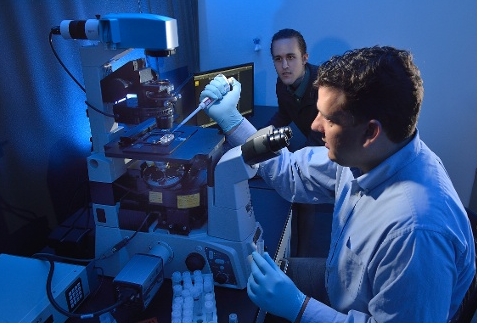
A Wilton man had a hand in helping to develop a model to show how bacteria can control the behavior of a robot, according to R & D Magazine.
Virginia Tech biomedical engineering doctoral student Keith Heyde, of Wilton, studies phyto-engineering for biofuel synthesis and partnered with Warren Ruder, assistant professor of biological systems engineering in the College of Agriculture and Life Sciences and the College of Engineering.
“Basically we were trying to find out from the mathematical model if we could build a living microbiome on a nonliving host and control the host through the microbiome,” Ruder told the Roanoke Star.
Find out what's happening in Wiltonfor free with the latest updates from Patch.
“We found that robots may indeed be able to function with a bacterial brain,” he said.
Ruder is building robots that will read bacterial levels in E. coli using fluorescent microscopes. The robots turn green or red based on what they consumed.
Find out what's happening in Wiltonfor free with the latest updates from Patch.
These findings could potentially impact healthcare by getting a better understanding of bacteria’s role in bacteria-based prescriptions to treat mental and physical illnesses. In agriculture the bacteria brain robots would allow studies to explore the connection between soil bacteria and livestock.
Click here to read more on the Roanoke Star.
Photo: Virginia Tech
Get more local news delivered straight to your inbox. Sign up for free Patch newsletters and alerts.