Schools
Region 15 Survey on Student Behavior Opens Communication Avenues
A panel of Region 15 students presented data from the survey to a room of approximately 90 people.




Sometimes surveys yield unexpected results.
These results have the opportunity to become talking points in town, said Tim M. Duffey, president of Vision Training Associates, at a Thursday, Oct. 13, presentation at Pomperaug High School.
Vision Training Associates manages the North American Training Team of Search Institute, a national leader of applied research in positive youth development, according to the Vision Training Associates website.
Find out what's happening in Woodbury-Middleburyfor free with the latest updates from Patch.
Jennifer DeWitt said that 1,793 Region 15 students from grades seven through 12 were surveyed on 40 different assets and 24 risk-taking behaviors in December 2010.
DeWitt is the executive director of the Central Naugatuck Valley Regional Action Council and the Region 15 youth retreat facilitator.
Find out what's happening in Woodbury-Middleburyfor free with the latest updates from Patch.
Assets are defined as protective factors -- ways that others support young people and ways that young people support themselves.
The asset test asks three questions:
- Does it prevent risk behavior?
- Does it build resiliency?
- Does it promote positive youth development?
Duffey said he found it particularly interesting and troubling that most of the time, females reported having more of an asset than males, with the exception of four categories:
- Self-esteem
- Sense of purpose
- Positive view of personal future
- Safety
"The males were notably higher in those areas," said Duffey. "I would like to see those numbers higher than they are."
He is especially concerned that females ranked lower in having a positive view of their personal futures. These kinds of results are launching pads for discussions in the community, said Duffey.
Survey reports are in the PDF section of this article. The information can also be found on the Region 15 website, under the Parental Involvement section.
How the Survey Results Were Analyzed
Twenty-seven students got together and looked over the data of the Profiles of Student Life: Attitudes and Behaviors survey, Duffey said. That is a uniqueness he finds refreshing: Most surveys are completed by students and analyzed by a company of experts.
This survey was also analyzed by experts, but the fact that students looked at the data and came to conclusions about areas of strength and areas that need improvement is incredible, said Duffey.
This Small Town Can Start Something Big
Pomperaug High School student Blair Feller participated in the youth retreat and analyzation of data. She said a huge opportunity exists for the region.
"This little town can be the first to change in this whole country," she said. "We can start something big."
Region 15 Superintendent Frank Sippy discussed events that led to the survey.
"Two years ago, we learned about tragic events involving young people," he said.
This led to increased awareness and action in the community: Police presence outside the school, more avenues for students to tell their concerns and periodic canine searches, said Sippy.
Duffey said a typical response after tragedy is to tighten rules and monitor behavior more closely. Sometimes that results in losing sight of opportunities to engage young people and make a connection, he said.
"It's important we look to balance the ways we respond to situations of concern," said Duffey. "It's important that you begin a lot of community conversations and those are better when young people are included."
The survey provides five to 10 years of potential community action and response, Duffey said.
Change is not the sole responsibility of the school system, DeWitt said.
"It starts here," she said. "It starts with me and with each of you in this room."
DeWitt recommended building relationships close to home as a start. She encouraged those who attended to talk to their community members.
"Share the information you received with someone else," said DeWitt. "Start with your circles of influence."
Areas of Strength
Areas of strength in the district were chosen by 27 youth retreat participants: five Memorial Middle School students, four Rochambeau Middle School students and 18 Pomperaug High School students.
The following areas were identified as significant strengths:
- Positive view of personal future
- Family support
- Time at home
Areas of Concern
- Safety
- Equality and social justice
- Positive family communication
- Restraint: The ability to resist peer pressure
- Cultural competence
Twenty-four percent of the students surveyed said they feel adults in the Region 15 community value them, a result that garnered gasps from the audience.
The old adage of leading by example showed up in the survey results: 37 percent of the students surveyed said their parents and other adults model positive and responsible behavior.
The survey results were analyzed and categories based on assets were created. Students determined which assets were strong and which were weak.
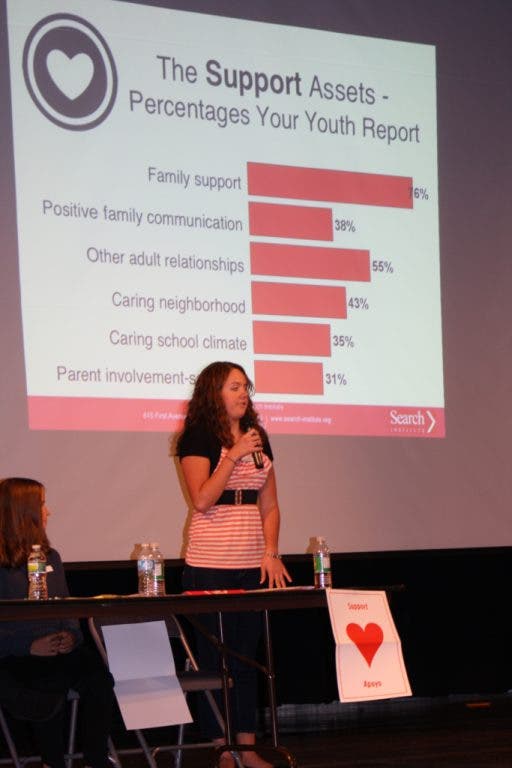
Asset: Support
Pomperaug High School sophomore Cassie Clemens presented the support category.
- Strength: 55 percent reported having strong relationships with other adults.
- Weakness: 38 percent reported having positive family communication.
That percentage tends to decrease as students get older, said Duffey.
"It's common that they break away and establish their own identity and it challenges our relationship with them," he said.
That drop-off in communication cannot be stopped but there is a way to shorten its duration, Duffey said.
"We want to start out at a higher level [of assets] and we'll see less of a drop over time and a quicker rebound," he said.
Overall Assets of Those Surveyed
- 10 percent reported having 0-10 assets.
- 39 percent reported having 11-20 assets.
- 36 percent reported having 21-30 assets.
- 15 percent reported having 31-40 assets.
"That is a challenge," said Duffey. "How do you ensure that all young people have a good amount of assets?"
He gave the example of teachers becoming invisible mentors to students, simply by asking questions about students and really being attentive to the answer. Then, a week later, he recommended talking to students again and asking a question about their hobby or something specific to them as individuals.
Asset: Empowerment
Eighth grader Lauren Perry presented the empowerment category.
- Strength: 54 percent reported engaging in service to others.
- Weakness: 59 percent reported experiencing safety: How safe one feels at home, in school and in the community.
Duffey said that Perry raised a good point.
"The lowest number is not always the greatest concern for you or for me," he said.
Asset: Boundaries and Expectations
Pomperaug High School student Stephanie Alvey presented the boundaries and expectations category.
- Strength: 71 percent reported having positive peer influences.
- Weakness: 37 percent reported having adult role models.
Asset: Commitment to Learning
Perry presented the commitment to learning category.
- Strength: 76 percent of students reported motivation to achieve.
- Weakness: 26 percent of students reported reading for pleasure.
Asset: Positive Values
Pomperaug High School student Feller presented the positive values category.
- Strength: 70 percent of students reported having integrity.
- Weakness: 45 percent reported having restraint.
"Restraint is a life skill and if you don't have restraint, you will get stuck eventually," said Feller.
Asset: Social Competence
Pomperaug High School student Kristy Matasavage presented the social competence category.
- Strength: 53 percent of students reported being able to resolve conflicts peacefully.
- Weakness: 41 percent of students reported cultural competence: knowledge of and comfort with people of other cultural, racial and ethnic backgrounds.
Duffey noted that within the category of peaceful conflict resolution, 67 percent of females reported having that asset, while 39 percent of males reported having it.
Asset: Positive Identity
Clemens presented the positive identity category.
- Strength: 78 percent of students reported having a positive view for their personal future.
- Weakness: 53 percent reported feeling like they have personal power.
What Happens Next
Duffey challenged those in attendance to go forth and increase connections in the community.
"Greet each young adult you meet with renewed interest in them," he said.
This is a call to action, said DeWitt.
"The worst thing you can do when you leave here is put the folder [of information] down," she said. "The best thing you can do is tell someone about what you heard."
Feller said the support adults give does affect her and other teenagers. Clemens said technology has altered communication.
"Today with all the technology, we lose some of the person-to-person discussion," she said.
Clemens suggested parents reach out more and not just ask, "How was your day?" Feller agreed with Clemens on how technology changes communication. She said the question becomes: "Can parents and children talk about the bigger issues?"
"Can you talk to your parents about alcohol, drug use or sex?" said Feller. "These things are hard for kids to talk about."
She acknowledged that it is hard for parents to talk about those topics too.
"Start reaching out to them," said Feller. "Start with 'how was your day?' and then ask, 'What was good about it'?"
Alvey had one bit of advice for parents and adults in the community regarding their children and other young adults.
"Don't give up on them because they've done something stupid," she said. "They need your support and your help, from people who have been there. So don't give up on them."
Get more local news delivered straight to your inbox. Sign up for free Patch newsletters and alerts.