Neighbor News
A Forum on Human Rights and Anti-Corruption: The Tai Ji Men Case
MNN TV station in New York broadcast a program featuring a forum in support of Human Rights Day and Anti-Corruption Day.
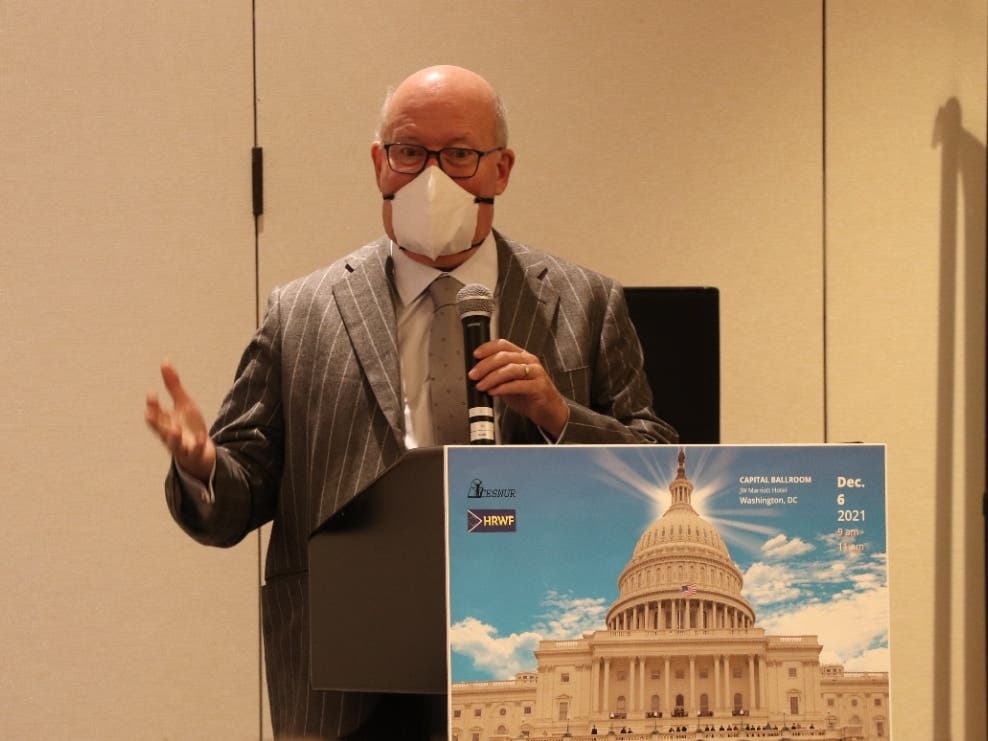

The MNN TV station in Manhattan, New York, broadcast a program on January 29 and February 2, 2022, featuring a forum titled "Human Rights and Anti-Corruption: The Tai Ji Men Case,” organized by the Center for Studies on New Religions (CESNUR) and Human Rights Without Frontiers (HRWF) on December 6, 2021 in Washington, D.C., to honor International Human Rights Day (December 10) and International Anti-Corruption Day (December 9). The forum, which participants attended in person or virtually, focused on the Tai Ji Men case, which has been ongoing in Taiwan for a quarter-century.
The Tai Ji Men case began in Taiwan in 1996, when Hou Kuan-jen, then a prosecutor, wrongly accused Tai Ji Men of fraud, tax evasion, and raising goblins. Tai Ji Men was declared not guilty of tax evasion or any other accusations by Taiwan's Supreme Court in 2007. The case should have ended there in a democracy that follows the rule of law; nevertheless, Taiwan's National Taxation Bureau ignored the Supreme Court's decision and continued to levy unjustified taxes on Tai Ji Men. The taxation bureau, in collaboration with the Administrative Enforcement Agency, illegally auctioned and forcibly confiscated Tai Ji Men's sacred land meant for a self-cultivation center for Tai Ji Men members in August 2020, based on the illegitimate tax bill.
Prof. Massimo Introvigne, a world-renowned scholar of new religions as well as the founder and managing director of the Italian Center for Studies on New Religions, flew to Washington, D.C., to speak out for justice and support Tai Ji Men. Corruption in the Tai Ji Men case is not just about a few government officials pocketing money; it is also about corruption on the spiritual level, assaulting the core values of conscience and devouring Taiwan's soul, according to Prof. Introvigne. Normally, a nation with this level of corruption, noted Prof. Introvigne, would destroy itself if it was not stopped in time, and this is the risk Taiwan faces now, if it does not admit what rogue bureaucrats did and rectify the Tai Ji Men case.
Find out what's happening in Washington DCfor free with the latest updates from Patch.
Five additional scholars and human rights experts also shared their insights on the case. Willy Fautré, the director of Human Rights without Frontiers, pointed out that corruption is clearly at work in the Tai Ji Men case and urged the Taiwanese government to take action to redress the case: “Human Rights Without Frontiers recommends a reform in the Taiwanese judicial system, especially the administrative litigation system; the annulment of the bonus system as it creates incentives that can lead to undue fiscal and judicial harassment in total impunity; and sanctions against those in state administrations and the judiciary who are found to be negligent or to have abused their power.”
PierLuigi Zoccatelli, professor of sociology of religions at Pontifical Salesian University, Italy, also criticized Taiwan’s bonus system, saying, “Unless the bureaucrats are all angels, the system also becomes a machine to generate corruption.” He noted that the United Nations acknowledged that article 2(1) of the International Covenant on Economic, Social and Cultural Rights (ICESCR) implicitly includes the notion that corruption is a violation of human rights. Corruption played a key role in the Tai Ji Men case, causing Tai Ji Men’s human rights being violated, stated Prof. Zoccatelli, adding that since Taiwan made the ICESCR part of its domestic law, it should apply the Covenant and rectify the injustices vested on Tai Ji Men.
Find out what's happening in Washington DCfor free with the latest updates from Patch.
Camelia Marin, deputy director of Soteria International, said that in today's world, the rule of law is undermined not only by legal abuse but also by corruption. As demonstrated in the Tai Ji Men case, administrative persecution based on corruption emerges. "Let me express my gratitude for the perseverance and optimism that Tai Ji Men shows and shares by standing for their case, for their rights, bringing hope to the many others around the world who have not yet found justice but are still persecuted," she said, conveying her admiration for Tai Ji Men's efforts to insist on doing what is right. "Now is the time to solve it," she said, urging the Taiwanese government to do the right thing.
Alessandro Amicarelli, a London-based human rights lawyer and the president of the European Federation for Freedom of Belief (FOB), said, “Corruption is at the very core of the Tai Ji Men case.” He viewed this Human Rights Day as the right time to rectify the Tai Ji Men case by prosecuting the criminals who wrongly accused Tai Ji Men and violated the human rights of Tai Ji Men shifu (master) and dizi (disciples). It's also time for the Taiwanese government to return Tai Ji Men’s land that was unlawfully confiscated and pay damages for the suffering of the Tai Ji Men community over the last 25 years, he added.
Following a video presentation highlighting some of Tai Ji Men’s cultural performances and religious ceremonies, Dr. Chen Ying-Jing, an assistant professor at National Taiwan University, summarized the impressive efforts by Tai Ji Men and its leader, Dr. Hong, Tao-Tze, to promote conscience, love, and peace in over 100 nations. Dr. Hong is instrumental for the United Nations’ designation of April 5 as the International Day of Conscience, according to Dr. Chen. She also outlined the key events in the Tai Ji Men case, emphasizing that this is not merely an administrative matter of tax law, but rather a flagrant violation of religious freedom with international ramifications.
Source: ACT 1219