Neighbor News
House Passes Ban on Mink Farming to Prevent New COVID-19 Variants
Amendment led by Reps. Rosa DeLauro, Nancy Mace, and Peter DeFazio would better protect animals and humans alike

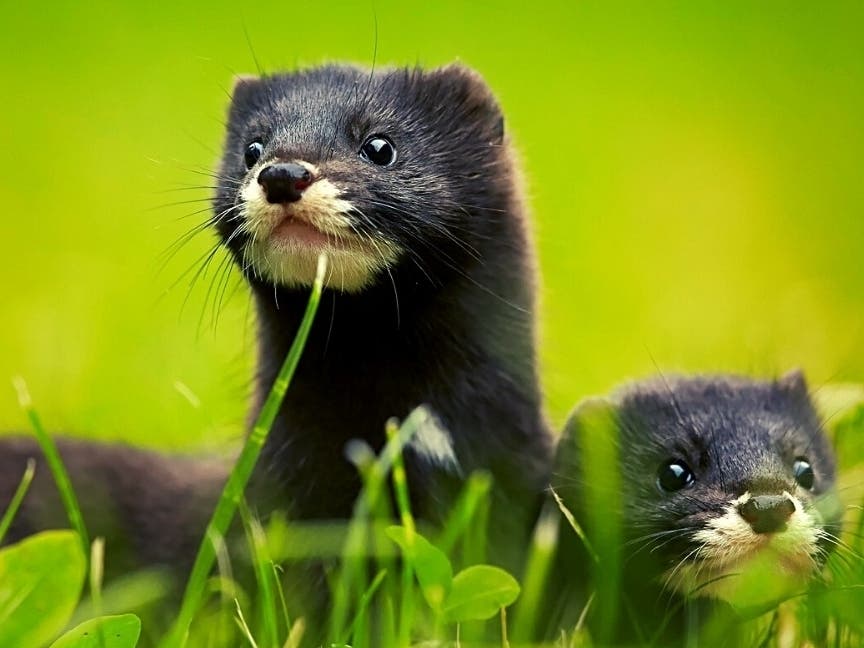
Earlier this month, U.S. Reps. Rosa DeLauro, D-Conn., Nancy Mace, R-S.C., and Peter DeFazio, D-Ore., shepherded a key amendment to end the factory farmed production of minks to passage in the House. In doing so, they stood against needless cruelty to animals, stood up to protect Americans from the next new emerging zoonotic disease. Mink are uniquely susceptible to the virus and captive mink on fur farms have already spilled back a mutated form in Denmark and the Netherlands. It will happen here if we don’t do something about it.
The DeLauro-Mace-DeFazio amendment mirrors the bipartisan Minks In Narrowly Kept Spaces (MINKS) Are Superspreaders Act, H.R. 4310, they introduced in 2021 with Reps. Michael McCaul, R-Tex., Claudia Tenney, R-N.Y., Raul Grijalva, D-Ariz., David Valadao, R-Calif., Jan Schakowsky, D-Ill., Veronica Escobar, D-Texas, and Lance Gooden, R-Texas.
The amendment to the America COMPETES Act bans the possession of mink “raised in captivity for fur production,” stopping the routine misery of animals on around 60 farms that have anywhere from a few thousand to 100,000 mink kept in cages. Scientists and public health authorities recognize the health risks are far too great to allow this kind of major cruelty and minor commerce to persist. These American mink farmers almost exclusively export the pelts to elite customers in the People’s Republic of China. In short, our nation is raising mink on factory farms, and taking the risk of an emerging variant, all to supply a small number of Chinese elites with a luxury garment.
Find out what's happening in Washington DCfor free with the latest updates from Patch.
The Center for a Humane Economy’s conclusive 102-page report entitled “Mink Farming & SARS-CoV-2,” by former USDA infectious disease expert Jim Keen, D.V.M., Ph.D., details the public health risk associated with mink farms. In practical terms, there are just two species that contract the virus in large numbers and spill it back to other species – humans and mink. There have been outbreaks of COVID-19 at 450 mink farms in North America and Europe, spawning at least three variants. The environment in which factory farmed mink are raised “maximizes chances for intraspecific aggression, viral infections, and mutations,” according to Dr. Keen. And as a result, for public health and safety, jurisdictions including Denmark, France, the Netherlands, and British Columbia have eliminated mink farming as an act of mercy for animals and a bulwark against the emergence of a new variant. The U.S. response is lagging and it’s time to turn that around.
“One of the many lessons we learned at the beginning of the COVID-19 pandemic is the real danger of animal to human transmission of disease,” Rep. Mace announced publicly.” “In fact, If COVID-19 could design its perfect habitat for mutation and transmission, it would closely resemble a mink farm, where thousands of mink are kept in small, often unsanitary, overcrowded cages, for days on end.”
Find out what's happening in Washington DCfor free with the latest updates from Patch.
In recent years, Saks Fifth Avenue, Neiman Marcus, Macy’s, Bloomingdales, and every other major fashion retailer, along with the biggest names in design, have ceased fur sales and have acknowledged that confining and factory farming a wild species like mink in cramped, barren cages with little to no room to move around, is clearly archaic and inhumane. We have a wide range of alternatives and real fur has no practical value any longer.
As fashion trends have changed over the last few decades so has our arcane attitudes towards the animals that share our planet. Fur farming is an antiquated and barbaric practice that has no place in a civilized world. The combination of animal welfare hazards and viral risks does indeed warrant the attention of the nation.
Now it’s time for the Senate to help enact the ban on mink production, and we hope you will take action by clicking here and asking the Senate to support the inclusion of this important provision in the final version of the America COMPETES Act. We cannot sit idly by and allow new COVID variants to emerge in American mink farms that will further decimate our population and economy – the risk is far greater than the reward.
Marty Irby is the executive director at Animal Wellness Action and Sr. Vice-President at the Center for a Humane Economy in Washington, D.C., who was named as one of The Hill's Top Lobbyists for 2019, 2020, and 2021 and honored in 2020 by Her Majesty Queen Elizabeth, II for his work to protect animals. Follow him on Instagram, Twitter, and Facebook @MartyIrby.