Politics & Government
Fate Of West Grove Stalled By Commission Infighting
Friday's special commission meeting to finally vote on the new redistricting map for the city of Miami failed to deliver a solution.
Mar 15, 2022
Friday’s special commission meeting to finally vote on the new redistricting map for the city of Miami failed to deliver a solution, with the primary area of contention being the fate of Coconut Grove – and specifically the Black Grove.
Find out what's happening in Miamifor free with the latest updates from Patch.
Before the meeting, the plan that seemed to have the most traction would have kept the Black population together in District 2 while splitting the whole of Coconut Grove between three commissioners: Ken Russell, Manolo Reyes and Joe Carollo.
Consultants Miguel De Grandy and Steve Cody were scheduled to present their updated map with an explanation of changes that was expected to be followed by public comment, but within minutes of the start of the meeting, Carollo asked for time to address the commission.
Find out what's happening in Miamifor free with the latest updates from Patch.
That’s when things began to unravel and Carollo began to hurl accusations at Russell.
“Sadly, it is one of my colleagues that has been, since the recall, since this whole campaign, involved with these individuals to see how he can harm me,” Carollo said. “I do believe that I have every right to represent my district and vote like every one of us. But I do need to ask a question. Mr. Russell, do you live in the city of Miami? And where do you live, if I may ask?”
Carollo’s tirade referenced efforts to recall him in 2020 and came on the heels of a recent local article that apparently hit a nerve – accusing Carollo of trying to gerrymander his Coconut Grove home back into his district so he can move back into it and protect it from any future damages that could be awarded in the multiple lawsuits against him.
Without offering a shred of proof, Carollo identified Russell as the mastermind behind all of his troubles and went after his colleague in revenge.
Chairwoman Christine King tried to keep order but was interrupted many times by Reyes and Commissioner Alex Diaz de la Portilla, or was simply spoken over by Carollo.
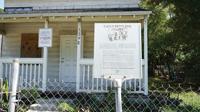
One of the original, historic, Bahamian-style homes in the West Grove.
(Miami Times File Photo)
After all of the vitriol and accusations made by Carollo about Russel’s domicile in district 2, Carollo asked the city clerk to refer his comments to the FBI, IRS and FDLE, as well as State Attorney offices in Miami-Dade and Broward counties. With all of that said and done, Carollo said he would abstain from voting during the meeting.
King then allowed Russell to respond to the attack made against him. Russell’s defense included having his realtors, Isabelle Andrews and Alba Biondi, show up to the meeting, to be questioned about his home sale and lease agreement.
With the political drama done for the moment, De Grandy and Cody presented an amended map provided to them by Russell. This new map kept all of Coconut Grove together while pushing portions of the Brickell area into District 3. De Grandy said the changes would follow all federal guidelines under the Voting Rights Act.
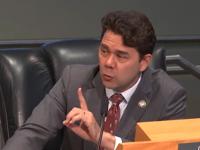
Commissioner Joe Carollo launched unfounded accusations against Commissioner Ken Russell, who was forced to defend himself.
(City of Miami Via YouTube)
De Grandy and Cody then attempted to defend themselves against media comments alleging racism in the redistricting process. They walked through the city’s total demographics and the demographics of each district to argue that the selections they’d made weren’t particularly racially motivated. When asked about keeping together Black voters in the Grove, De Grandy said that would be a “policy decision,” not a demographic decision, and was the responsibility of the commission.
After the presentation the floor was opened to public comment, with nearly every person coming to the microphone to request that Coconut Grove stay together, even residents of other neighborhoods of Miami. The best example of the passion and determination of the crowd came from Reverend Nathaniel Robinson III of St. Paul African Methodist Episcopal of west Coconut Grove.
After speaking about how previous legislation from the commission has removed Black residents from the West Grove through special use permits and evictions, Robinson repeated this phrase seven times regarding new maps that keep the Grove together: “Alternative maps have been presented that meet all of the criteria and the residents are satisfied with them.”
During most of the public comment period, Reyes and Diaz de la Portilla were absent from the dais.
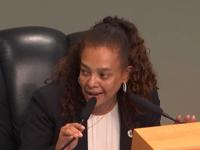
Chairwoman Christine King tried to keep order during a chaotic meeting.
(City of Miami YouTube Channel)
After public comments, the commission took a recess that was only supposed to last an hour but pushed well past two. At the return to the meeting, Reyes asked De Grandy to remove any part of Coconut Grove from his district.
“I don’t like to be where I’m not welcome,” Reyes said. “I know you will have to find the population someplace else. If you could do that … That part of Coconut Grove is going to stay intact.”
Russell was pleased, but also supportive of his fellow commission member.
“I know you are a strong, good person and will represent anyone in your district,” he said. “But I very much appreciate it.”
Then King raised a map change issue of her own to keep a portion of her existing district from going to Diaz de la Portilla’s District 1, in order to hold onto the lucrative waterfront Wharf Miami project – a mixed-use entertainment and hotel area that, when completed, will be a strong economic driver.
When asked about her sudden desire to make a change to the base map, she replied, “Let’s be clear. I’m not changing anything. I am keeping what is in my district already.”

A rendering of the Wharf Miami project that Chairwoman Christine King wants to keep in her district, but which is now slated to move into Commissioner Alex Diaz de la Portilla’s district.
(AIMIR CG)
King said she was previously unaware Wharf Miami was part of the base map that was approved on a 4 -1 vote. Diaz de la Portilla, however, wasn’t about to give up the area. Even if it was currently population neutral, he predicted how it would grow in the next 10 years.
“I happen to know what projects are in place to happen down the line and it’s going to be predominantly Hispanic,” Diaz de la Portilla said.
He then insisted that King’s change to the base map be voted upon, which ended up failing on a 2 -2 tie with the abstaining Carollo now absent from the meeting altogether.
De Grandy asked for direction several times to arrive at closure, but wasn’t provided anything concrete, leaving commissioners with no choice but to vote on extending his contract.
After a nearly seven-hour process, De Grandy pledged to “bring one alternative for each commissioner, and leave it up to them to decide how to proceed.
The next redistricting meeting is scheduled for March 24 at 2:30 p.m.
The Miami Times is the largest Black-owned newspaper in the south serving Miami's Black community since 1923. The award-winning weekly is frequently recognized as the best Black newspaper in the country by the National Newspaper Publishers Association.