Community Corner
Gators Attack Pasco Horse, Kill Venice Dogs, Injure FishHawk Lab
The New Port Richey rancher believes the increase in gator attacks in Florida is due to people feeding the reptiles.


NEW PORT RICHEY, FL – While it may have been a gator that savagely attacked his champion race horse, as far as Mike Santo is concerned, the cause of the gator’s aggression lies with man, not beast.
The New Port Richey rancher believes the rising frequency of gator attacks in Florida is due to people feeding the reptiles, causing them to lose their natural fear.
Santo, a lifelong Floridian who has four horses on his ranch in Pasco County, said he never had reason to worry about gators. They’d always kept their distance.
Find out what's happening in New Port Richeyfor free with the latest updates from Patch.
That all changed last week when Jay’s Crown, a majestic 21-year-old dark bay gelding that amassed a collection of rodeo racing ribbons in his heyday, took a dip in the pond on Santo’s pasture to cool off, something the horse has done countless times before.
However, this time a 9- to 10-foot gator attacked him.
Find out what's happening in New Port Richeyfor free with the latest updates from Patch.
As the terrified horse escaped the gator's clutches and struggled out of the pond, Santo was horrified to see the bloody bite marks, shredded flesh and gouges from the gator’s claws on the horse’s flank.
"There were teeth marks, claw marks, ripped skin…” he said. "It was horrible."
Santo promptly took the horse to the Brandon Equine Medical Center where equine veterinarian Dr. Elizabeth Dammers removed the flesh around the bite marks, cleaned the wounds and placed the horse on powerful antibiotics to prevent infection.
“She did an amazing job,” said Santo.
Nevertheless, Crown has a long road to recovery.
“This is a very large open wound that will take about eight to 10 months of daily therapy,” said Santo. “Therapy like this is a long process with a lot of medication and wound-dressing products.”
And that treatment doesn’t come cheap. The horse is on massive doses of antibiotics and the wound requires cleaning twice a day. Because of the location of the bite marks, the wound has to be left uncovered so there’s a constant risk of infection.
To help cover the horse’s medical costs, the Santo family has set up a GoFundMe page for Crown. In the five days since the page was established, well-wishers have donated nearly $2,500. Santo, however, estimates the cost of rehabilitating Crown could be as much as $10,000.
“Any help and support in his fight would be greatly appreciated,” he said, adding his thanks to those who have already contributed both funds and words of support. “The positive energy and prayers have been amazing.”
Santo said it’s been heartbreaking to see the horse in so much pain.
“Crown has been a part of our family for 18 of his 21 years, and we are doing everything we can to take care of him and to show the same love and devotion to him as he has done for us for the past 18 years,” he said.
In addition to doing whatever is possible to help the horse recover, Santo has taken on a new mission.
The one-time rodeo rider and now professional rodeo judge has launched a public awareness campaign through social media on the dangers of feeding gators.
It wasn’t a lack of food that prompted the gator to attack the 1,000-pound horse, said Santo, who has been a licensed nuisance gator trapper for 20 years.
In fact, the attack was contrary to the reptile’s nature. Alligators hunt at night and rarely take on a larger animal.
“To go after a thousand-pound animal that's 16 hands high, that's a pretty big undertaking even for a 10-foot alligator,” he said. "That alligator came to that horse because it had been fed by somebody.”
Santo has been working with the Florida Fish and Wildlife Conservation Commission on trapping the gator. He’s caught sight of it several times but so far it had eluded attempts to bait it.
He said he’s worried its next victim could be a child.
"There's an elementary school right across from here,” he said. “An alligator can easily go through a fence, under a fence, over a fence and attack a child.”
While he can’t say for certain that someone in the area is feeding the gators, “we assume that’s what’s happening by his (the gator’s) willingness to come dangerously close to people,” he said. “People have to stop feeding alligators. They're not pets, they're wild animals."
Wildlife conservation officers couldn’t agree more.
For hundreds of years, alligators have thrived on a diet of fish, snakes, turtles, lizards, small mammals and birds.
So, the recent spate of gators attacking people and pets is worrisome.
On June 8, a Davie woman walking her dogs in a nature park was attacked and killed by a gator. (See related story).
On June 29, a group of gators chased a 15-year-old girl up a tree in Lake County. (See related story.)
On July 1, a couple took their two German shepherds to Shamrock Park in Venice where the dogs were attacked by gators. One was killed. The other is missing and presumed dead.
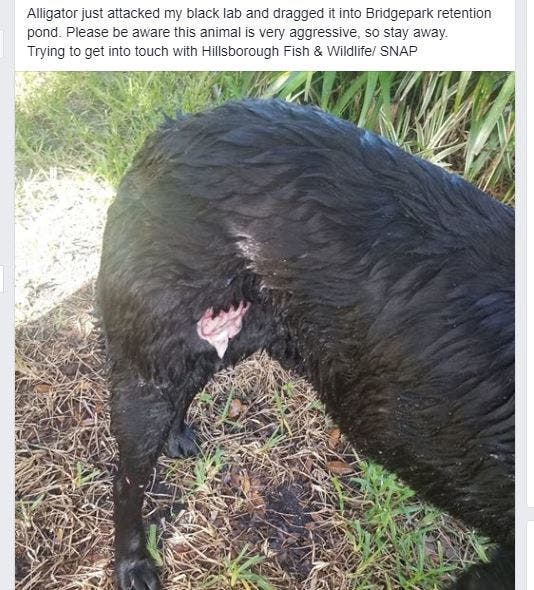
A similar attack occurred Monday, July 2 in FishHawk Ranch in Hillsborough County. A gator attacked an 8-year-old black lab in a retention pond in Bridgepark while on a walk with his owner. While off its leash, the dog waded into the pond where it encountered the gator. This time the dog survived.
There have been unsubstantiated reports on social media from residents who say they have seen people feeding the gator in the pond. The Florida Fish and Wildlife Conservation Commission has been contacted but hasn't been able to trap the gator.
“I absolutely think the attack on Crown could have been avoided if people had not fed that gator,” said Santo. “It's a huge problem in Florida. There have been three attacks in the last three days.”
He said the state’s lottery system allowing gators to be hunted once a year simply isn’t sufficient to control the growing alligator population.
Florida Fish and Wildlife Conservation Commission’s Statewide Nuisance Alligator Program permits the killing of approximately 7,000 nuisance alligators each year. The FWC estimates there are now 1.3 million alligators in the state.
“Gators are everywhere, and they’re losing their fear of people,” said Santo.
From 1948 to 2016, 388 unprovoked alligator bites were reported in Florida. Twenty-four of those attacks were fatal.
In the past 10 years, the FWC has received an average of nearly 16,000 alligator-related complaints per year. Most of these complaints deal with alligators found in back-yard ponds, canals, ditches and streams, but other conflicts occur when alligators wander into garages, swimming pools and golf course ponds.
FWC’s alligator experts say several factors may be contributing to the recent spike in attacks.
As suggested by Santo, people may be feeding gators without realizing it, whether it’s innocently leaving leftovers from a picnic near a gator habitat or tossing leftover bait into the water after a fishing trip. Under Florida law, even feeding gators unintentionally is against the law.
The FWC has also arrested people for deliberating using food to entice gators to come closer.
Florida’s growing population and development near gator habitats including swamps, wetlands, rivers and lake are another reason for more gator-human encounters.
And, finally, the increasing number of residents and visitors participating in recreational activities in wetlands, lakes and rivers may contribute to an increase in alligator attacks.
“This is a popular time of year for people to recreate near the water, creating the potential for human-alligator interactions,” said an FWC spokeswoman.
The FWC has produced a brochure called “A Guide to Living with Gators."
The brochure advises:
- Never feed alligators – it’s dangerous and illegal. When fed, alligators can overcome their natural wariness and learn to associate people with food. When this happens, some of these alligators have to be removed and killed.
- Dispose of fish scraps in garbage cans at boat ramps and fish camps. Do not throw them into the water. Although you are not intentionally feeding alligators when you do this, the result can be the same.
- Seek immediate medical attention if you are bitten by an alligator. Alligator bites can result in serious infections.
- Observe and photograph alligators only from a distance. Remember, they’re an important part of Florida’s natural history as well as an integral component of aquatic ecosystems.
- Be aware of the possibility of alligators when you are in or near fresh or brackish water. Bites may occur when people do not pay close enough attention to their surroundings.
- Do not swim outside of posted swimming areas or in waters that might be inhabited by large alligators.
- Alligators are most active between dusk and dawn. Therefore, avoid swimming at night.
- Dogs and cats are similar in size to the natural prey of alligators. Don’t allow pets to swim, exercise or drink in or near waters that may contain alligators. Dogs often attract an alligator’s interest, so do not swim with your dog.
- Leave alligators alone. State law prohibits killing, harassing or possessing alligators. Handling even small alligators can result in injury
If you encounter an alligator that poses a threat to people or property, call FWC's Nuisance Alligator Hotline at 1-866-FWC-GATOR. The agency will evaluate your complaint and, if warranted, will send a trapper to remove the animal. Nuisance alligators are killed, not relocated.
Video and image courtesy Mike Santa
(For more local news from Florida, click here to sign up for real-time news alerts and newsletters from Tampa Patch. If you have an iPhone, click here to get the free Patch iPhone app; download the free Patch Android app here.)
Get more local news delivered straight to your inbox. Sign up for free Patch newsletters and alerts.