Community Corner
Pasco's Most Distinguished Pioneer—Ehren’s Old Growth Cypress
Estimated to be more than 400 years old, Pasco's most distinguished pioneer isn't a person, but instead is a tree.


The native Seminoles called it “hatch-in-e-haw” which means everlasting wood, but we know it more commonly as the cypress tree.
This mystic and majestic tree has long been appreciated for it beauty, size, longevity, and variety of uses.
But, during the first half of the 20th century, the heartwood from these old trees, which required centuries to develop, was marketed as “tidewater cypress”, the commericalized term for the cypress, and resulted in the removal of the larger, old-growth trees from virtually every swamp in Florida.
Find out what's happening in New Port Richeyfor free with the latest updates from Patch.
However, tucked away deep in the swamps east of Ehren Cutoff Road near Land O’ Lakes, one old growth cypress survived the centuries and escaped the sawmills to become one of Pasco’s most distinguished pioneers—the Ehren Cypress Tree.
Today, very few know of this enormous tree’s existence on Southwest Florida Water Management District lands, but there it stands, unaware of its own record as Pasco County’s oldest living cypress tree.
Find out what's happening in New Port Richeyfor free with the latest updates from Patch.
According to Historic Places of Pasco County, professional forester Jack Vogal estimated the Ehren Cypress Tree to be more than 400 years old.
In 1989, the last time the tree was measured; it was an amazing 27 feet in circumference, 8.59 feet in diameter, and approximately 116 feet tall.
About two weeks ago Vogal attempted to take the tree’s current measurements, however was unable to complete the task because of the seasonal waters flooding the swamp.
So, why was the Ehren Cypress tree spared by area logging crews?
Some speculate that a large hollow split in the tree’s trunk made it undesirable for the mill, especially when there were bigger and better trees to choose from.
But, in comparison, the 1989 figures are in line with those of the humongous cypress trees felled throughout our area more than 100 years ago.
Speaking of Those Other Trees
In 1911, the distinction of the largest cypress tree cut in South Florida was awarded to Pasco County through the efforts of resident Emory Jackson Carraway, who discovered the mammoth softwood.
According to the Tampa Morning Tribune, Carraway divided the massive tree into three sixteen-foot sections. And, using Doyle’s rule and log book for measurement, the trees board feet of lumber were estimated on site.
One section (8½ feet in diameter) reportedly measured 8,464 board feet of lumber, while the other two sections averaging 7½ feet yielded a total of 14,792.
And, in order to make sure these figures would not be discredited, Carraway secured verification from the general manager of another nearby mill.
The total board feet of lumber from the Carraway cypress tree was an astonishing 23,256 feet—enough to build four houses.
But, while Carraway’s cypress was a record, it wasn’t the only old growth tree discovered that year.
Felled in the Chassahowitzka swamps of Hernando County, the record of another massive cypress also came in 1911—this one from the little sawmill town of Centralia.
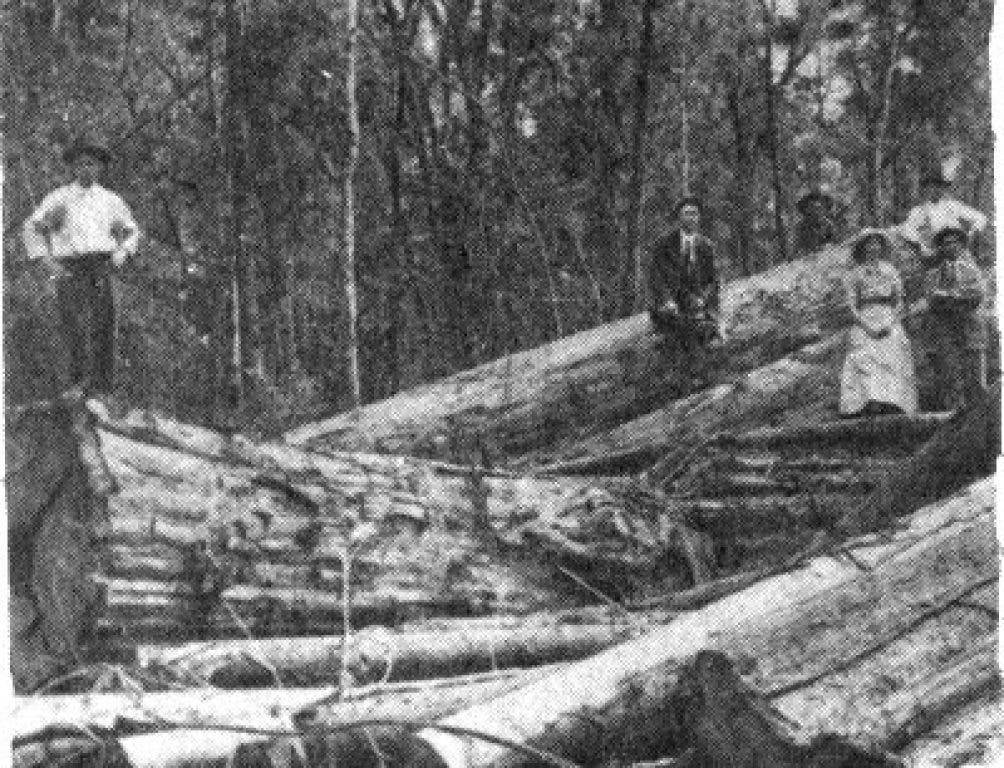
The butt cut of the tree was so large that it had to be quartered by a dynamite blast before it could even be moved.
After finally winching the mammoth pieces from the swamp, a large 20-foot section was loaded onto a flat car, hauled back to the mill, and put on display for all to marvel at, pictures of which still survive today.
According to the St. Petersburg Times, from the single Chassahowitzka cypress, Centralia Sawmill workers received the largest log they had ever seen.
And, while no records were made of the tree's entire board feet, the large 20 foot section was estimated to yield 5,476 board feet of lumber—enough to build one house.
The Chassahowitzka cypress might have been the largest ever milled at the Centralia Sawmill, however, when comparing figures, its record likely didn’t beat that which was set here in Pasco County by Emory Carraway.
So, How Do Old growth Records Compare to Today’s Ehren Cypress Tree?
In 1989, when the Ehren Cypress Tree was measured, it was estimated that it could produce approximately 20,000 board feet of lumber making is slightly smaller than the Carraway and Chassahowitzka cypress trees of 1911 and largest still living in Pasco County.
However, according to the University of Florida, geologist believe cypress trees have been present in southwest Florida for more than 5,000 years and just over 6,500 years in the far northern regions of the state, making the Ehren Cypress Tree an infant in comparison to others around the state, some of which are estimated at 2,500 years old.
But, unlike other monster cypress trees around the state, our Ehren Cypress Tree hasn’t been turned into a tourist attraction—there are no boardwalks, viewing platform, or plaques to commemorate its legacy.
Instead, this hidden secret of our past continues to quietly grow and will hopefully survive for another 400 years.