Community Corner
What’s in a Name: Pasco County’s Twin Ports, Old and New
Have you ever wonder why we have a Port Richey and New Port Richey?


I’ve often been asked in conversations about our local history, why do we have a Port Richey and New Port Richey and why were both so closely named?
So, this week in our “What’s in a Name” series, we explore the origins of the place names of Pasco County’s twin ports, historically known as old Port Richey and new Port Richey.
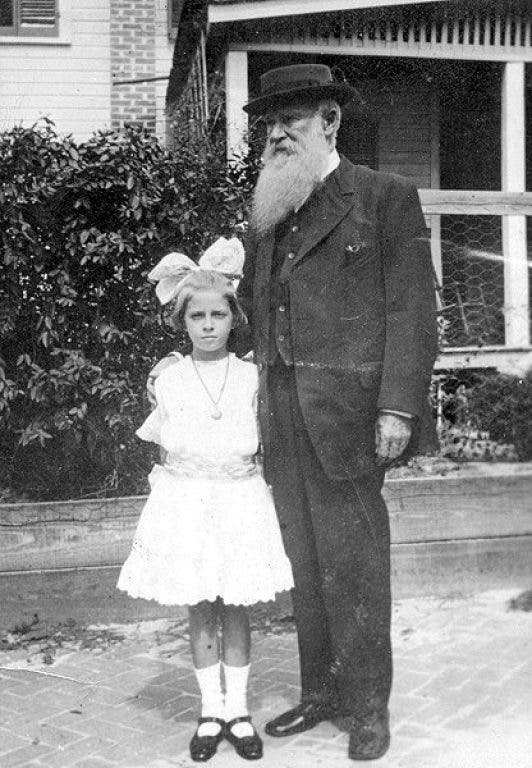
And, while Port Richey’s namesake Aaron Richey wasn’t the first owner of the small point of land that became widely known as Richey Point, it was his contributions that put our little coastal community on the maps.
Find out what's happening in New Port Richeyfor free with the latest updates from Patch.
A furniture dealer and horticulturalist by trade, Richey arrived to Pasco’s west coast in December 1883, from St. Joseph, Missouri.
Here, the family settled at the mouth of the Pithlachascotee River in the former home of Felix Sowers, purchased only six months prior to their arrival, according to county records.
Find out what's happening in New Port Richeyfor free with the latest updates from Patch.
Upstream, several cottages already lined the beautiful river banks and aside from the planted orange groves that abounded, the tropical scenery was painted with broad ferns, intermingled with flowers that dipped into the broad river, flowing past the large stately palms, hickory, silver maple, magnolia, and green cedar trees that formed the canopy above — a true paradise.
According to the Tampa Tribune, when Richey arrived to settle at the mouth of the Cotee River, he soon thereafter purchased a common, two-mast, sharpie to use as a freighter on the Anclote-Cedar Keys run.
To pilot this new vessel, Richey employed the young, 19-year-old, Franklin Hudson, whose family was already familiar with these coastal waters of the Gulf, having settled the town of Hudson, Florida five years earlier.
Aboard the boat, goods and merchandise was exported from Cedar Keys to Richey Point, where Richey erected a small wooden building which became the community’s first permanent business — a small general store built for the convenience of the numerous fisherman and scattered settlers throughout the region.
But, Richey’s contributions didn’t stop there.
To better serve his customers and the community at large, on July 9, 1884, after petition, he received approval from the postmaster general in Washington, D.C. to establish what he deemed the Port Richey post office — a move that put the Richey name on the maps.
According to the Tampa Tribune, with his store serving as the community’s first post office, a small slot in one side of Richey’s little wooden building was where letters were posted in the early days.
And, with a core group of residents, a post office, and general store, Port Richey was beginning to take its shape.
To make it official, in March 1885, Richey hired surveyor John B. Walton to survey and divide his Port Richey point into a town site, 26 years before the new Port Richey town site was designated.
Although Port Richey’s official designation as a town through incorporation didn’t’ come until much later, by October 1885, residents made a formal petition to establish the community’s first schoolhouse.
One month later, on September 5, 1885, the Port Richey School was organized with Aaron M. Richey, Hill W. Howse and Malcolm N. Hill appointed as the first trustees.
Fast forward to 1911 — The population had grown, the Richey family had moved on and the entire landscape was becoming a different scene.
As part of the dissolution of Aripeka Saw Mills, a large tract of prime Florida land was sold to Pete L. Weeks, who formed the Port Richey Company along with J.S. Weeks, his brother, and W.E. Guildford. Their purpose was colonizing and developing lands along the Cotee River into a new town site and using the Port Richey name to do it.
Sales maps for the future town were drawn and, on October 16, 1911, a map titled “Port Richey Company Plan for Town of Port Richey” was filed for record — not to be confused with the filing of the “Map of the Town of Port Richey” in 1887.
With a new town site planned the distinctions began to follow. As early as July 1914, the use of the unofficial names “old Port Richey” and “new Port Richey” began appearing in news print.
But, with no direct roads connecting what are now Port Richey and New Port Richey, it was a dispute in the delivery of mail that formally prompted the official naming and designation of New Port Richey, ultimately breaking away from its older counterpart.
According to New Port Richey’s first postmaster Gerban DeVries, mail wasn’t delivered to the few residents living south of Port Richey at the new town site.
Instead, the route was by row boat, down the river, to retrieve the mail from Port Richey.
As population grew, new Port Richey’s residents soon grew tired of boating to Port Richey for their mail.
So, according to DeVries,
“[residents] set apart a day and cleared a road down part of what is now Madison street; and along this route we put up our mail boxes. But the carrier, Driver by name, had a will of his own which we had not reckoned with, and he would not accept this as his routing, hence all our work went for nothing. This disappointment, however, did not peeve us. We said, ‘If we cannot be served by carrier from Port Richey we will get a postoffice of our own.”
According to The Tampa Morning Tribune, on March 30, 1914, the post office inspector was in Port Richey to investigate the need of the new post office.
However, so confident in their position, there was no question among residents that the new office would be established. And, as if taking aim at their Port Richey neighbors to the north, their proposal called for the new office to be named Newport-Richey.
DeVries goes on to say,
“In due time the petitions were acted upon, and I was examined for the important position of postmaster. But a delay occurred in establishing the office on account of our not choosing a suitable name.
The department contended that since there was already a Newport, Florida and a Port Richey, Florida Newport-Richey would lead to errors and confusion. Quite a number then favored calling the place Chascotee, after the latter part of our river’s name. This too was considered unsuitable by the land company and many of us settlers, who had done so much advertising under the name of Port Richey.”
However, it was the honorable Congressman Sparkman who suggested a division of the name Newport-Richey to create the more acceptable New Port Richey.
By May 1915, and even before the new office had been officially approved, the name New Port Richey began to appear in the minutes of a Pasco County school records.
But, after much deliberation and numerous correspondents to Washington, it was finally agreed and the name New Port Richey was accepted.
A month later, on June 29, 1915, Gerban DeVries took his post as New Port Richey’s first postmaster, and, on December 27, 1915, the Port Richey Company filed for record what they called the “Revised Plan for Town of New Port Richey”.
On October 27, 1924, the residents of New Port Richey voted 201 to 4 in favor of incorporation.
Perhaps with a little inspiration from their neighbors to the south, six-and-half months later, old Port Richey’s residents had also decided upon incorporation, this move forever and distinctly separating the old and the new.
And, while these two cities still remain separated through their municipalities and city limits, they remain united through the history that made them what they are today.
If not for the old Port Richey, would we have ever had a New Port Richey?
Or, better yet, where would we be if the mail carrier in 1914 had decided to delivery mail to Port Richey’s southern residents?