Neighbor News
Colliers Executive Exchange Highlights Central Florida Retail Growth
Investor Demand Surges Amid Constrained Supply in Central Florida Retail
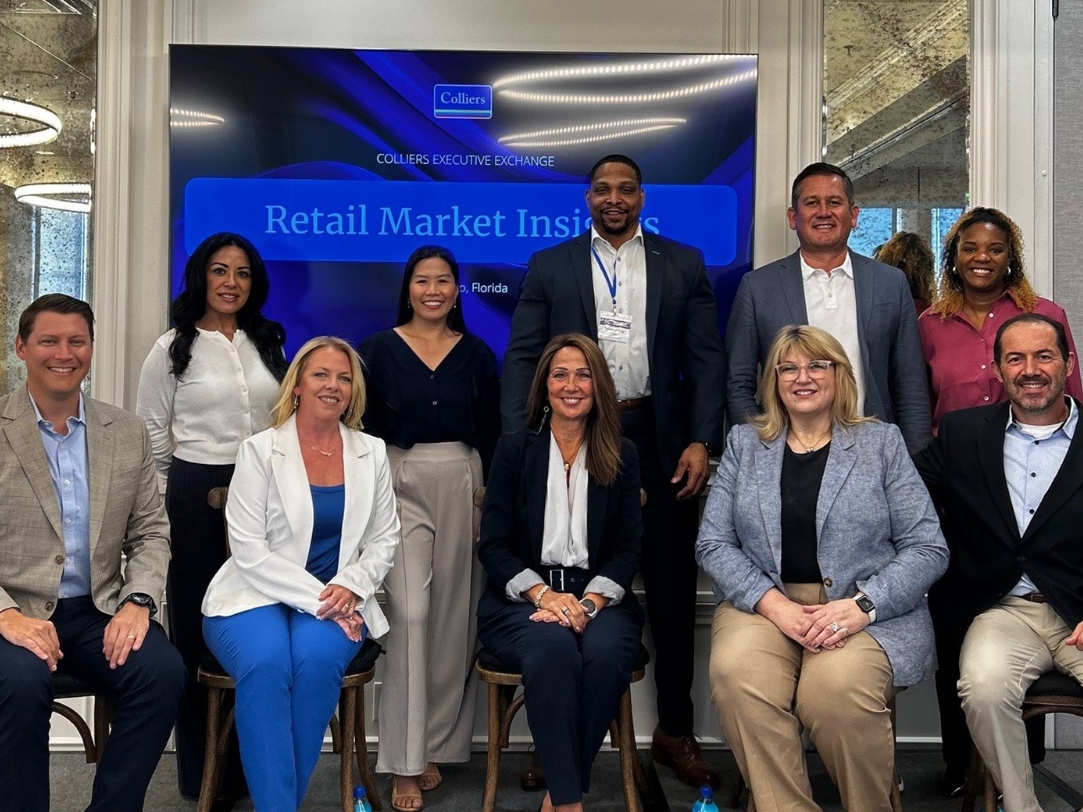
Colliers hosted its latest Executive Exchange in Orlando, bringing together industry leaders across brokerage, development, lending, and investment to examine the forces shaping Central Florida’s retail and commercial real estate landscape. Opening remarks were delivered by Alex Evans, Managing Director for West and Central Florida at Colliers, and the discussion was moderated by Jorge Rodriguez, Executive Vice President, and Vanesa Rodriguez, Associate Vice President at Colliers.
Central Florida—particularly Orlando—remains a top destination for capital, supported by population growth, tourism, and ongoing economic expansion. Panelists noted that compared to legacy markets such as New York, Chicago, and Atlanta, Florida continues to stand out as a high-growth investment environment. A recent West Colonial shopping center listing illustrated this momentum, with investor interest increasing from approximately 100 to 150 groups and offers doubling, including multiple bids above guidance pricing. Population and economic growth stories are directly translating into stronger investor demand and rent growth.
Growth Corridors and Development Momentum
David Gabbai, Executive Vice President at Colliers, highlighted the importance of a fully integrated development ecosystem—from permitting and capital to leasing execution—as projects become increasingly complex. He pointed to Lake Nona, Hamlin in West Orlando, and the Haines City/Davenport corridor along US-27 as key growth markets driven by population inflow, job creation beyond tourism, and expanding infrastructure.
Find out what's happening in Orlandofor free with the latest updates from Patch.
Gabbai also emphasized the continued evolution of Orlando’s retail landscape, particularly in food and beverage, noting the market’s transition from tourism-driven dining to a recognized culinary destination with growing demand for chef-driven and experiential concepts.
Rising Costs and Development Challenges
Ginger Simoens, PMP, Project Director at Project Management Advisors, highlighted growing constraints on development, particularly rising impact fees and extended project timelines. Developers are increasingly accelerating entitlement submissions ahead of fee increases, while rising costs and tightening margins are requiring higher rents to maintain feasibility.
Find out what's happening in Orlandofor free with the latest updates from Patch.
Gabbai added that impact fees are now a primary consideration in site selection, citing an example in Osceola County where a drive-thru project faced a twelvefold increase in fees if not grandfathered under previous structures.
Capital Markets and Financing Discipline
From a lending perspective, Jen Pollock, CCIM, Senior Vice President in the Commercial Banking Division at Ameris Bank, noted that while banks remain the lowest-cost source of capital, underwriting standards remain disciplined. Deals must make financial sense, and rising costs related to construction, delays, and impact fees often require additional layers of private equity or alternative capital sources.
Pollock also highlighted the rapid expansion of healthcare-oriented retail, including med spas, wellness clinics, and physician-led concepts. Combined with a strong rebound in fitness demand, these uses are increasingly backfilling large retail vacancies and reshaping demand patterns across the region.
Retail as a Catalyst for Community Growth
Joanne Ling, Senior Director of Commercial Sales, Leasing & Development at Tavistock, emphasized the critical relationship between retail and residential development. In master-planned communities such as Lake Nona and Sunbridge, retail is essential to supporting residential growth by providing necessary amenities that drive long-term livability.
Ling also pointed to continued retailer demand from both regional operators and national brands entering Florida from markets such as New York, Chicago, California, and Texas, driven by population growth, income gains, and infrastructure expansion.
Investment Trends and Market Fundamentals
Whitaker Leonhardt, Executive Vice President at Colliers, highlighted evolving lease structures, noting a shift toward annual escalations and CPI-based adjustments as landlords respond to inflationary pressures and post-pandemic market conditions. He added that limited new development relative to population growth is creating tight vacancy, strong rent growth, and increasing value in existing retail assets.
Leonhardt also noted growing demand for upscale retail and fitness concepts, particularly in submarkets such as Winter Garden, where higher-income in-migration is driving repositioning toward premium offerings.
Redevelopment and Adaptive Reuse Gaining Traction
Across the panel, speakers agreed that redevelopment is becoming increasingly attractive relative to ground-up construction. The ability to reuse previously paid impact fees and reposition aging retail centers offers a more viable path forward, though permitting delays and expiration timelines are creating urgency for execution.
About Colliers Executive Exchange
Colliers Executive Exchange is a thought leadership series that brings together industry experts and clients to discuss key trends shaping the commercial real estate landscape.
For more information or to explore collaboration opportunities, please contact Aleine Lagasca.