Health & Fitness
Safe Stretching
Getting fit is on the top of most New Years Reolution lists. Here is some good info on safe stretching to avoid injury, keep yourself healty and feel better.
Stretching is the absolute best self-healing technique.
Stretching is like giving yourself a massage. And it's free!
A good stretch moves old stagnant blood out and allows fresh nutrient rich blood in. When you stretch your muscles you lengthen them and release tight fascia. This can relieve a lot of pressure off your joints and your nerves. Muscles that are strong and flexible support your joints in their proper place. When your joints are working in their best range of motion (ROM) there is less wear and tear on them. When joints are working against tight muscles it puts too much pressure on your fluid filled disc tissue.
Find out what's happening in Safety Harborfor free with the latest updates from Patch.
Ever hear the word arthritis? Osteo-arthritis is an inflammation in your joints that destroys your discs that cushion your joints when you move. Eventually the inflammation will eat away at the disc and you will be "bone on bone," a painful condition that leads so many to joint replacement surgery.
Muscles work in groups. For primary movements you have an "agonist" (muscle that is directly moving a segment) "antagonist" (muscle that does the opposing movement and is stretching to allow the motion) stabilizers (muscles that assist primary movement by helping to hold the joint in its proper alignment.) There is a principle called reciprocal inhibition which means that if one muscle (biceps) is contracted then the brain tells the antagonist (triceps) to let go. This important trait is why active stretching is so effective.
Find out what's happening in Safety Harborfor free with the latest updates from Patch.
We all learned passive stretching in 6th grade gym class. (Sit on the floor, lean over and pull on your foot to stretch the back of the leg) Too often I find people think stretching is a battle between them and their muscles. I see them pulling, straining, fighting to MAKE IT happen! This is absolutely ridiculous. It is counterproductive and dangerous for your muscle fibers. Over pulling is how you create muscle tears and spasms.
Another factor is the "Myotatic stretch response".
In every muscle there is are spindle fibers that contract when the brain receives the signal that you are overstretching your muscle The tendons have something called the "Golgi apparatus" The GA is monitoring how much tension there is in the muscle tendon junction When you stretch too long, too hard and too far, a signal is sent to the brain and the brain tells the muscle to clamp down to keep from tearing off the bone. (This causes spasm in the muscle.)
Some of the main principles of Safe Stretching are:
- When you want to stretch a muscle, you need to engage the opposing muscle.
- Relax. Relax. Relax. Let your whole body relax. Engage only the muscles you need to facilitate the stretch. Relax everything else. Your muscles will let go better if you are not tensing up.
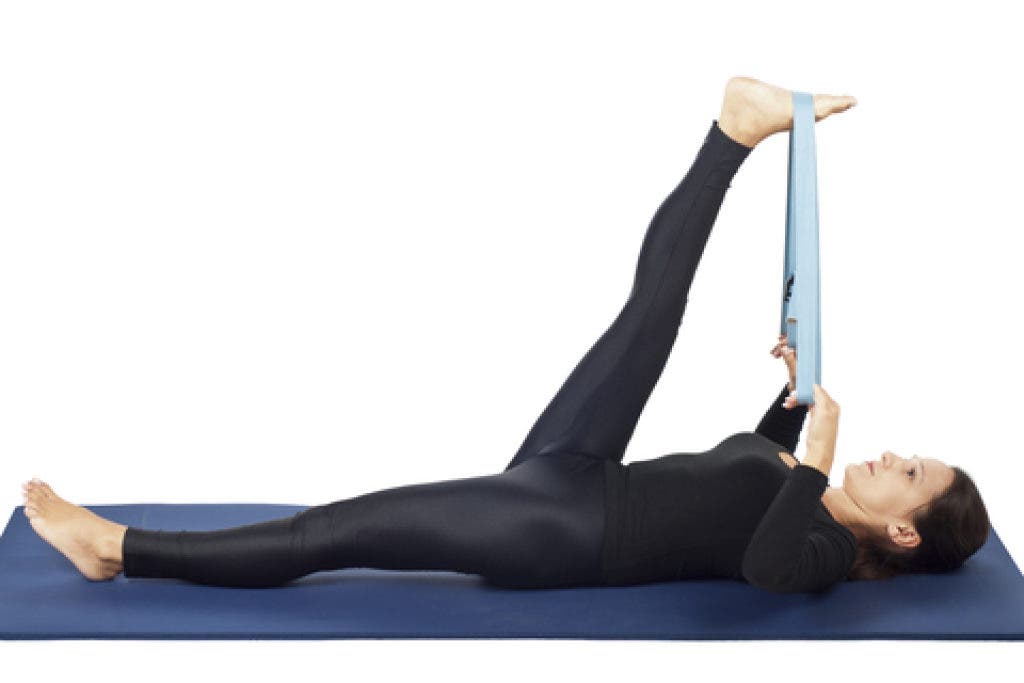
- The strap is only an assist. Do not use it as the primary pulling tool. Use your muscles and then assist with the strap.
- Even if you can't get your body to go where you want in the beginning, see it in your mind's eye. Your body will respond quicker if it has a picture of where you want to be in your mind.
- Enjoy it!
Let's use hamstrings and quads for example. Everyone needs to lengthen the back of the legs. A safe stretch for the hamstrings looks like this. Lay on your back with your body relaxed. Use a strap around the ball of your foot and hold one end in each hand. (I have used leather belts, towels, ropes and yoga straps. They all work, but the yoga strap is most comfortable.)
Relax your whole body. Keep your shoulders down on the floor. The leg that you are not stretching should be straight out on the floor with the toes pointed straight up. Roll the thigh in slightly to "lock down the pelvis". This is a firm relaxed hold, not an over-clenching. The leg you are stretching should be also straight with the toes up. Use the muscles on the front of the leg and thigh to pull the toes back. Now gently use the strap to "assist the stretch." Do not over-pull.
It is ok to feel where the tightness is in the tissue, but if it hurts and it feels like you are fighting it you are using too much force.
Now for some people this is enough of a stretch. Let your mind and body relax. Breathe slowly and deeply. When you feel a release you can go a little further. When your body allows, begin to use your quad muscles to pull your leg up in a straight line. Keep your legs straight but your knees soft; do not lock them. The minute you need to bend your knee to raise your leg further you have gone too far.
If your knee needs to bend, that is compensation and that means your leg is really too tight to go any further. It is not about how far your leg can go straight over your head; it is about how well you maintain your alignment. (Now there are different stretches that do allow for a bent knee to get into different muscle segments, but for your first stretch just work with a straight leg.)
We have a saying in Yoga. "Work your edges" Relax and take your body to its edge. The edge has sensation, but not real pain. When your tissue releases, it feels good. Don't worry if you think it won't let go. It may take a few sessions to get your body to respond, depending on your age, level of physical activity and toxicity. Just keep doing it and it will improve. Don't pull harder in your frustration. A body forced against its will....
For Beginners, (or anyone) I suggest a good soak in a hot bath or tub before stretching and use a cold pack on any areas that felt really congested when you are done stretching or on any cranky joints. The heat beforehand helps to release the fascial binding and makes it easier. The cold packs after help relieve any inflammation that may occur as you open up areas that have been shut down for a long time.
Enjoy it, Stretching feels good and will make you move with ease and feel younger. And it’s FREE!
**P.S. You may feel tenderness and sensation around your joints while you stretch. The muscles you are stretching are attached to the joints, but pain in the joint is a sign that you are pulling the tendons and not the muscles. Don't put yourself in pain! This happens when muscles are so tight, stagnant and fascial bound that they are not letting go before the tendons feel strain. DONT force it! Go get some bodywork (Myofascial Release, Neuromuscular Therapy) to get the fibers released. This will make stretching easier and safer for your tendons and joints.
Jacqueline M Linder RDMS LMT
727-797-0874