Crime & Safety
Families Of Missing Tampa Bay Women Wonder Why Their Cases Receive Less Attention
While the Gabby Petito case claims the national media spotlight, families of other missing women in the Tampa Bay area seek answers.


Correction: Suzanne Failla last spoke to her daughter on Aug. 7 and reported her missing to the Pasco County Sheriff's Office the next day, on Aug. 8. A statement by sheriff's public information manager Amanda Hunter gave a different date.
PORT RICHEY, FL — It wasn't the outcome Suzanne Failla prayed for when her 27-year-old daughter, Angelina Marie Failla, disappeared.
While the Gabby Petito case claims the national media spotlight, families of other missing women in the Tampa Bay area seek answers with little news coverage and smaller search efforts by authorities.
Find out what's happening in Tampafor free with the latest updates from Patch.
Angelina Failla of Port Richey, the mother of a 2-year-old daughter and a 5-year-old son, last spoke to her mother on Aug. 7 and disappeared the following day.
"Under very suspicious circumstances," Suzanne Failla said. "She supposedly walked off without her car, her shoes, her purse and her phone."
Find out what's happening in Tampafor free with the latest updates from Patch.
Angelina Failla's boyfriend told deputies that she simply walked out, but Suzanne Failla couldn't believe she would leave without telling her mother.
"It doesn't sound right ... This isn't like her," Suzanne Failla said. "We don’t lose contact, not even for a day."
Angelina was her only child. Suzanne Failla said she immediately began searching for her daughter. She posted flyers throughout Port Richey and surrounding communities, as well as on social media.
She also reported her daughter missing to the Pasco County Sheriff's Office.
"l begged for the major crimes unit of Pasco County since they have had her case to execute their search parties," Suzanne Failla said.
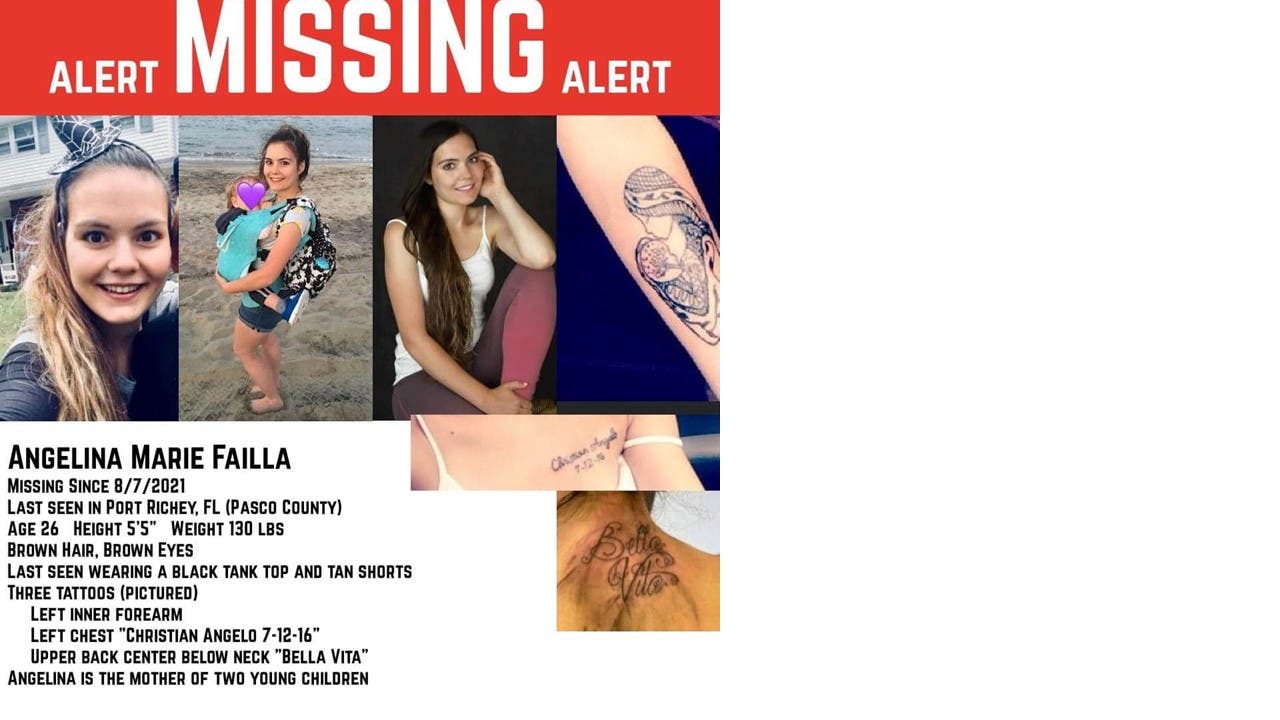
The sheriff's office said it did "a thorough and extensive search for Angelina."
"These efforts included K9 searches, business visits (hotels, gas stations, restaurants, churches, hospitals), checking with transportation companies (Pasco Transit, Uber, Lyft, Greyhound, local taxis, etc.), neighborhood searches and interviewing numerous people related to this case," said Amanda Hunter, public information manager for the sheriff's office.
"Additionally, Angelina's information was shared twice on our social media channels and was shared to local media outlets in early September. Efforts to locate Angelina encompassed several units of PSO. She was reported missing on Aug. 10 and these efforts continued until her remains were identified on Sept. 30," Hunter said.
Pasco Sheriff’s detectives continue to search for Angelina Failla, a missing 27 year old. She was last seen in the Port Richey area on Aug. 7, 2021, but is believed to be in the greater Tampa Bay Area. Failla is 5’5”, approx. 130 lbs, with brown hair and brown eyes. pic.twitter.com/ZGfZ6uhnAG
— Pasco Sheriff (@PascoSheriff) September 2, 2021
Suzanne Failla said family, friends and even some strangers came forward to help her search on land and from the water in kayaks for her daughter.
"Unfortunately, we were completely ineffective," Failla said.
In a last-ditch effort, Suzanne Failla launched a petition drive through the website Change.org. She hoped that if she could get enough signatures, it would force the sheriff's office to take notice.
Meanwhile, Port Richey residents posted comments on Facebook wondering why the disappearance of a young mother wasn't receiving the same concern and attention that was being given to the Gabby Petito case.
Petito, 22, disappeared Sept. 11 while on a cross-country trip with her boyfriend, Brian Laundrie. Her disappearance sparked a nationwide manhunt and received worldwide publicity. She was found dead in Wyoming eight days after her disappearance.
Missing Cases Not In The Spotlight
During that same eight-day period that the search was underway for Petito, Suzanne Failla said the search for her daughter barely received the attention of the local media.
It wasn't a nationwide manhunt that led to the discovery of Angelina Failla's body on Sept. 26, Suzanne Failla's birthday. It was the odor of decaying flesh.
Neighbors living in the Jasmine Estates neighborhood contacted the sheriff's office to complain of a foul smell. Starting around 8 p.m. Saturday, Sept. 25, and continuing well into the early-morning hours of Sunday, forensic investigators and cadaver dogs combed the area searching for the source of the odor.
They eventually found a "heavily decomposed body" in the back yard of a home off Richwood Lane in Jasmine Estates. While the sheriff's office confirmed the body appeared to be that of a female, it was too badly decomposed to identify.
The remains were turned over to the Pasco-Pinellas County Medical Examiner's Office, which confirmed it was Angelina Failla's body.
It can take up to two weeks for the medical examiner's office to complete an autopsy and reach a conclusion on the cause of death. However, the sheriff's office said it doesn't appear as if Angelina Failla was the victim of a homicide.
"The investigation into the death is ongoing, but preliminary information suggests that there is no evidence of foul play," said the sheriff's office.
Other Families Await Closure
Other Tampa Bay families of missing women say they'd give anything for that kind of closure — to simply know whether their loved one is alive or dead.
Among them is Natosha Watkins who reached out to Patch when her younger sister, 28-year-old Cieha Taylor, disappeared Feb. 6, 2020.
Although Cieha Taylor previously lived with her mother, Canitha Taylor, in Dade City, she had recently moved in with her boyfriend. His home at 1140 Cowart Road in Plant City was just a few blocks from the call center where she worked.
Around 4 p.m. on the day she went missing, Cieha Taylor dropped her boyfriend off at his home. That was the last time anyone saw her.
A few hours later, around 7 p.m., Cieha Taylor's black 2000 Toyota Solaris was found abandoned about a mile away on railroad tracks on East Trapnell Road, just west of Jap Tucker Road. The engine was still running and her belongings, including her cell phone and debit card, were in the car.
Natosha Watkins said her sister never went anywhere without her phone.
The Hillsborough County Sheriff's Office questioned Cieha Taylor's boyfriend and found nothing suspicious.
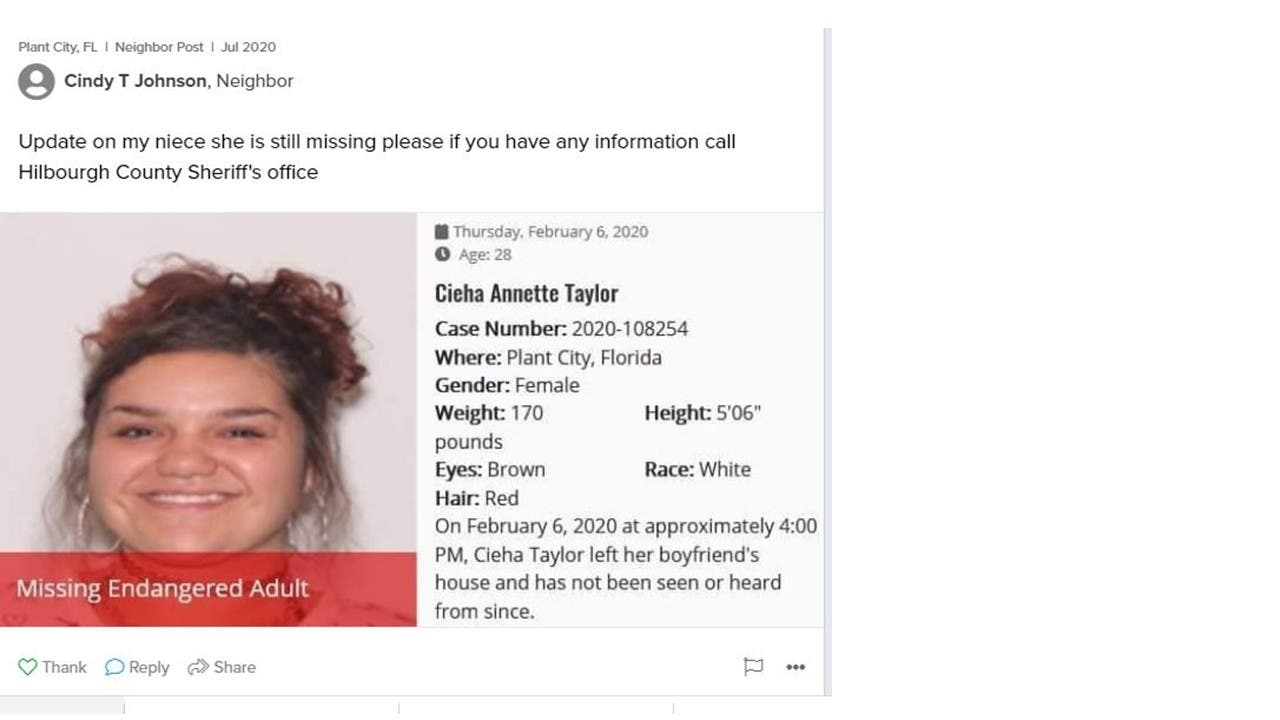
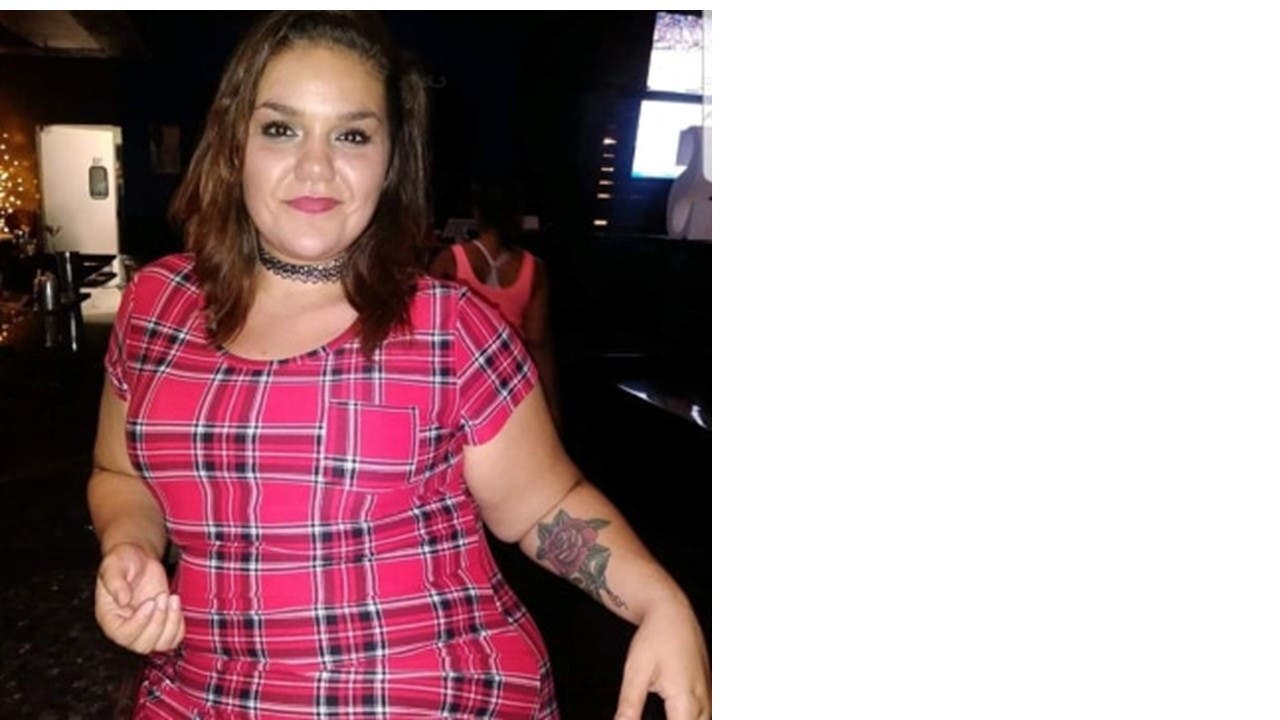
Cieha Taylor has been missing since Feb. 6, 2020.
Cieha Taylor's sister-in-law, Porshia Taylor, flew to Florida from Iowa and, for weeks, family members searched the area around the railroad tracks including the woods.
About three weeks later, Cieha Taylor's shoes were discovered sitting on a drainage pipe on East Trapnell Road near the railroad tracks where her car was found. Hanging on a post near the shoes was one of the flyers the family had posted notifying the community that Cieha Taylor was missing.
The family is convinced the shoes were placed there by someone after they searched the area. Otherwise, they would have seen them.
Watkins said it's been difficult to listen to the daily bombardment of media updates on the Petito case when her sister's case received so little media attention.
"It has me very emotional," Watkins said.
In the meantime, Cieha Taylor's case grows cold. "There isn't much positive information regarding my sister," she said.
Taylor, Wahl Missing Cases Have Few Leads
Sheridan Wahl, a 21-year-old University of South Florida student, also went missing while the world was focused on the search for Gabby Petito.
Wahl drove from Tampa to Myrtle Beach, South Carolina, to visit her father, who lives in Myrtle Beach. However, her father said she never arrived at his house.
Her mother, Kelly DeArment Wahl of Tampa, said she spoke to her daughter around 1 p.m. Sunday, Sept. 19, using FaceTime. Her daughter was trying to rent a scooter on South Ocean Boulevard in Myrtle Beach but told her mother the scooter rental company wouldn't rent to her because she wasn't wearing shoes.
She told her mother she wanted to drive the nine hours back to Tampa, but her mother suggested she spend the night at a hotel in Myrtle Beach and start fresh in the morning.
That was the last time Kelly DeArment Wahl heard from her daughter. All attempts to contact her went to voicemail.
A day later, South Carolina authorities discovered Wahl's burgundy Toyota. It had been set on fire.
Two days later, on Sept. 21, Wahl's body was found behind a training tower at the Hannah-Salem-Friendfield Fire Department in Pamplico, South Carolina, about 10 miles from where her car was discovered.
Initial autopsy results were inconclusive and the family is still awaiting word on the cause of her death.
How Law Enforcement Investigates Missing Person Cases
Hunter said the Pasco County Sheriff's Office "treats all missing persons cases with the same urgency, regardless of race, gender or age."
"While we can't comment on non-PSO cases, we can assure our citizens that all cases receive the same level of care and concern once they're reported," Hunter said.
Other than the ability for some families to attract more media attention on behalf of their loved ones than others, Hunter said she can't explain why the Gabby Petito case has received so much publicity.
"From a PIO perspective, we put out all missing persons cases for those who are endangered (due to age, medical concerns, threats to harm themselves, etc.) the same way every time," she said. "The PSO has a standardized protocol used for missing persons cases to ensure that information is shared accurately each time. We cannot compel media entities to cover cases, and I don't know why some cases garner more attention than others."
The Hillsborough County Sheriff's Office also has a standard protocol it uses to investigate and get the word out about missing people.
During an interview regarding Cieha Taylor's disappearance, Hillsborough County Sheriff Chad Chronister commented that "time is critical when it comes to finding a missing person."
The likelihood of a person being found is greatest in the first 48 hours when clues and the memories of witnesses are still fresh. After that, the chances of a person being found alive or dead greatly diminish.
However, he said there's always a chance that someone will come forward months, even years, later to report a sighting of a missing person or with a clue that could reactivate the case.
To increase the likelihood of that occurring, Chronister's office maintains a missing person website with photos of those missing, dates last seen and descriptions of the person. The website currently contains photos and information on 89 people missing out of Hillsborough County from 1970 to this week, Cieha Taylor among them.
Among those listed on the website are:
- 23-year-old Nicole Guzman of Tampa who left her family's home on Sept. 27 around 11:30 p.m. and hasn't been seen or heard from since.
- 15-year-old Kalany Hillmon of Tampa who was added to the website Tuesday after she left her home and never returned.
- 28-year-old Anastacia Shilon of Tampa who was last seen by her sister on Sept. 30 at 3:30 p.m.
- 34-year-old Tiffany Frances Malott of Tampa who left her family's home after an argument on Aug. 9 around 11 p.m. and has not been seen since.
- 21-year-old Kelly Vazquez of Valrico who hasn't been seen since leaving her home on May 23.
- And 23-year-old Veronica Marllen Reyes Diaz of Dover. On Jan. 18, 2020, Diaz tucked two of her kids into bed and hasn't been seen since.
The Pinellas County Sheriff's Office maintains a similar website.
No Missing Person Forgotten
In 1982 the Florida Legislature appropriated funds for the Florida Department of Law Enforcement to establish the first missing persons clearinghouse in the nation.
Originally known as the Missing Children Information Clearinghouse, it was expanded by the Florida Legislature in 2008 to include endangered missing adults.
The Missing Endangered Persons Information Clearinghouse is based in the FDL's Enforcement and Investigative Support Bureau as part of the Investigations and Forensic Science Program.
It assists law enforcement and families in locating missing persons by providing analytical services, collecting and disseminating relevant information and engaging the public in the search for the missing person.
It also works with other state clearinghouses, the National Center for Missing and Exploited Children and Interpol, exchanging tips and leads about missing persons.
In 2005, MEPIC began collaborating with the Medical Examiners Commission on the Unidentified Deceased Initiative to help identify bodies and give families closure.
With the recent wide use of DNA testing for genealogical searches, the clearinghouse has hired an analyst who works exclusively on unidentified cases, collecting and analyzing DNA samples from remains found around the country.
"Due to enhancements in laboratories and databases, law enforcement and medical examiners are encouraged to resubmit fingerprints, dental records and DNA on older cases as the technology has evolved over the years, which in turn could generate positive identifications," according to Dinah Johnson of MEPIC.
MEPIC is also charged with sending out Amber alerts for missing children and Silver alerts for missing senior citizens, creating and distributing flayers, training law enforcement and putting together a directory of resources for the families of missing people.
Currently, MEPIC has 726 missing people listed in its clearinghouse.
Family Still Seeks Baby Taken 25 Years Ago
Among them is the subject of another case that garnered national attention nearly 25 years go.
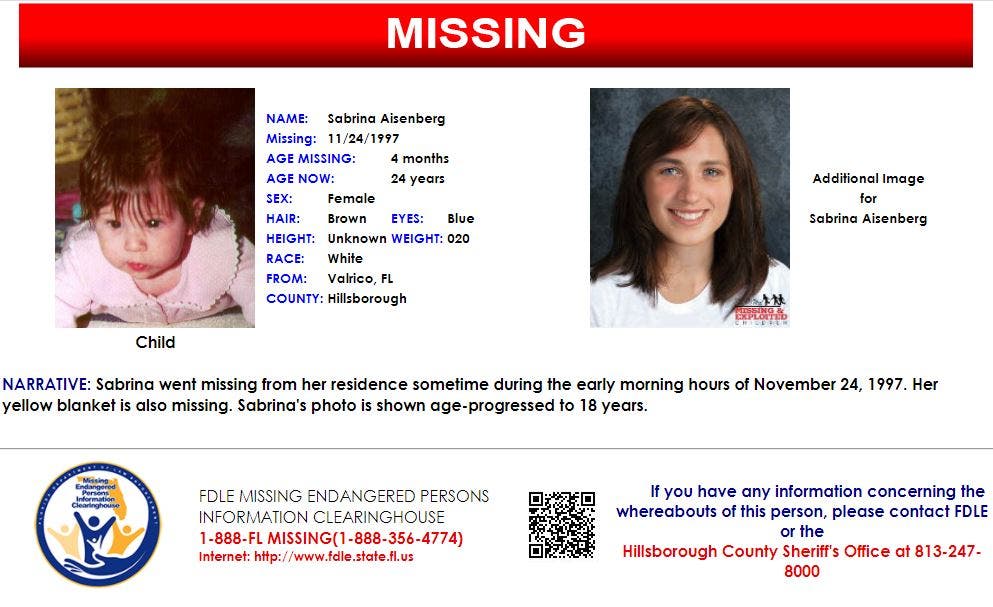
On Nov. 23, 1997, Marlene and Steve Aisenberg tucked their three children — William, 8, Monica, 4, and 5-month-old Sabrina — into bed for the night at their home in quiet subdivision of Bloomingdale in Valrico.
The next morning, after getting William out of bed, Marlene Aisenberg said she noticed her garage door and the door from the house to the garage both open. She ran to Sabrina’s room to find the baby missing.
A massive search ensued. Police divers explored lakes and retention ponds in the area. Police K9s, after sniffing the scent left on the baby's clothes, searched the conservation areas surrounding Bloomingdale.
The FBI followed leads on the suspected sale of babies around the world while the Aisenbergs appeared on national television to appeal to whoever took their baby to return her.
The Aisenbergs themselves ultimately fell under suspicion and were subjected to relentless questioning. Investigators even bugged their home for three months.
Now living in Bethesda, Maryland, the Aisenbergs believe baby Sabrina is still alive. They maintain a bedroom for the day she returns home. But there have been no new leads on her whereabouts.
The MEPIC website features a photo of what baby Sabrina might look like at the age of 18. She would be 24 years old now.
![]()
MEPIC One Mother's Determination Changes Laws
Between 4 and 5 p.m. on the day Sessions disappeared, she told her roommate she was going out for a power walk. Wearing a Sony Walkman, she left her apartment with her wallet, identification and keys.
When she hadn't returned after five hours, Sessions' roommate alerted Sessions' mother, Hilary, in Valrico.
After the Alachua County Sheriff's Office initially failed to launch a search for Tiffany Sessions, maintaining there was no evidence of a crime, the grieving mother became a driving force behind the adoption of new missing person protocols by Florida law enforcement agencies.
The publicity she generated on her daughter's behalf, including national television and newspaper interviews, a $25,000 reward and the distribution of more than five million flyers around the country, resulted in the largest FBI search in Florida history. Law enforcement followed up on more than 3,000 leads in the case.
On Florida Missing Persons Day Oct. 27, 2008, then-Gov. Charlie Crist signed the Jennifer Kesse and Tiffany Sessions Missing Persons Act that expanded the Florida Department of Law Enforcement Missing Children Information Clearinghouse into the Missing Endangered Persons Information Clearinghouse.
The law also requires law enforcement agencies to enter a missing person into the FBI’s National Crime Information Center (NCIC) within two hours after a person is determined to be missing.
Additionally, if a person has been missing for more than 90 days, the act requires Florida law enforcement agencies to collect DNA samples from the belongings of the missing person or biological relatives.
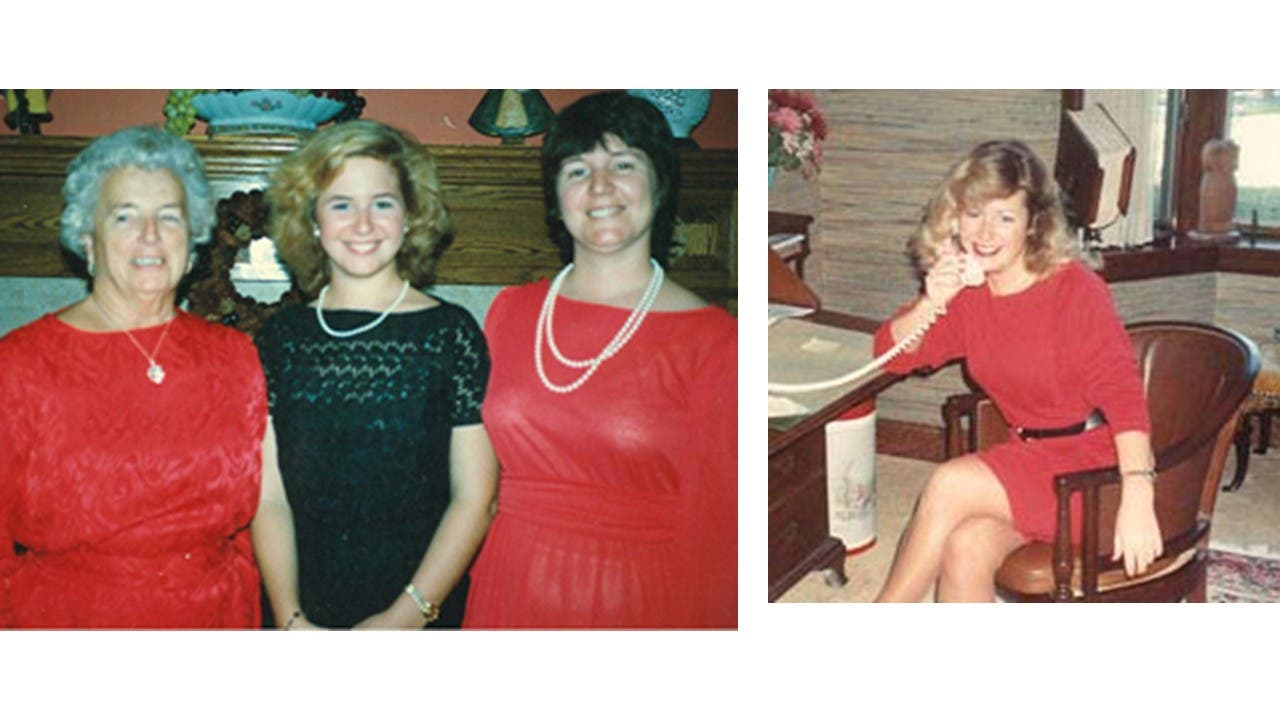
Left, Hiliary Sessions poses with her daughter and mother. Right, Tiffany Sessions was a bright, vivacious college student majoring in business when she disappeared.
In 2014, the Alachua County Sheriff's Office identified deceased serial killer Paul Eugene Rowles, as the primary suspect in Tiffany Sessions' disappearance.
Rowles, who died in prison in 2013 after being convicted of murder, rape and kidnapping, lived in the Gainesville area at the time Sessions disappeared.
Danny Rolling, known as the Gainesville Ripper, was also considered a suspect. Rolling was convicted in the murders of five Gainesville students in August 1990, the year before Tiffany Sessions disappeared. He was executed by lethal injection Oct. 25, 2006.
However, there was never conclusive evidence in either case and Tiffany Sessions' body was never found.
Hilary Sessions went on to help form the Surviving Parents Coalition with other grieving parents around the country including John Walsh, whose 7-year-old son, Adam, was abducted from a Sears department store at the Hollywood Mall in Florida on July 27, 1981. His severed head was found two weeks later in a drainage canal alongside State Road 60 at Yeehaw Junction in Indian River County, Florida.
Another coalition member who's become a national advocate for missing children is Mark Lunsford. His 9-year-old daughter, Jessica, was abducted from their home in Homosassa, Florida, Feb. 24, 2005, by convicted sex offender John Couey. Couey held her captive over the weekend, repeatedly raping her and then burying her alive.
Today, Sessions is active with radKids, a safety education program to help children defend themselves against abductions.
"Every day I make it my mission to do something for Tiff's case specifically, to help another family with a call, assistance, a contact or encouragement or take part in an educational speaking engagement, a fingerprinting event or promoting the radKIDS Program," Hilary Sessions said.
She still occupies the same house Valrico where she lived when her only child when Tiffany Sessions disappeared 32 years ago.
"Because Tiff would only know to come back to my house; I have not moved since before she disappeared," Hilary Sessions said. "I do not plan on moving until the case is solved and I know what happened to her. I choose to live with the hope of a live return because I cannot imagine the other."
See related stories:
Get more local news delivered straight to your inbox. Sign up for free Patch newsletters and alerts.