Community Corner
It Began With A Bear; Now 36,445 Acres Are Preserved In Florida
"Live Wildly" is the first campaign of the Live Wildly Foundation, a nonprofit backed by Tampa philanthropist Arnie Bellini.


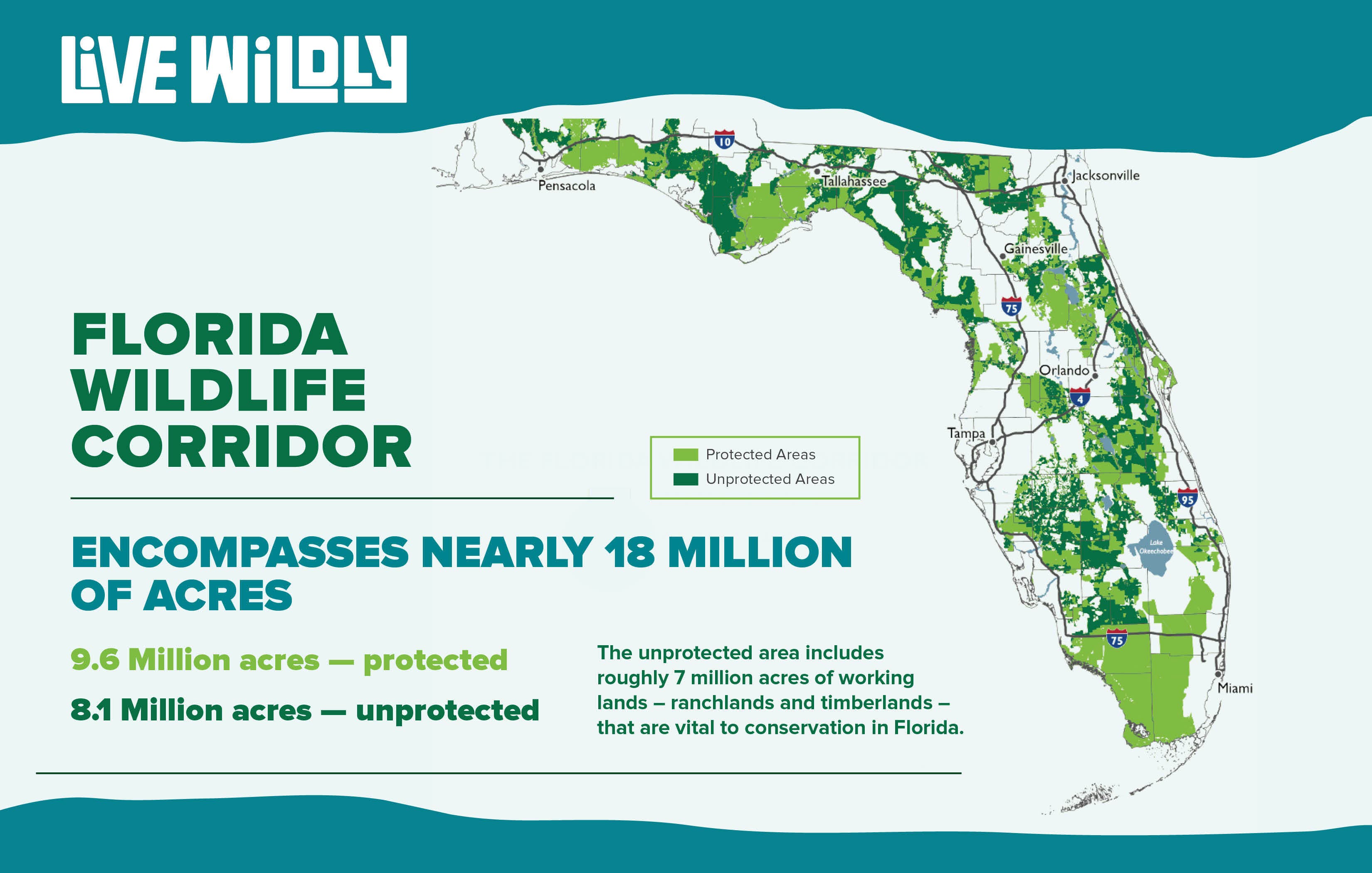
TAMPA, FL — Coinciding with the one-year anniversary of the Florida Wildlife Corridor Act, the nonprofit group Live Wildly has launched a statewide education and awareness campaign to illustrate how the 18 million-acre corridor touches everyday lives of Floridians.
Live Wildly is the first campaign of the newly established Live Wildly Foundation, a nonprofit organization backed by Tampa businessman and philanthropic leader Arnie Bellini.
The foundation is working with dozens of conservation impact partners across the Sunshine State including Conservation Florida, the Florida Wildlife Corridor Foundation, Path of the Panther, Archbold Biological Station, Florida Wildlife Federation and Florida Trails Association to support on-the-ground efforts to protect the corridor.
Find out what's happening in Tampafor free with the latest updates from Patch.
The Florida Wildlife Corridor comprises nearly 18 million acres of contiguous wilderness and working lands crucial to the survival of many of Florida’s 131 imperiled animals, including the Florida panther, Gopher tortoise, manatee, burrowing owl, red-cockaded woodpecker, swallow-tailed kite and black bear.
See related stories:
Find out what's happening in Tampafor free with the latest updates from Patch.
Additionally, there are 1,346 named rivers and streams crossing the corridor that include 1,683 miles of designated paddling trails.
There are also 6,273 miles of trails within the corridor; including 1,085 miles of the Florida National Scenic Trail.
The Everglades headwaters and other crucial areas which feed springs and reservoirs responsible for protecting much of Florida’s drinking water can be found within the corridor as well as 171 first and second magnitude springs and portions of 23 of Florida’s 30 Outstanding Springs springsheds.
Live Wildly intends to jumpstart a movement to secure the remaining eight million acres that remain unprotected.
"With more than 1,000 people moving to Florida every day, preserving these unprotected areas and positioning nature as a green infrastructure solution for the state is even more urgent," said Bellini. "Yet, few Floridians are aware of the corridor, its impact or the urgency to connect it — and that's where Live Wildly comes in. When we connect citizens to the corridor through the things they care about most, we capture their hearts and mobilize action."
"We are thrilled to link arms with Live Wildly to promote a groundswell of support for the protection of our wildlife corridor," said Traci Deen, president and CEO of Conservation Florida.
"The important work happening by conservation partners statewide coupled with citizen action is just what we need to protect our wildlife, water, wild places and a $9 billion ecotourism industry."
Throughout the United States and around the globe, wildlife corridors are gaining attention as a solution for knitting together critical habitats, helping to prevent species extinction and creating new economies for local communities.
Deen said the Florida Wildlife Corridor stands to be a model for public-private partnership, citizen advocacy and grassroots support that other corridor initiatives could learn from and replicate.
It Began With A Bear
In 2009, a young black bear with the identification tag M34 traveled 500 miles over eight weeks through Florida in pursuit of a mate.
Through its journey, the bear revealed the existence of a statewide corridor that wildlife needs to survive. The discovery also highlighted the precarious nature of the connections between the land parcels that make up this corridor. M34’s journey proved a wildlife corridor existed that needed to be protected.
After decades of work by conservationists, scientists, politicians and concerned residents, the Florida Wildlife Corridor Act was approved on June 29, 2021 with unanimous bipartisan support from the Florida Legislature and signed into law by Gov. Ron DeSantis on July 19.
In the year since, the act has resulted in the protection of at least 36,445 acres of land.
At a meeting of the governor's cabinet in September 2021, seven parcels containing 19,739 acres of land were approved for acquisition.
Then, on March 30, the cabinet approved a proposal to invest $32 million in public funds to acquire seven parcels encompassing 16,706 acres. The seven parcels of land include ancient scrub, archeological and prehistoric sites and the property that will help protect endangered and at-risk species like the Florida panther and the swallow-tailed kite.
“The Florida Wildlife Corridor Foundation and our partners applaud Gov. Ron DeSantis and the board of trustees for their leadership in safeguarding Florida’s wild legacy for future generations. This $32 million public investment is a huge step toward preserving key linkages throughout the Florida Wildlife Corridor,” said Jason Lauritsen, chief conservation officer of the Florida Wildlife Corridor Foundation.
Funding for the purchase of the 36,445 acres of land came from the Florida Department of Environmental Protection’s Florida Forever Program, the Florida Department of Agriculture and Consumer Service’s Florida Forest Service Rural and Family Lands Protection Program, The Nature Conservancy, Trust for Public Land, Florida Conservation Group, National Wildlife Refuge Association, Tall Timbers, private real estate agents, the federal Forest Legacy Program administered by the U.S. Forest Service through the Florida Forest Service and the Department of Defense.
In addition to protecting wildlife, conserving wild spaces is crucial to mitigating climate change, Lauritsen said, noting that studies show natural spaces play a significant role in reducing greenhouse gases and guarding against the impacts of increased temperatures.
The corridor also protects ranching and fishing, supporting large sectors of Florida’s economy, he said.
Florida is one of nine states that have passed wildlife corridor-related legislation. Of those nine, Florida is the fastest-growing and second-most populous.
“This anniversary provides an opportunity to reflect on the progress to date and envision how best to continue protecting the corridor and the wildlife which inhabit it,” said Mallory Dimmitt, CEO of the Florida Wildlife Corridor Foundation. “We need to continue taking thoughtful steps to ensure the corridor’s protection. From the natural resources that millions of Floridians rely on to a variety of industries crucial to our state’s economy, preserving Florida’s wildlife and wild spaces has many ripple effects.”
Among the 14 land parcels conserved since the Florida Wildlife Corridor Act was approved are:
- The Red Hills Conservation Area protects biodiversity and endangered animals through conservation of pine savannah, rolling hills and miles of shoreline on Lake Miccosukee. This 4,132-acre easement was approved for protection in March was the first acquisition in this critical area. Its protection was assured through the efforts of Tall Timbers, the landowners, and the Florida Department of Environmental Protection.
- Corrigan Ranch, part of the Corrigan Ranch Florida Forever Project, provides resource-based public recreation opportunities, such as assisting with the completion of the Florida National Scenic Trail and expanding the acreage of the Kissimmee Prairie Preserve State Park, which is the state’s first Dark Sky Park (recognized by the International Dark Sky Association). This 4,381-acre acquisition was approved in September 2021 and was funded in part by the U.S. Air Force to buffer the nearby Avon Park Air Force Range.
- The Wakulla Springs Protection Zone protects Florida’s water supply by conserving land above the conduits that feed the caverns and springs, connecting one of the largest and deepest artesian springs in the world to Apalachicola National Forest. This 313-acre acquisition was approved in March. Significant funding for the project was secured by the Florida Forest Service through the Forest Legacy Program.
- The Coastal Headwaters Longleaf project serves the dual purposes of protecting forest habitat for flora and fauna and acting as a buffer to Naval Air Station Whiting Field, protecting the installation from encroachments that might be incompatible with the military mission. This 2,115-acre land acquisition was approved in September 2021 with the support of the Forest Legacy Program, The Conservation Fund and the National Fish and Wildlife Foundation/Walmart’s Acres for America Program.
To get involved, click here.
Get more local news delivered straight to your inbox. Sign up for free Patch newsletters and alerts.