Schools
Student's Artwork Will Be Displayed in Paris
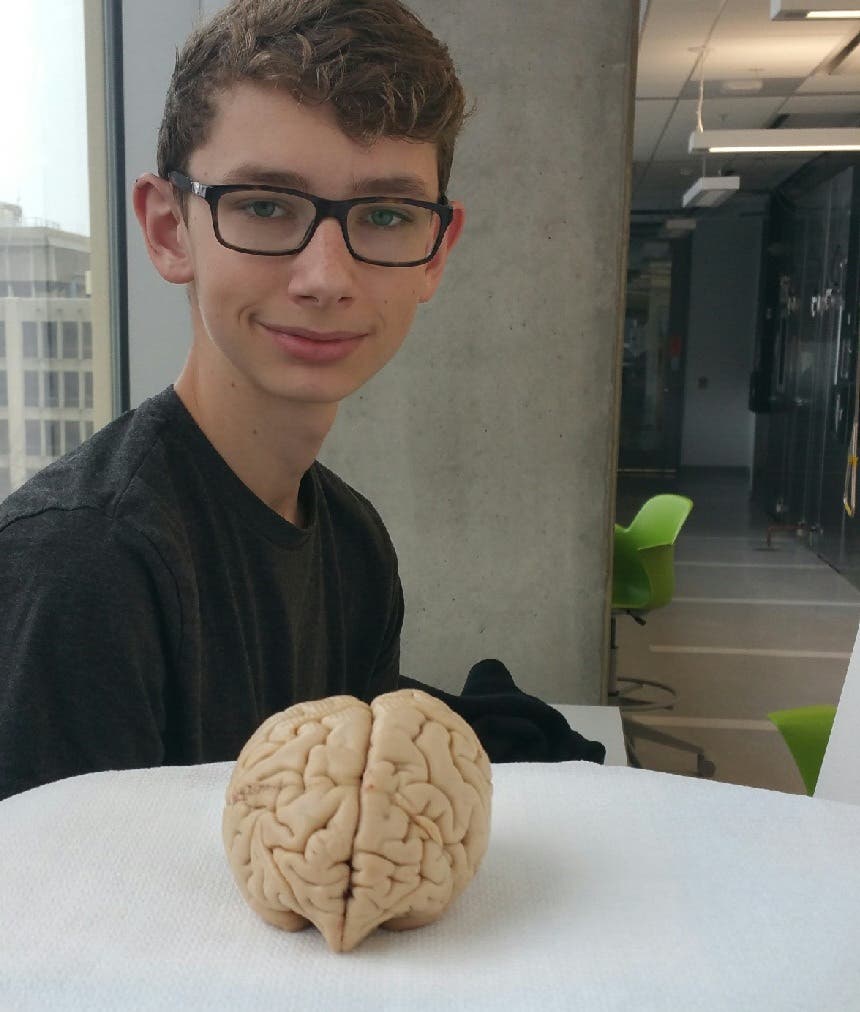
A 3D printed model of a brain created by Creekview High School student Joshua T. McFarlin will be featured in an exhibit later this year.




------
Submitted by Linda McFarlin
Find out what's happening in Canton-Sixesfor free with the latest updates from Patch.
Joshua T. McFarlin, a 16-year old sophomore at Creekview High School, performed a one-week mini-internship at The George Washington University’s Laboratory for Evolutionary Neuroscience in Washington, D.C. during his spring break, March 30 - April 3.
McFarlin used photogrammetry — the process of taking a high number of photos from all sides of an object, then using computer software to combine them into a single three dimensional computer image — to create 3D printed models of an orangutan brain specimen from the department’s collection.
Find out what's happening in Canton-Sixesfor free with the latest updates from Patch.
Dr. Chet Sherwood, professor of anthropology at George Washington University, informed McFarlin his 3D printed model of the brain is being sent to their collaborator in the Musée de l’Homme (“Museum of Man”) in Paris, France. It will be included in their upcoming exhibit on human evolution, which will open in October 2015, when the museum reopens to the public following an extensive, six year renovation.
McFarlin was invited to conduct the weeklong project based on his skillset in computer programming and hardware design.
“The project that you will undertake will involve the piloting and testing of a pipeline to produce digital 3D models of brains from a diversity of animals based on photogrammetry,” wrote Sherwood in a letter outlining the goals of the project.
During his week of research, McFarlin took 59 digital photographs from various angles of the top, bottom, and sides of the Orangutan II brain specimen. He then loaded the images into a software program to complete a 3D rendering process, which resulted in a highly detailed, accurately colored and shadowed 3D model on the computer screen. McFarlin then used a MakerBot Replicator to 3D print physical casts of the brain in two different resolutions and two different colors to test the quality of the finished product for research purposes. It is McFarlin’s second, higher resolution brain model that will appear in the Musée de l’Homme exhibit. The life size cast took 32 1/2 hours to produce on the 3D printer.
“Thanks for all your excellent work in the lab,” Sherwood wrote McFarlin. “And thanks for sending the report and protocol from your mini-internship,” he wrote of McFarlin’s 17-page research document written as the high schooler resumed his regular class load following spring break. “The training document that you provided will be used by graduate students and postdocs in the lab as they carry out their research.”
“It was an amazing experience to work in GW’s Anthropology Department,” said McFarlin. “My favorite part of the project was conducting the actual research and printing out the 3D models. The intimidating part was writing the longest paper I had ever written in my life, knowing it wasn’t for school or a grade, but to document my work so adult researchers could use it in their own work. There were one or two times I wished we had gone to the beach for spring break! But in the end, hearing the brain model will be displayed in a museum made this one of the most interesting and important experiences of my life.”
According to Sherwood, The GW Department of Anthropology has over 600 brains from a diversity of animals, one of the largest collections of mammal brains in the world.
Researchers use the specimens to characterize and analyze variation in brain structure, comparing the brains of humans to diverse species including chimpanzees, gorillas, whales, elephants, tigers, and many others. Researchers reconstruct the evolutionary history of brain structure across mammals, and identify possible neural specializations underlying behavioral adaptations of species, including humans.
“The ability to create 3D computer models of brains that can also be used in digital morphometric research and to create physical casts will provide researchers with a means to document, use and share the valuable specimens that are later permanently altered when samples are removed for microscopic research,” Sherwood added.
Researchers at the university had previously attempted to cast 3D replicas of intact brains with dental molds, but found the process damaged the specimen, making the method undesirable. The use of photogrammetry will allow researchers to share the digital models of brains with others and enable physical casts to be 3D printed locally and around the world for research and educational purposes.
GW’s Department of Anthropology also plans to use future 3D printed models of brains from a variety of animals for the laboratory’s ongoing educational outreach activities at the Smithsonian Institution’s National Museum of Natural History and elsewhere.
McFarlin and his family will be visiting France this summer. Although their trip will occur before the museum and exhibit officially open, the Musée de l’Homme will still be on their list of key sites to see in Paris.
-----
Photo credits: Linda McFarlin
Get more local news delivered straight to your inbox. Sign up for free Patch newsletters and alerts.