Community Corner
150 Years: Civil War Battles Fought Right Here in Southwest Atlanta
As the country remembers the 150th anniversary of the start of the Civil War, southwest residents are mindful of several important battles fought in and around Cascade during the Battle of Atlanta.
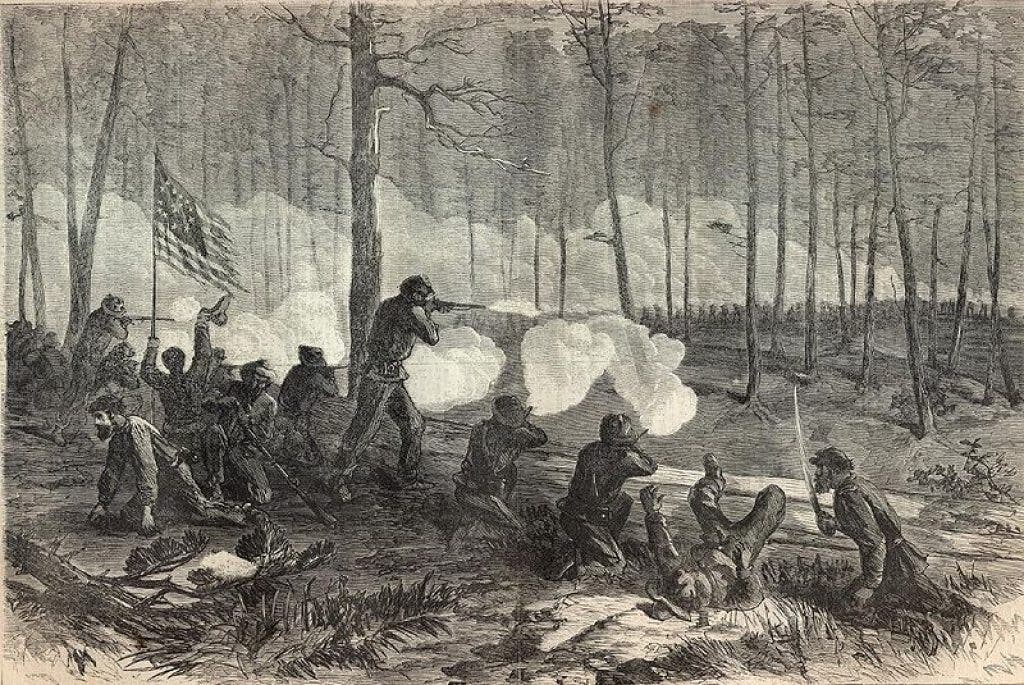
If someone told me ten years ago that I had a Civil War ancestor, I would have laughed.
Loudly.
But here I am today, an African-American woman, looking at the name of my great-great-great grandfather, Berry De Loach, on his Civil War pension record.
Find out what's happening in Cascadefor free with the latest updates from Patch.
His tombstone stands tall and the words inscribed read " Berry Loach Co.H., 57 U.S.C.I." He was enlisted in Company H, 57th Infantry Regiment, Arkansas, U.S. Colored Troops.
Fighting as a black Union soldier in a southern state during the Civil War.
Find out what's happening in Cascadefor free with the latest updates from Patch.
As a recent transplant to Atlanta, a city rich with Civil War heritage, I now find myself drawn to each and every giant metal marker that springs from the side of a street or crook in a neighborhood. On more than one occassion I've heard the groans of my husband and children as I insist that we pull over and read an obscure posting that I had previously passed without interest.
Residing in southwest Atlanta, I also realize that pre and post Civil War history exists here in my own neighborhood, literally in my backyard. Soldiers fighting for both sides marched through the communities we know as Ben Hill, Sandtown, Cascade, Adams Park, East Point, Camp Creek and Campbellton.
During this Sesquicentennial commemoration it is important to remember and acknowledge that southwest Atlanta is rich with battle grounds and interesting individuals who contributed to America's bloodiest conflict.
Legacy of the Civil War in Southwest Atlanta
- Historical Marker - The Battle of Ezra Chruch - July 28, 1864, 1565 MLK Jr. Blvd. Mozley Park
Principal commanders in this battle were Maj. Gen. Olovier O. Howard of the Army for the Union and Gen. John B. Hood for the Confederates. Casualties were 3,562 total (US 562; CS 3,000).
The description from the U.S. National Park Service reads: "Earlier, Maj. Gen. William T. Sherman’s forces had approached Atlanta from the east and north. Hood had not defeated them, but he had kept them away from the city. Sherman now decided to attack from the west. He ordered the Army of the Tennessee, commanded by Maj. Gen. O.O. Howard, to move from the left wing to the right and cut Hood’s last railroad supply line between East Point and Atlanta.
Hood foresaw such a maneuver and determined to send the two corps of Lt. Gen. Stephen D. Lee and Lt. Gen. Alexander P. Stewart to intercept and destroy the Union force. Thus, on the afternoon of July 28, the Rebels assaulted Howard at Ezra Church. Howard had anticipated such a thrust, entrenched one of his corps in the Confederates’ path, and repulsed the determined attack, inflicting numerous casualties. Howard, however, failed to cut the railroad."
The result was an extreme Union victory. Of note is the fact that Ernest R. Torgler, a 16-year old Union Sergeant received the Congressional Medal of Honor for saving the life of his commanding officer during this battle.
- Historical Marker - The Battle of Utoy Creek -August 5 thru 7, 1864, Intersection of Cascade Road and Woodland Terrace.
Principal commanders in this battle were Maj. Gen. John M. Schofield (Ohio), for the Union and Gen. John B. Hood for the Confederates.
The U.S. National Park Service says, "After failing to envelop Hood’s left flank at Ezra Church, Sherman still wanted to extend his right flank to hit the railroad between East Point and Atlanta. He transferred John M. Schofield’ s Army of the Ohio from his left to his right flank and sent him to the north bank of Utoy Creek.
Although Schofield’s troops were at Utoy Creek on August 2, they, along with the XIV Corps, Army of the Cumberland, did not cross until the 4th. Schofield’s force began its movement to exploit this situation on the morning of the 5th, which was initially successful. Schofield then had to regroup his forces, which took the rest of the day.The delay allowed the Rebels to strengthen their defenses with abatis, which slowed the Union attack when it restarted on the morning of the 6th.
The Federals were repulsed with heavy losses by Bate’s Division and failed in an attempt to break the railroad. On the 7th, the Union troops moved toward the Confederate main line and entrenched. Here they remained until late August."
The end result of the battle was inconclusive. According to the Utoy Cemetery Association, while many of the causalities were eventually moved to the National Cemetery in Marietta, GA, 35 soldiers still remain buried in the historic Utoy Church Cemetery.
- Historical Marker - Confederate Entrenchments - 1864, Adams Park Golf Course
The Georgia Historical Society lists this marker as follows: " This line of earthworks in Adams Park is one of the few remaining sections of the exterior portion of Atlanta's defenses designed as a barrier to Federal attempts to cut the two railroads that enter the city from the S.W. Built about Aug. 1, it joined the main line of city fortifications at W. Fair & Ashby Sts., from which it ran S.W. to East Point - later prolonged to Thames' Mill in Clayton County.
Manned by troops of Hardee's and S.D. Lee's corps, it with-stood all Federal attempts to seize it and was abandoned only when the Federals cut the railroads at Fairburn and Jonesboro."
- Historical Marker: Utoy Post Office on Old Sandtown Road - August 26 thru 27, 1864, Cascade Road at the 285 North on ramp
The Army of the Cumberland camped here before marching up Ben Hill to Red Oak until they reached Mt. Gilead Church. At the time, this area housed an important Post Office and stagecoach route that was used prior to and during the war.
- Historical Marker: Dry Pond- August 27, 1864, Intersection of Campbellton and Boat Rock Road
From the Georgia Historical Society: "An old Campbell County crossroad cited in James P. Snell´s Diary as "a one-horse settlement with no pond, but two or three houses and blacksmith shop´‘~~ a landmark in movement of Howard´s Army of Tennessee (US) from the Atlanta siege lines to the A. & W.P. railroad.
Aug. 27, 1864. From this crossroads, the 15th A. C. marched S. E. the 16th & 17th A.C. due South, their objective: Shadnor Church & Fairburn where, together with Army of the Cumberland & 23d A.C. troops, the R. R: was after which moved E. to Rough & Ready and Jonesboro to seize the Macon R. R. The 2 days of battle at Jonesboro caused the evacuation of Atlanta."
- and : August 1864
While not a historical marker, I found this mention of Sandtown and Owl Rock church interesting and a fitting end to this list of wartime monuments.
Owl Rock's cemetery, which sits just off of Campbellton Road near County Line Road, contains the graves of a "slave matriarch" as well as unknown slaves, and historic founders of the Sandtown and surrounding communities.
Census records beginning in 1870 show a large African American population in the area at that time, presumably freed slaves. How they might have played a role in this area's Civil War history remains a mystery worth exploring, however, insight into how other members of the community dealt with soldiers in their midst are available.
In the book "Sherman's Horsemen" by David Evans, some understanding is given to what it must have been like to have lived in the Cascade area as the seige took place. In August, 1864, Isarael Garrard, colonel of the 7th Ohio Cavalry was sent by General Sherman to rebuild the bridge at Utoy Creek. As Garrard leads his men, Evans gives this description of the journey, "They then followed the Sandtown Road eastward two and a half miles before turning south at Dry Pond. As they approached Owl Rock Church, Garrard saw telltale piles of horse dung, withered corn fronds and scores of smoldering campfires."
He continues, "An old man named McWilliams who lived near the church said three brigades of Frank Armstrong's cavalry had left there for Campbellton early on August 10, on a raid, but about 200 of them had returned that morning, heading toward East Point." Other citings of southwest residents and locations playing a crucial role in Sherman's defeat of Confederate Atlanta exist as well.
These various state markers and mentions in literature are gems that allow residents to see the importance of our neighborhoods in this war, that forever changed the moral and physical landscape of the United States.
The Georgia Historical Society provides a comprehensive list of all of Georgia's markers as well has an application for smart phones that allows you to map your route to visit the historic treasures of our neighborhood and city. New markers have been erected this year that show the contributions of women and African Americans to the Civil War in Georgia.