Business & Tech
Lawn Q and A with Tarver Turf's Willie Tarver
Cascade lawn care expert Willie Tarver, who's just launched his own company, offers advice about Atlanta lawns and common mistakes.
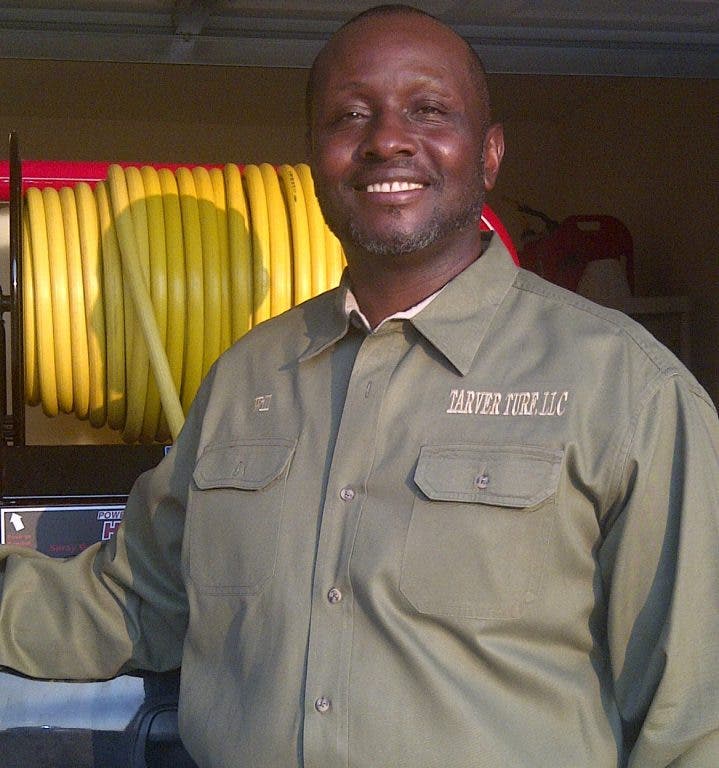
Cascade lawn care expert Willie Tarver, who's just launched his own company, offers advice about Atlanta lawns and common mistakes.
Tarver, a Southwest Atlanta native, is an alumni of Carver High School and Savannah State College as well as a U.S. Army veteran. He spent the first part of his career on the rails as a locomotive engineer. But when he switched to lawn care five years ago, he discovered what he calls his "passion." Now the second-generation entrepreneur is striking out on his own, offering residential and commercial lawn care at Tarver Turf.
P: What are some issues homeowners need to be thinking about with their lawns here?
Find out what's happening in Cascadefor free with the latest updates from Patch.
WT: One of the common issues is we’re not supposed to have fescue grass this far south. That’s a common issue. It’s not geographically meant to be this far south. Maybe northern Georgia, North Carolina, South Carolina. But not this far south. So that’s one issue.
Another issue is that most homeowners want to water their grass at night. If you water your grass at night you have a tendency to bring about lawn diseases.
Find out what's happening in Cascadefor free with the latest updates from Patch.
P: So what kind of grass do we need and when should we water?
WT: That sould be done in the morning time. You can start as early as about 5:30 a.m. until the sun comes up, that would be good. And the grass types would be Bermuda first and then zoysia. You can actually have centepede and St. Augstine, but they’re a little more tempremental than Bermuda and zoysia.
P: What advice do you have for other small business owners?
WT: You have to have a passion for what you’re going to get into as a business ... you need to be a student of your craft if you’re going into business. ... In lawn care, I’m the only one in lawn care that has to be certified [by the Georgia Department of Agriculture to apply pesticides]. So you have to have credentials in the business you're going in. That will put the customer at ease that you do know your craft or your trade.
P: What else do our readers need to know?
WT: Make sure when they're cutting their lawns it's not always good to leave the clippings on the lawn ... Once the clippings build up to about a fourth of an inch, it tends to get what we call thatch in the lawn and when you get thatch in the lawn, that keeps the lawn from breathing, that keeps sunlight from getting to the lawn, keeps air from getting to the lawn. So therefore you develop brown spots in the lawn. It would be better, let’s say, if you’re going to cut the grass twice a month, one time you bag the clippings and the next cut you let the clippings fall. Because the clippings are good for the lawn, it’s just that over a fourth of an inch, that’s bad. And the grass needs to grow, over the summer especially, at least two and a half inches.
The dew that’s falling in the morning is going to water the lawn so you don’t have to water your lawn every day or every other day. You can water about once a week ... for at least 25 minutes in each area. That'll be very helpful to your lawn because the lawn is actually like a human, it needs water. If it doesn’t get it, the lawn will go into a state of dehydration.
P: It sounds like a lot of work.
WT: Well, I enjoy what I’m doing, actually being out in the elements. It’s very rewarding to see a lawn going from nothingness to having wonderful curb appeal.