Business & Tech
Willie Watkins Provides Signature Funerals For People From All Walks of Life
Watkins is living his dream, providing home-going celebrations for the deceased




Willie Watkins’ grandmother didn’t know the 7-year-old was gone until he waived at her from a moving hearse.
It was part of their tradition to attend funerals on Sundays in Scottsdale. Young Watkins liked being in the mix, helping to take the flowers from the church and doing any odd jobs his boyish strength could handle. Then, finally, they said he could ride in the hearse.
The crowd thought he was bold; a boy who wasn’t afraid of the dead. Watkins had found his calling.
Find out what's happening in Cascadefor free with the latest updates from Patch.
His first-grade classmates laughed. His father balked. And as he got older, others in the business told him he would never make it. He didn’t have the blue blood – his family was not one of them, they said.
But Watkins had a vision.
Find out what's happening in Cascadefor free with the latest updates from Patch.
“I knew I had a calling. I just wanted to be different from everyone else,” Watkins said. “I wanted to create a home-going celebration.”
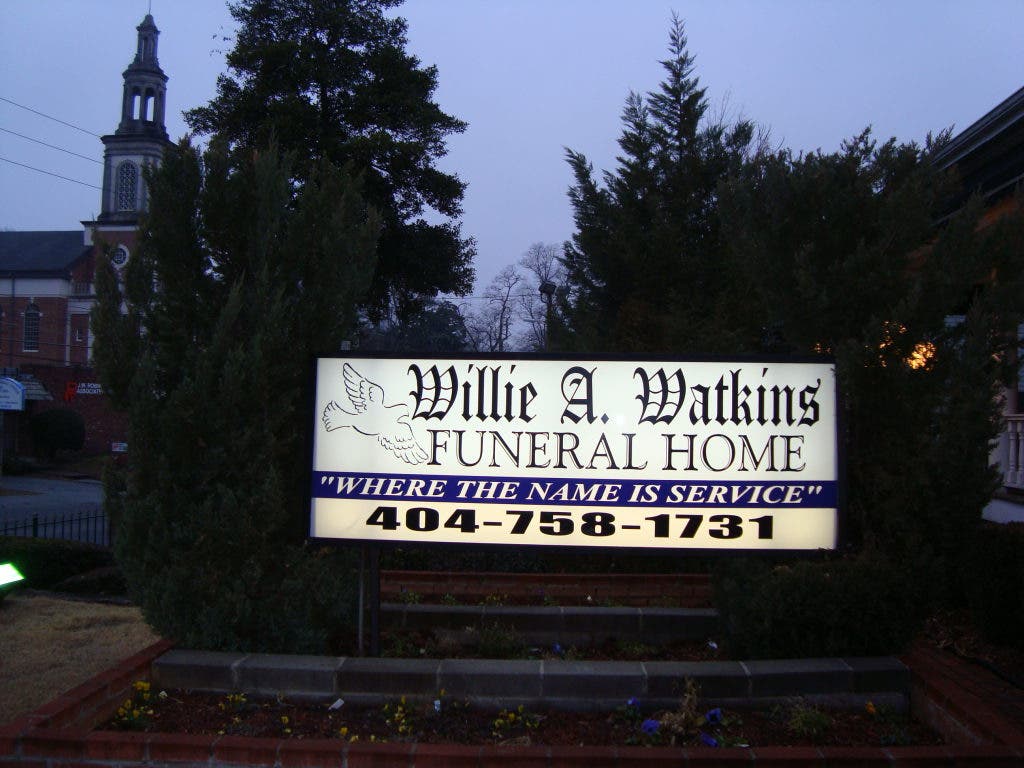
Watkins was determined to be an undertaker. And now Willie A. Watkins Funeral Home Inc., with its headquarters in a Victorian-style home at 1003 Ralph David Abernathy, is one of the largest black-owned funeral home in Atlanta. And in 2006, it was handpicked to handle one of, if not the largest, funeral in the state’s history – the burial of Coretta Scott King.
Still, it’s not the size of his business that makes Watkins stand out; it’s the services that he provides.
“It’s one of the most different funeral homes I’ve worked for in my 21 years,” said R. Jermaine Williams, who has worked at three other funeral homes. “He thinks outside the box.”
With his signature service that includes the releasing of doves, swordsmen dressed in tuxedos and top hats, and vehicles with outside speakers that chime gospel music, Watkins is not like any other funeral director – at least not in Georgia, Williams said.
“Whatever the service, whatever the family desires, contemporary or traditional, he makes that happen,” Williams said. “People go to any funeral, they don’t remember what happen. They go to a Willie Watkins funeral they will be able to tell you what happened from start to finish.
“He does the unthinkable.”
He always has.
At 14, Watkins sought out Herschel Thornton Mortuary in Atlanta. But the undertaker wouldn’t hire the teen.
Still, Thornton’s wife liked Watkins and gave him odd jobs to do. Eventually he made it to the embalming room where he studied Thornton’s every move – watching as the undertaker disinfected the body; then draining the blood as he simultaneously injected the carotid artery with embalming fluid. Then the restoration: Thornton dressed and groomed the body, cutting or curling the hair.
“I watched him intensively; what he was doing, how he was doing it,” Watkins said. “He would transform someone who was dead into a lifelike form.”
Thornton saw that Watkins had an interest. But Watkins didn’t wait for permission. He decided to prove himself and at 15 years old, he stepped from behind the undertaker’s shadow.
“A body came and I did the embalming before he came,” Watkins said. “I knew I would catch hell if I didn’t do it right.”
When Thornton arrived, Watkins told him what he had done.
“If you blew up the body back there, you’re going to be in trouble,” Thornton said.
Thornton inspected the body. Then he stared at the teen.
“Boy, you didn’t do this,” Thornton said.
“Yes, sir,” Watkins said.
“You did it just by watching me?”
Watkins shook his head.
“You’re going to be a good undertaker.”
Watkins moved into the funeral home and stayed there through high school.
“That changed my life a little bit. I ran it, waited on families, embalmed bodies, made funeral arrangements.”
After getting a degree in business administration from Morehouse College, Watkins said he became one of the first African Americans to graduate from Gupton-Jones College of Mortuary Science in 1971. He now had his license to be a funeral director and embalmer.
Watkins handled mortgages for Citizens Trust Bank. But always broke free to go work at Thornton funeral home until he opened his own on Dec. 7, 1982.
He marketed himself, attending three or four churches on Sundays. He worked seven days a week with his mother by his side. His father wanted him to be a shoe repairman. His mom wanted him to be happy. She was always there: answering calls, cleaning, coaxing families through the funeral arrangements.
For 24 years she was there, and the father of three sought to emulate her compassion. He treated every family like they were his- giving them a ride from their home to the service, hugging them and doing whatever he can to help.
“He always said the funeral home is built on service,” said Watkins’ nephew, William Thomas, who works at the home and plans to have his own.
Watkins said many in the business have gotten away from serving.
“We had compassion for people and we really loved what we were doing. It wasn’t about the money.”
His philosophy appealed to many. And despite his lack of connection, Willie A. Watkins Funeral Home, Inc. grew from handling 100 calls a month to a $6 million-business that handles 800 calls a month.
He has 65 fulltime and part-time employees, some of them family and three locations with one more on the way. He also has a special events center in Lithonia. He has buried some of the state’s elite such as Whitman Mayo who played Grady in Sanford and Son, Bishop Earl Paulk and Fulton County’s first black police Chief, Louis Graham.
But when he handled the funeral arrangements for Coretta Scott King, which had attendants in the thousands, Watkins earned the salutation of other black directors, who were happy to see one of their own burying the widow of the Civil Rights leader.
“I am an innovator. I believe in the flare and glare. I don’t believe in the traditional.” Watkins said. “I need to make a statement. The person has yet lived because their memories live on.”