Business & Tech
Dojo Karate Shaping Kids' Lives
Martial arts studios offering unique after-school care.


Funny, the Rowe children's behavior improves when it's their parents who threaten to notify the day care provider.
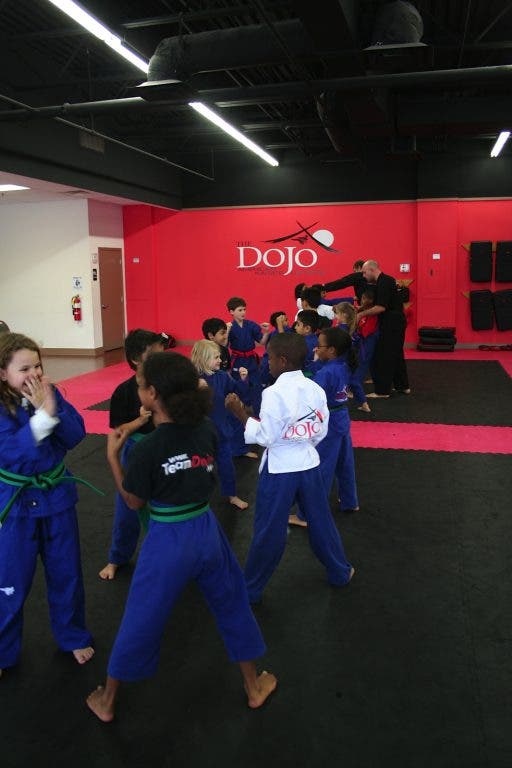
It's usually the other way around, but 8-year-old Chase and 6-year-old Tara attend Johns Creek's after-school day care. There, instructor Seth Schilke and others not only teach karate, but also focus on personal discipline and attitude and reward students for accomplishments at home and school.
"It's been a privilege to watch them grow physically and mature and see these kids make better choices in their lives," Schilke said. "It's definitely an environment I would have wanted to have as a kid."
Find out what's happening in Johns Creekfor free with the latest updates from Patch.
Chase and Tara are among 22 students picked up by Dojo's van after school at Wilson Creek and Abbotts Hill elementaries and driven to the studio on Abbotts Bridge Road near Jones Bridge. Another 19 Hillside and Northwood elementary students are shuttled to Dojo's other Johns Creek location on Old Alabama Road near Haynes Bridge.
Seems everyone recognizes the Dojo van's vibrant bumper-to-bumper billboard paint job, boasting the chain's after-school karate program at four of its eight locations. Parents pay $74 weekly for their elementary kids to be taken there, eat a snack and have a karate lesson and study time until 6 p.m. And while karate is the vehicle, parents like the martial art's traditional focus on life skills, including focus, respect and discipline, compared to day care that perhaps just occupies kids.
Find out what's happening in Johns Creekfor free with the latest updates from Patch.
Often, near the end of a day, Dojo's program includes one-on-one counseling with instructors.
"You learn respect for yourself, for karate, for everything in general," said Chase and Tara's mom, Heather. "(Tara) had a harder time focusing and listening, but through the focus of Dojo, she's learned to focus more and direct her energy in a good way."
Dojo kids are asked for informal conduct and grade input from home and school. They earn patches to sew to their gis and stripes to apply to their belts for successes at home and school. Conversely, those can be withheld for troublesome grades or behavior at home, perhaps even failure to do chores.
"We have take-home assignments to have mom and dad sign off that they were well behaved, had their room clean or whatever," said Dojo director C.R. Munhall. "Karate is the base of what we do, but what we weave into it is talking to them about personal discipline, (whether they're) focused and whatnot."
Chase Rowe, briefly sidelined after breaking his leg snow sledding in January, still enjoyed watching. He finds karate challenging.
"Some things are hard, some are easy," said the Wilson Creek third grader. "Some kicks like tornado kicks and jumping kicks are really hard."
Tara Rowe, a first grader at Wilson Creek, said she enjoys practicing kicks and punches, adding of Schilke, "He's really nice, but he's strict, too."
But strictness is what Dojo considers its unique appeal. Its literature boasts how, instead of merely supervising kids, their regimen enhances kids' lives.
"Unlike regular after-school programs, our students are held accountable for their actions," Dojo's literature reads. "Karate and positive peer pressure are used to teach lessons on how to be more disciplined. We don’t just tell (kids) they are misbehaving. We teach them how to have better decision-making skills. They learn how to have better discipline from within and make better choices."
And for educators like Carrie McCormack, a Hillside teacher, Dojo's program is ideal. She said her 7-year-old daughter, Hannah, a first-year participant at the Old Alabama studio, has been made more family- and community-minded by Dojo's program.
"They're tying all the parts of Hannah's life together – how she is in the community, how she is around family, etc.," McCormack said. "She has more respect for herself and respect for others. She's being a self starter and really has been motivated."
Some, like Chase Rowe, have enjoyed karate so much they've enrolled in summer camps and other year-round instruction. Others have stuck to just an after-school program that seems effective.
And if behavior or initiative wane at home or school, Heather Rowe said the karate studio often is an ideal place to rekindle it.
"We tell (Chase and Tara), 'If you don't behave, we're going to tell Mr. Schilke,'" she said. "That snaps them right into shape."