Schools
Cherokee Charter Academy's Help for Haiti
Since last fall, students at CCA in Canton worked hard to support a mission trip to Haiti by 5th grade teacher Whitney Bailey.

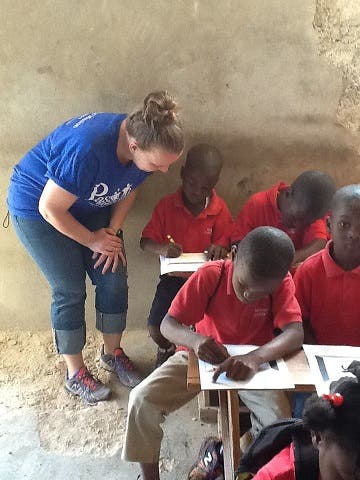


The goal of Ms. Bailey’s trip was to aid students & teachers at the Genecoit Vertus School of Excellence (K-6) in Francois, Haiti.
The tiny school in this impoverished Caribbean nation is supported by Charter Schools USA through its non-profit foundation, “The Giving Tree.” CSUSA is the management company that runs Cherokee Charter. Several times a year, CSUSA sends a group of its teachers, principals and other employees to the Vertus School where they work for about a week.
To help with Ms. Bailey’s trip, Cherokee Charter students collected money through “Jeans for Haiti” and “Headbands for Haiti” fundraisers (for a dollar, students could skirt the school’s uniform policy), kids brought in their coins in a “Change for Change” campaign and a Kindle raffle on CCA’s Bingo Night netted $138. Rulers and pencil sharpeners were collected for Ms. Bailey to give to the students in Haiti.
Find out what's happening in Woodstock-Towne Lakefor free with the latest updates from Patch.
For Ms. Bailey, who just returned from Haiti, it was a life-changing experience. Here is her story in words and pictures:
“I had the privilege of traveling to Haiti with Passion Rescue Mission, a non-profit organization that operates the Vertus School of Excellence in Francois, Haiti.
Find out what's happening in Woodstock-Towne Lakefor free with the latest updates from Patch.
We flew in and began our drive to the house we would call home for a week. Once settled in, we met to discuss the plans for the next few days; when we would meet and work with the students. Our house was at the bottom of a mountain, the school was on the top. The view of the mountains was stunning; looking down were row after row, level after level, of unfinished or partially damaged homes of cinder block. Families living in tents, hanging out laundry could be seen and smoke from outdoor kitchens where evening meals were being prepared. It’s easy to see the poverty in the broken homes, the lack of clean water and trash removal. But what had a greater impact were the sounds. The sounds of laughter, conversation, children playing soccer with whatever means of a ball were available. You couldn’t help but want to give them shoes and help with solutions for regular water and food. But I also felt envy in the idea of being so happy with so little, we should all be so lucky. That is not to say there is not a lot of work to do. Many are the challenges faced by the communities both at the bottom of the mountain and up top at the school.
After a good night’s rest we headed up the mountain on Monday morning, as we would each day via Tap-Tap. A Tap-Tap is a truck with benches in back and a metal cover. It is often used much like a taxi. The road up the mountain was dirt & gravel and quite bumpy. Our travel time was dictated by the road conditions as we waited for the road to dry out and become passable and safe. We arrived at the school as students were beginning to come out for recess. We were greeted by smiling, sometimes shy faces, all the personalities you would find at a school.
Our first two days we were split into two groups, those that would conduct activities in the classroom and those that would help with the dentists that came to provide much needed dental care to the community. I was in the group assigned to classroom activities. Each day we came up the mountain to work with the children on a different activity. On Monday it was a “getting to know you” activity complete with self-portraits and learning five things important to each student. With the help of our translator, the students set to work on their portraits. In sharing stories, they thought it was funny that I have a pet dog at home. That’s something not very common in Haiti as many struggle with feeding just their family, let alone a pet. The students shared the things that they liked; basketball, soccer, motorcycles, trucks. We continued through the day, changing to a new classroom as we finished.
Students were fascinated with the technology we brought. They enjoyed seeing their faces on digital cameras, swiping left and right on iPads, pressing the buttons on a digital watch. These are items not often seen in their rural area. Most of the students live somewhere along the mountainside and although it’s only a few miles up and down the mountain, it is very steep, and most have not much reason to go into the city.
The students are assigned grade levels based on what they have learned, as opposed to age. There is not mandatory public school within the nation and typically if a student’s family cannot afford a private school, the child will not get an education. The Vertus school is free to these students and educates students from all ages.
Tuesday and Wednesday we read books with help from our translators and enjoyed some outside time with our students. We were able to see the new classrooms that are being built. Currently the school’s 225 students are taught primarily in the four corners of a church sanctuary. You can imagine the difficulty with the classes and their different lessons so close to one another. The students, however, remain focused and work on math, grammar, and history. They work on benches; one bench to sit on and another as a work space. Pencils are often handed out to complete an activity and collected upon completion to make sure there are enough pencils throughout the day and the following days.
We were able to feed all of the students at the school as well as some in the community. We lined up the mission workers like a flawless assembly line and passed bowls of rice & fish down the aisles to feed the hungry faces. The students were grateful and often shared their food with siblings or friends. We watched the regular teachers at the school give up their bowls to ensure every child in the building, whether a student or not, would eat. For many, this would be their only meal of the day. We were able to feed every person in the room and as word got out in the community, the numbers grew. It’s unfortunate that there are currently not enough funds for this meal to happen at the school every day.
The students want to be there and work very hard. At times you will see other students from the community lined up outside the church windows to catch a glimpse of the learning they hope to one day experience. The school, of course, has limited space. With the addition of these new classrooms there is hope that the school will soon expand through 7th grade.
We finished out the week with a Field Day with the kids. We played soccer, jumped rope and threw a football. The kids enjoyed a break from their regular studies for a little fun outside.
By week’s end, the visiting teachers had worked with all the students, coming to know many by name, bridging language gaps with pictures and smiles, and fed the town at least for a week.
It was time to head home with indelible memories, a camera full of beautiful images and the knowledge that there is much more to do.”
For information on how to support Passion Rescue Mission, please go to passionrescuemission.org