Neighbor News
Fire Prevention Tips from the Woodstock Citizens Public Safety Academy
It's easy to have a "that won't happen to us" attitude about fire prevention, but these tips will give you a lot to think about

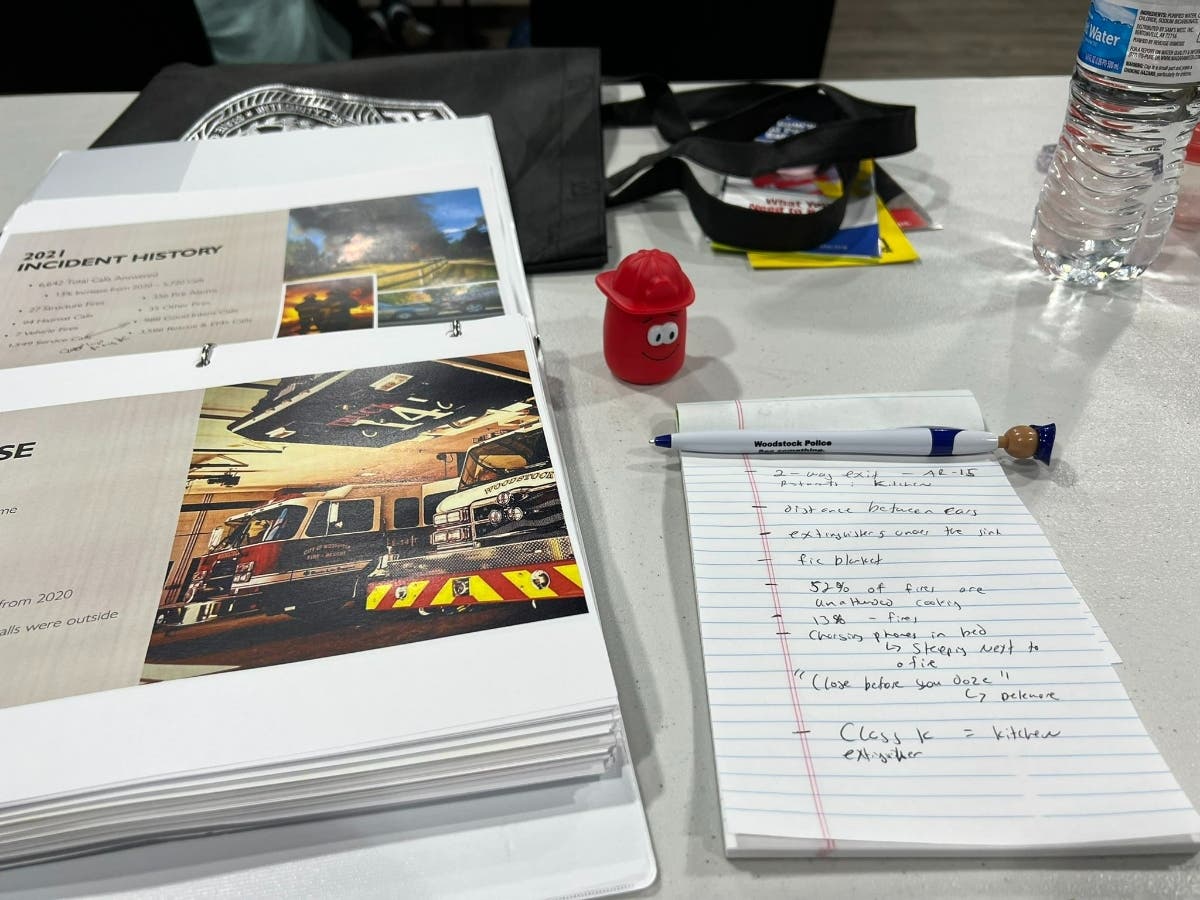

Every year, the Woodstock Police and Fire Departments team up to offer a class to residents called the “Citizens Public Safety Academy.” It’s a community relations program designed to educate residents about the capabilities, services and operations of these two departments.
It’s also a chance to pass along safety information. I serve as a board member for my homeowner’s association (HOA) and thought the program would be useful in this respect, so I applied and was accepted.
We just completed the second class which was presented by one of the fire investigators from Woodstock Fire & Rescue. It was a fascinating session, and we learned all sorts of interesting things – like the Woodstock Fire Department responded to more than 6,000 calls in 2021. While not all fire emergencies – but helps to demonstrate the value of having a local fire service.
Find out what's happening in Woodstock-Towne Lakefor free with the latest updates from Patch.
This class also covered fire safety and prevention. It’s easy to have a “that won’t happen to us” attitude about fire prevention, but I walked away from that class with a lot to think about.
Since this is a taxpayer-funded program, I feel an obligation to share some of what I’ve learned. Here are some of the tips things that stood out to me:
Find out what's happening in Woodstock-Towne Lakefor free with the latest updates from Patch.
1. Don’t leave cooking unattended
Unattended cooking is the top source of home fires (52%). It's easy to do in this era of remote work and multitasking. You know, you put the pan on the stove and the phone rings, you get that text alert, or you'll just step out for a moment.
This happens to me all the time...and I never really thought about it.
[Side note: home dryers are the next top source of fires (13%). And charging your phone in bed is starting to crop up – frayed wires and hot phones don't mix well with the synthetic threads on your bedding; plus the smoke is toxic.]
Here are some of the fixes:
- The fastest way to put out a grease fire in a pan is to put a lid on it. Have the right lid out and ready while you cook (Like our instructor, I have a few pans and many pan covers in the cabinet – no time to fish around for the right one in a hurry).
- Have a "Class K" fire extinguisher for the kitchen. Class K is a little thicker and better for grease fire (hopefully we all know this already, but a reminder, do not use water on a grease fire!) I bought one on Amazon that same evening after class for about $25.
- Don’t put the fire extinguisher under the sink! Why? Because the fire is growing while your back is turned to pull it out. Put it somewhere a little bit outside the kitchen so you move away from the fire and create some distance. That will give you room to think about whether or not it’s worth using – or if it’s time to get out.
2. Have two exits for every place you go
Prior to the class, I didn't have a rope ladder to escape the second floor of my home. These cost about $50 on Amazon – and I ordered on the same night – and it’s in my home as I write these words.
Having one isn’t enough: make sure your kids know how to use it too. Practice deploying it too. (I'm not sure I'd be comfortable having my kid climb down in anything other than an emergency, but certainly, she can practice deploying it).
Make sure your kids know how to open the window. I also make sure my daughter understands I won’t be upset with her for breaking a window to get out during a fire.
The two-exit guideline also applies when you are out in public. In restaurants, for example, the kitchen always has a back door that can be used in an emergency (this is good not only for fire situations but also in active shooter situations).
3. Close the doors inside your house
Candidly, I chaffed at this a bit. “I’m not going to shut the door,” I was thinking to myself as he was talking. I'm sure many of you might feel the same way.
It’s a tough sell for parents, but – look at this ‘close before you doze’ video – and see the difference closing a door makes in a house fire. That video got me thinking about this again.
Still not going to close your door? Okay, our instructor tonight said, at least close your kid’s door. Use a baby monitor if you must.
4. Change fire alarms every 10 years
They don’t work right after 10 years – even if the light is green. I’m sure my alarms are 20 years old. It would have never occurred to me this is a problem. I figured changing the battery was enough, but it’s not, so I’ve added this to my to-do list.
5. Put at least one fire extinguisher on every floor
You need to have a fire extinguisher on every floor – and make sure everyone in your home, including the kids, knows how to use it.
One acronym covered in the class that can help us to use fire extinguishers properly is PASS.
- Pull (the pin)
- Aim at the base of the fire
- Squeeze the lever
- Sweep from side to side.
A 5 lbs. extinguisher is going to give you about ~10 seconds of spray.
Something to think about too: you can use an extinguisher defensively – this is what we all think of when we think 'fire extinguisher.' But we can also use this offensively: spray yourself a path to get out if the situation warrants it.
6. Pick a safe rally point outside your home
The instructor shared a story about three firefighters that entered a burning home – at a parent’s urging – to save the kids. Once they entered, the building collapsed and all three firefighters died.
Then the kids appeared; they had escaped out the back and moved around the house to the front.
Make sure your family knows how to escape the house and move to a safe spot outside for accountability. This isn’t just for us – but for the firefighters’ safety too.
Have a plan – work the plan – and let the firefighters know.
7. "Stop, drop and roll" vs. "get low and go"
Use caution about teaching kids under 6 years of age “stop, drop and roll.” Teach them to “get low and go.”
Why?
They found kids that young can’t distinguish between these two – they will “stop drop and roll” during a fire – and then stay there – when getting low beneath the smoke and escaping might be preferable.
I found this unnerving, because, well, it flies in the face of everything I've been told my whole life. Right? Stop, drop and roll was a regular public service announcement (PSA) when I was a kid (the more you know!)
But it makes complete sense. I'm just a novice student in a part-time class – so feel to call your local fire department. I'm sure they'd be delighted to give you their expert opinion.
8. Have your kids practice fire drills at home (yes, really)
Every time your kids do a fire drill at school – they should come home and remind their parents to do one.
Why? Our instructor set this up this way:
Schools are made of brick, so there’s no fuel, have closed doors, good alarms, sprinklers, inspections, many staff, and do fire drills regularly.
Homes have tons of fuel, no inspections, open doors, no sprinklers, alarms without fresh batteries…and we never do fire drills.
* * *
Residents interested in participating must complete a written application and agree to a background check before being accepted. Applications are closed for this year, but since it is offered annually, there will be another chance to apply next year.
That course consists of one weekly two-hour class spread out over 11 weeks. I hope to write a bit more about it as we progress through this year’s program.