Community Corner
Illinois In Path Of Totality For The Great American Solar Eclipse
For the second time in seven years, Illinois will be at the centerline of totality when the moon's shadow sweeps across the state April 8.


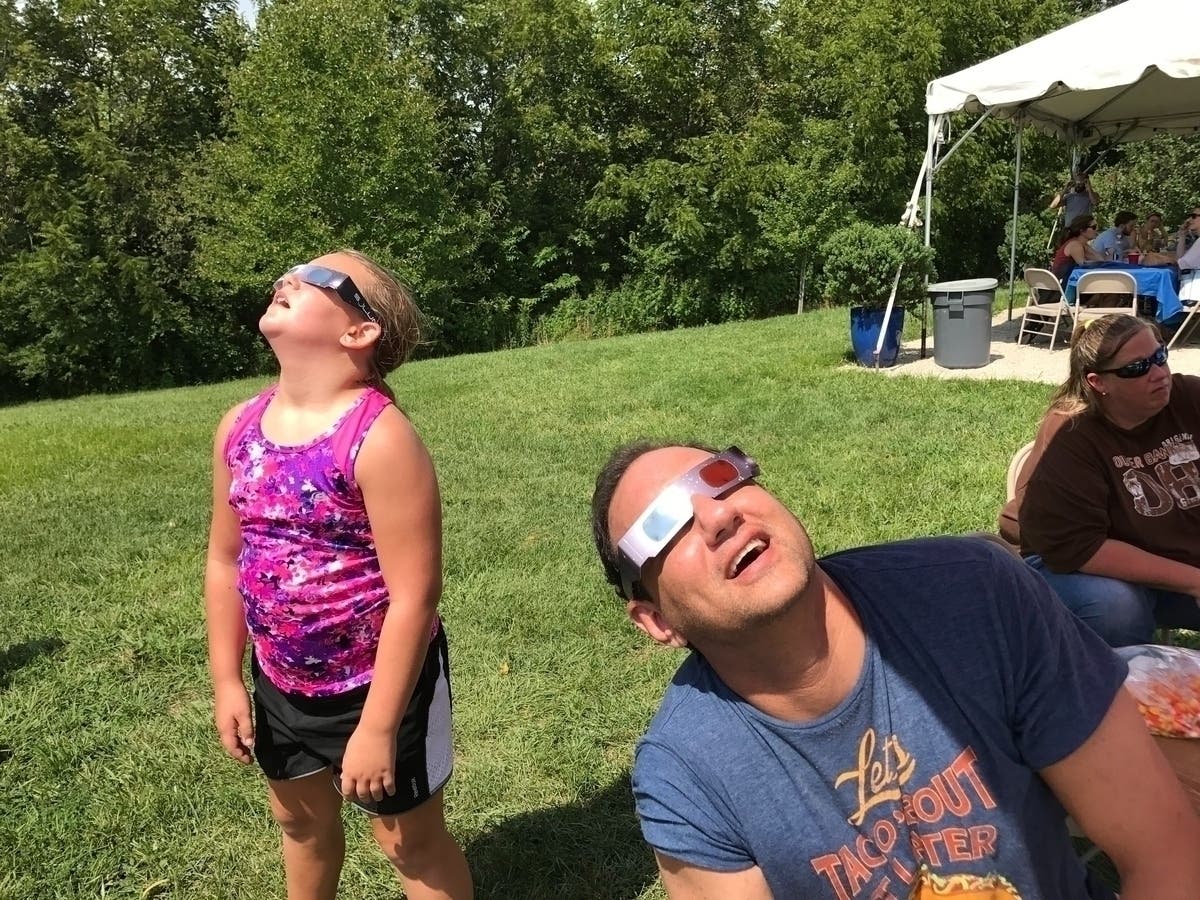
ILLINOIS — The longest and most visible solar eclipse for the United States in the past 100 years will align on April 8, and it's expected to be one of the best, with a maximum duration of four minutes in the path of totality.
A solar eclipse is a rare, celestial event where the moon passes between the sun and earth, partially or completely blocking the face of the sun. The sky will darken as if it were dawn or dusk.
The 2024 Great American Eclipse is a much bigger deal than the 2017 solar eclipse, when only about 12 million people lived in the path of totality. This time, something like 31 million U.S. residents live in places that will see daytime darkness at the peak of the eclipse. Another 1 million to 4 million people are expected to make a pilgrimage to states in the path of totality, according to eclipse travel projections.
Find out what's happening in Across Illinoisfor free with the latest updates from Patch.
While a total solar eclipse won’t be visible in the Chicago area on April 8, it will come close, with 95 percent totality, giving the sun a thin crescent wedge, and making it dark enough that you may hear crickets chirping. Partiality in the Chicago region will start around 12:50 p.m., with the eclipse peaking at 2:06 p.m.
Through Illinois, the speed of the moon's shadow will accelerate from 1,830 miles per hour to 1,975 miles per hour. The moon will complete its final pass between the sun and earth, leaving Chicago skies around 3:20 p.m., according to the interactive 2024 eclipse map for Chicago.
Find out what's happening in Across Illinoisfor free with the latest updates from Patch.
Path Of Totality
The 15 states in the path of totality are Illinois, Texas, Oklahoma, Arkansas, Missouri, Kentucky, Tennessee, Michigan, Indiana, Ohio, Pennsylvania, New York, Vermont, New Hampshire and Maine.
The solar eclipse on April 8 will start over the south Pacific Ocean, darkening Mexico’s Pacific coast at approximately 11:07 p.m. MDT. The path of the eclipse will continue from Mexico into Texas, where the duration of totality will be up to 4 minutes and 24 seconds in Eagle Pass, Texas, beginning at 1:27 p.m. CDT. For comparison, the eclipse reaches totality about an hour later, at 3:29 p.m. EDT in Jackman, Maine, and lasts about 3 minutes and 26 seconds.
Illinois stargazers will see the moon’s dark umbral shadow encroaching over the state at approximately 12:40 p.m., cutting a 115-mile path of totality over the state. Towns lying in the eclipse’s path will start to experience totality around 1:57 p.m.
Southern Illinois Centerline Of Totality
Southern Illinois is on the centerline of totality, celebrating the second total solar eclipse in seven years. SIU-Carbondale, in partnership with NASA, will host the Southern Illinois Crossroads Eclipse Festival. The astronomical celebration features a variety of world-class events and activities April 5 through April 8, concluding with a guided eclipse experience at Saluki Stadium. Standard tickets are available for $25, with VIP Stadium Club packages available for $200. Parking passes are available for $35 and are required to park on the SIU campus on Eclipse Day. Tickets can be purchased on SIU Eclipse.
If you're one of millions of Americans planning to make the trek to totality, there are plenty of towns along the Mother Road planning eclipse celebrations, which can be found on Illinois Route 66. Herald Square in Uptown Collinsville will be offering free solar eclipse viewing glasses for all in attendance, live music, a fire-blowing demonstration and shopping.
Old Herald Brewery & Distillery will also create a special craft brew — Solar Shandy — and will collaborate with Big Muddy Brewery to create Dark Moon Whiskey. Great Rivers and Routes Solar Eclipse landing page offers updates to events and activities, many within driving distance from the Chicago area.
Thirty-one Illinois state parks and sites managed by the Illinois Department of Natural Resources are in the eclipse’s path of totality. Numerous other parks and sites lie just outside the path of totality, offering equally spectacular views of the eclipse, though for shorter periods of time. Reservations for camping at an IDNR-managed campground during the April 8 total solar eclipse are highly recommended, and can be made by going to Explore More Illinois or by calling 866-716-6550.
It will be March 30, 2033, before another total solar eclipse touches the United States, and that’s only on the tip of Alaska. It’ll be Aug. 23, 2044, before the next eclipse sweeps across the lower 48 states, with parts of Montana and North Dakota experiencing totality.
Proper Eye Gear
Eclipse preparation Job 1 is to acquire protective eye equipment to block the harmful solar radiation. Amazon has a wide collection of NASA-approved solar eclipse glasses, and the American Astronomical Society has more vendors whose eclipse glasses have been certified as safe. Wherever you acquire protective eyewear, it should meet or exceed the international safety standard of ISO 12312-2:2015.
You’ll also need special solar filters for cameras, binoculars and telescopes, even in places far outside the path of totality, like the northwest corner of Washington state, which will see only 16 percent totality.
“Viewing any part of the bright Sun through a camera lens, binoculars, or a telescope without a special-purpose solar filter secured over the front of the optics will instantly cause severe eye injury,” NASA said.
One other safe way to view the eclipse is with a do-it-yourself pinhole projector that shows the sun on a nearby surface. The American Astronomical Society has pinhole projector DIY instructions.
Window For Solar Scientists
Another thing that makes the 2024 solar eclipse markedly different from the 2017 event is that it’s occurring as the sun is at its peak activity cycle, called solar maximum. In 2017, the sun was approaching minimum. This year’s eclipse opens a unique window for scientists to study the sun’s corona.
“The eclipse that we have coming up in 2024 is going to be a very different eclipse from what we saw in 2017 because this corona that we see is going to have much more structure,” Lisa Upton, a solar scientist at the Southwest Research Institute in Boulder, Colorado, told Scientific American.
The violent solar storms occurring right now are responsible for auroras that dance far outside their Arctic and Antarctic ranges but also carry the potential to knock out internet satellites for months, take down power grids, and interfere with navigation satellites. Right now, these events happen with little warning, but scientists are working on their ability to predict space weather.
Get more local news delivered straight to your inbox. Sign up for free Patch newsletters and alerts.