Health & Fitness
A Chef's Response to One of the Worst Food Trends
In a race to outdo each other, we chefs go out of our way to modify any dish to the customers delight, and in many ways, we have lost our focus.
Over the past few months the Algonquin area has witnessed a saddening trend that is sweeping many parts of the nation. Locally-owned restaurants are closing their doors for the last time at an alarming rate. Certainly there are many factors leading to the demise of these restaurants, bad management, poor location, stiff competition and so much more.
A few days ago an online article listing the 10 worst food trends was sitting in my inbox.
Of course I had to read it. In many instances I agreed with much of what the food critic Jonathan Gold had to say, but what continued to linger in my head for most of the day was the first trend.
Find out what's happening in Algonquin-Lake In The Hillsfor free with the latest updates from Patch.
Trend # 1 “Changes and Modifications Politely Declined”
This note is often found in small print on the bottom of the menu. Gold stated that though the passive aggressive approach, which is commonly found in most small-plate concept restaurants has its merits, the rule can sometimes go too far. I agree.
Find out what's happening in Algonquin-Lake In The Hillsfor free with the latest updates from Patch.
What lies beneath this argument is the fact that the general dining public has swallowed up the restaurant industry with their demands of any dish done to the specifications of the customer. Now, before you gather your pitchforks and torches and march on my front doorstep demanding my head on a plate with accompanying sauces on the side, let me clarify.
As a chef, our job is to keep the customer happy, give them a product that keeps the guests coming in our doors at great frequency night in and night out. In a race to out do each other to go out of our way to modify any dish to the customers delight, we chefs—in many ways—have lost our focus.
The goal of any good chef when designing and creating a menu is to give you a skeleton menu of items that bring the customer comfort. Items that you, the customer, know and are familiar with.
The fun part for a chef is to offer a few items that “WOW” you. These are the unexpected items that through good servers and solid kitchen execution have the ability to set your business apart from everyone else. When these intricately designed menu items become compromised by specific demands and modifications, the once special item morphs into the same dish you can get anywhere up and down Randall Road, thus killing any special or unique dining experience and thus making your dream business just like everyone else's. From a chef’s perspective, this becomes quite soul-crushing.
When I create a dish, there are certain criteria that I always adhere to. The dish must achieve a full balance of flavor and texture. Think of it like this: The item can take your palate from sweet to a lingering effect of heat, there should be a salt component and there should be a certain amount of texture. The item should also have a touch of bitterness and an accompanying richness. Too much one or the other can throw the whole thing out of the desired balance, diminishing the
“WOW” factor.
What often happens in the restaurant setting is that the customer requests that one of the components be omitted or substituted with something else of his or her choosing. On occasion the transaction has minimal impact on the overall outcome, but in many instances, the substitution or omission is just not a very good idea! This ultimately leaves the customer with an experience that was just not as appealing as the chef had originally designed.
This dish is the perfect example.
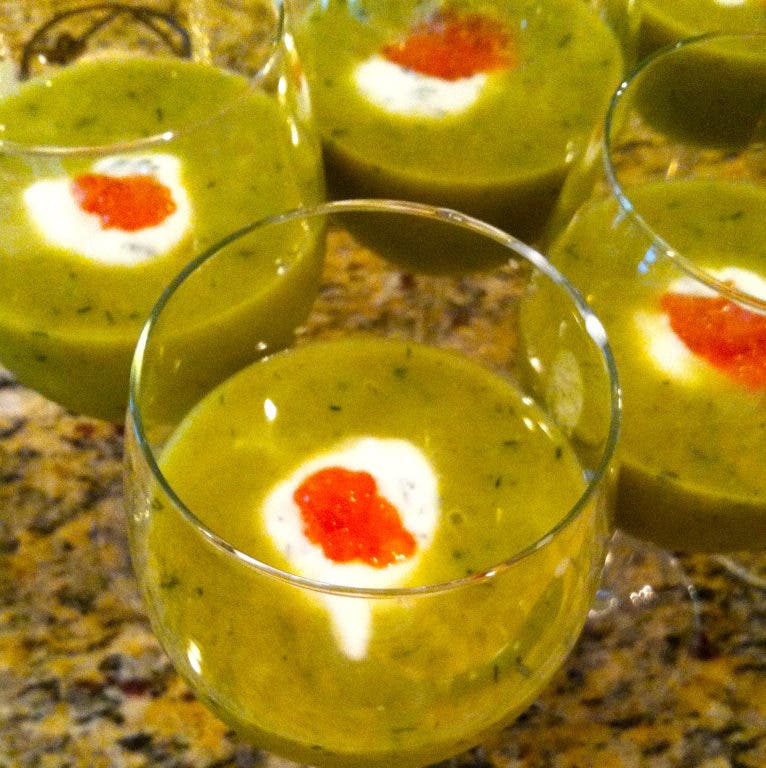
Chilled Leek Soup with a Lemon Dill Yogurt, finished with Salmon Roe
What you’ll need.
8-large leeks thoroughly washed and dried. Once dried, slice the leeks into small thin rounds including the white portion of the leek. Often times the produce section neglects rinsing the inner strands of leek leaves and it’s a safe haven for dirt and soil. Wash thoroughly under cold water!
6-cloves of garlic, minced
2-Idaho baking potatoes peeled, small dice. I find that baking potatoes work best in this situation for one main reason. The potato lacks flavor! I know I know it’s quite unlike me to use a component that does not have an overall impact on the flavor profile of the dish but listen up! There’s a method to my madness. Trust me. The role of the potato in this instance is to give body to the soup. I’m not a fan of using a roux in soups for many reasons and you’ll discover that the potato is the binder of the whole thing. A cohesive glue if you will!
1 ½ cup of dry white wine. Remember my rule??? If it’s good enough to drink, it’s good enough to cook with!
1-tbsp. nutmeg
1-bunch of dill, finely chopped.
In a medium sized stockpot, sweat the leeks in a knob of butter, a pinch of salt on medium heat for about 8 minutes. The salt is needed here to dehydrate the leeks of their inherent moisture, isolating the sugars of the leeks with the heat of the hot butter. The isolation of sugars allows the leeks to show off their inner sweetness. This is necessary because this soup is you guessed it, all about the leeks. Now add the minced garlic and the nutmeg and cook until the garlic has achieved a caramel color. At this point, deglaze the pan with the white wine and let the wine reduce by half. About six minutes. Now add the diced potatoes and enough water to cover the potatoes by an inch or so. Increase the heat to medium high, bring the soup to a slow boil and cook until the potatoes have thoroughly cooked through. When the potatoes are fully cooked, season with salt to taste and remove from the heat to allow the soup to chill.
Once the soup has chilled, use an immersion blender and puree the soup until the texture is smooth. Now add the dill. If you add the dill when the soup is hot, the heat of the liquid will kill all the flavor of the dill. No bueno!
Here’s a hint. Perform this process a few days ahead of time! Chilled soups need time to achieve full flavor. Another tip: When foods are hot, the flavors are much more prevalent. When foods become chilled, the flavors become hidden due to the lack of heat. Heat allows your taste buds to open and receive all the delicate seasoning and flavor that you have so strategically applied. It is essential that you overseason your soup. You’ll have to trust me on this one.
Lemon Dill Yogurt
This one’s a breeze!
1-pt plain yogurt
2-lemons. You’ll ultimately want the zest of both lemons and the juice of the lemons added to the yogurt.
1- bunch of dill, once again, finely chopped.
In a small mixing bowl add the yogurt, the zest of the lemons as well as the juice. Add a pinch of salt along with the chopped dill and gently fold in. Top the bowl with plastic wrap and set in the fridge for at least a few hours. Once again, you can do this a few days in advance. It will only get better as the flavors get to know one another.
To plate. Fill your serving vessel with the pureed leek soup. I like using wine glasses for chilled soups but feel free to use your beautiful small white rimmed bowls if you like. Make sure that you place these bowls in a cooler or freezer a few hours before you serve. The idea here is to use a chilled serving vessel for your chilled soup. If you use a warm vessel it will only drop the temperature of your chilled soup thus diminishing the effect.
Next, use a small spoon and add a dollop of the lemon dill yogurt to the center of the wine glass or soup bowl. Lastly, add a small portion of the salmon roe.
Don’t get too carried away with the roe here. The roe has amazing flavor but the saltiness of the roe can easily overpower the sweetness of the leeks. The same goes for the yogurt. The richness and acidity is a small part of the flavor profile. Ultimately you want a nice balance of sweetness from the leeks, a small amount of richness from the yogurt, a touch of acidity from the lemon, freshness from the dill, and the salt component of the roe. Too much of any one component will throw the whole dish into a tailspin. Be careful here.
**********
Lastly. I generally save my personal opinions for the dinner table or when I’m with the people who matter most to me, but I will say this: Algonquin needs its locally-owned restaurants!
With so many corporate giants in the area, it’s difficult for the local restaurants to compete and stand out. It’s so easy to get caught in the wash of what the giants are doing that we lose our identity. I am in no way knocking what the giants do. They have established themselves across the country for good reason. They do good work and we can learn a lot from them. I also feel that they have stripped much away from the true dining experience. We have forgotten how to dine.
When was the first time you fell in love with food? When was the last time you had a love Affair with food? When was the last time a chef aroused you? When was the last time you stepped out of you comfort zone to allow food in its most purest sense to ignite you? Food has the power, when created by a talented chef, to take you to levels you never knew. Let chefs be chefs! Let us excite you with our passion, our talents and our love of food! Food should be more than a conglomeration of fried components arranged on a plate with a sprig of rosemary. For me, food is an expression of love, a pure and genuine gift from my heart to your soul.
Buen Provecho!