Politics & Government
Burr Ridge Mayor Called 'Legal Bully'
Mayor Gary Grasso is fighting a resident who tried to get him knocked off the ballot.


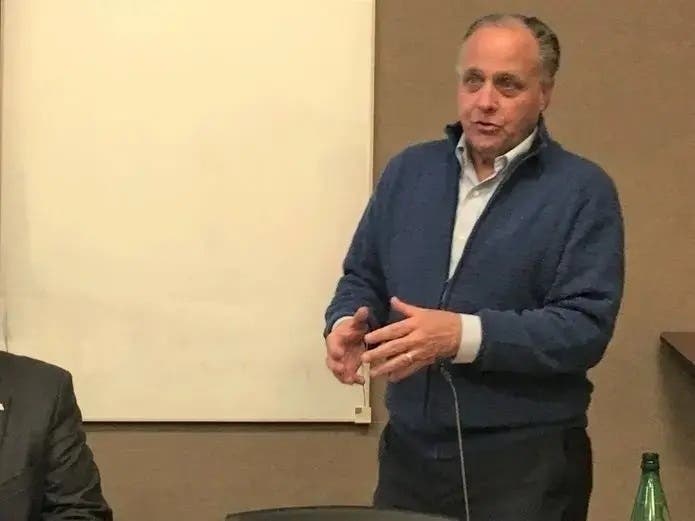
BURR RIDGE, IL — Burr Ridge Mayor Gary Grasso's "egregious abuses" of the legal system in dealing with a resident should be punished, a lawyer argues.
Burr Ridge resident Steven Mueller is appealing DuPage County Circuit Court's ruling in October rejecting his request for sanctions against Grasso.
In January, Mueller filed a challenge against Grasso's election petition. The village's electoral board rejected it, and Grasso ran unopposed in April's mayoral election.
Find out what's happening in Burr Ridgefor free with the latest updates from Patch.
Grasso later sued Mueller, accusing him of filing a frivolous challenge. That lawsuit was dismissed, with a DuPage County judge saying the court had no jurisdiction. Grasso is appealing.
Then Mueller, represented by attorney Neal Smith, sued Grasso, alleging he filed a frivolous lawsuit in court.
Find out what's happening in Burr Ridgefor free with the latest updates from Patch.
Grasso has told Patch that he filed the lawsuit because Mueller's challenge was baseless and cost the village $6,000 in attorney fees and wasted two afternoons for three village officials.
Grasso, who is now running for Congress, sent an email on June 14 to Smith titled "FOR RESOLUTION PURPOSES ONLY."
"My informal discussions w(ith) others about Mr. Mueller ... led me to the conclusion that he would not spend the money for an election challenge — even a valid one," Grasso said. "I understand he is quite frugal. I also understand his acquaintances include the person or person(s) who convinced Mr. Mueller to file the challenge."
Grasso said he would not pursue his litigation if Mueller revealed who was behind the effort.
Grasso, a lawyer, said his "RESOLUTION PURPOSES" email should not have been released to the media. He was referring to a Patch story in September.
"Mueller has gone so far as to cause the settlement communication to be published in the media as a means to threaten and harass Grasso...," the mayor's brief in October said. "Mueller utterly fails to establish how the substance of the communication is in any way untoward, impermissible or a credible basis for sanctions."
Grasso said Mueller has not denied that someone else was behind the challenge and paid his legal bills to bring the challenge. In reply, Smith, who is with the Chicago-based Robbins Schwartz law firm, said his client was not required to specifically identify Grasso's untrue allegations.
Grasso said the state's rules of evidence protect settlement communications from public release.
But Smith said that was not the case for bad faith communications.
"Grasso thought he could get away with making strong-arm demands that Mueller divulge certain information by labeling correspondence 'FOR RESOLUTION PURPOSES ONLY,'" Smith said.
Grasso, Smith said, admitted he was pursuing the names of "person or persons" who put up Mueller to the challenge.
"This is precisely the type of bad faith that settlement negotiations can be used as evidence to show," Smith said. "Grasso's abuse of the judicial system should not be tolerated, and this Court has an opportunity to show that egregious abuses of the legal system will not evade punishment, no matter how politically powerful the offending party may be."
Grasso said the court should reinstate his original lawsuit. Election challenges, he said, are often meant to deplete the resources of candidates and hinder their campaigns. Municipal candidates are particularly vulnerable, given they lack the resources of candidates for higher elected offices, he said.
He said Mueller thumbed his nose in the face of the court, gloating about having brought a frivolous election challenge. Mueller's challenge, the mayor said, caused considerable expense to both Grasso and the village.
"One need not speculate whether this will encourage future impunity for the likes of Mueller (and in particular those who lurk in the shadows paying the bills of the likes of Mueller) in the future," Grasso said.
Smith's briefs call Grasso a "legal bully" and describe the mayor as "unrepentant in his shameless attempted power play against Mueller."
After DuPage County Circuit Court ruled against him, Mueller appealed to the 2nd District Appellate Court in Elgin.
In January, the village's electoral board — made up of trustees Al Paveza and Guy Franzese and Clerk Sue Schaus — unanimously granted Grasso's request to dismiss Mueller's challenge, which was based on procedural issues.
Under Illinois law, candidates are required to follow an exacting process with their paperwork. Seemingly small errors can get them removed as candidates.
Mueller filed to run for Village Board two years ago, but the village's electoral board barred him from the ballot.
One of the problems with Grasso's petition, Mueller said, was that it was not validly notarized because the notarization was dated "December 3, 2021," nearly a year into the future at the time.
The village's electoral board unanimously rejected that argument.
Mueller also pointed to a law that says the "heading of each sheet shall be the same" in the petition. Grasso's petition alternated between "Village President" and "Mayor/Village President."
The electoral board said either title was acceptable.
Grasso filed his lawsuit as a citizen, not as mayor.
Grasso couldn't be reached for immediate comment.
Get more local news delivered straight to your inbox. Sign up for free Patch newsletters and alerts.