Politics & Government
Property Taxes The Focus: Local Lawmaker
After Rauner experience, House GOP Leader Jim Durkin and fellow Republicans say relatively little about cutting state income tax.


BURR RIDGE, IL — For years, the state GOP focused on reducing the state income tax, which the Democratic-controlled state government raised in 2011. But these days, Republicans say relatively little about the income tax other than promise to oppose an increase.
Instead, Republicans focus on Illinois' property taxes, which finance local governments such as schools and municipalities. This is a juicy target, given Illinois' property taxes are second only to New Jersey.
In an interview last week, House Republican Leader Jim Durkin of Western Springs criticized a recent legislative task force on property taxes, which he said did not make a serious attempt to get a grip on the problem. The main proposal from the Democratic-controlled task force was to expand the state sales tax, which Democrats said could go toward schools, reducing pressure on property taxpayers.
Find out what's happening in Burr Ridgefor free with the latest updates from Patch.
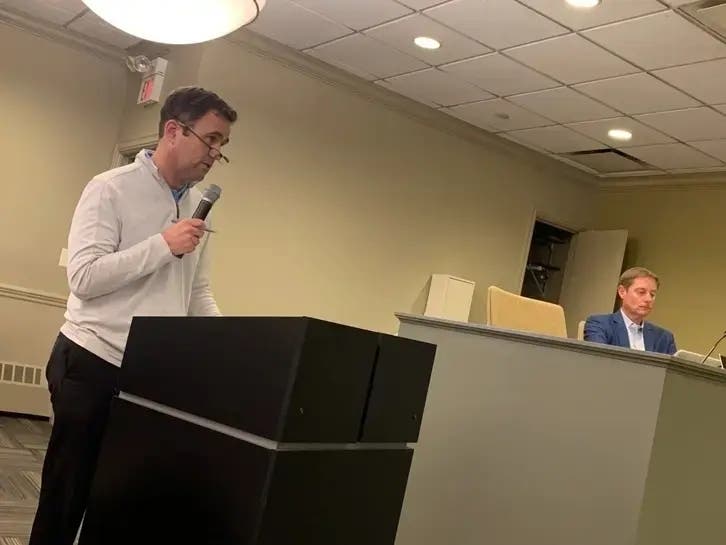
"The task force did not offer reforms to the system," Durkin said in an interview with Patch at his Burr Ridge office. "At what point will the taxpayers get a break?"
One major way to curtail government spending and thus reduce property taxes, Durkin said, was to amend the state constitution to loosen its pension clause. More than a quarter of the state budget goes toward the pensions of retired state workers, and local governments are struggling to keep up with police and fire pension costs. Without a new amendment, the state Supreme Court says the legislature cannot alter the terms of employees' pension benefits throughout their entire careers. While Republicans say they support protecting already-earned benefits, they propose changing the terms going forward.
Find out what's happening in Burr Ridgefor free with the latest updates from Patch.
Durkin and other Republicans also propose consolidation of government entities and sharing of services between entities as ways to reduce pressure on property taxpayers. They push for "greater mandate relief" for school districts by reducing the number of regulations.
This November, voters will decide whether to support a constitutional amendment for a progressive tax system, where tax rates increase along with income. Illinois has long operated on a flat income tax, now at 4.95 percent.
The legislature's Democratic majority last year voted for progressive tax rates that would take effect if voters approved such a system. Under the bill, which Democratic Gov. J.B. Pritzker signed, the tax rate would drop to 4.75 percent for the those making under $10,000. People making between $10,000 and $100,000 would get an income tax rate of 4.9 percent and those between $100,000 and $250,000 would see their rate remain at 4.95 percent. Those over that level would be taxed from 7.75 to 7.95 percent.
Priztker contends this legislation would cut taxes for 97 percent of taxpayers. But Durkin said he doubted these tax rates would remain and that eventually middle-class taxpayers would see their tax rates increase.
Durkin also said the Democratic plan would have much more credibility if it included the proposed rates in the constitutional amendment.
"I don't trust the legislature will live within those rates. We know they won't stay at those rates because that's why they put them in a statute, not a constitutional amendment," he said.
Durkin also said the progressive system would drive wealthier taxpayers out of state, reducing the state's tax revenue.
"High wealth individuals are going to pack up and leave," Durkin said. "The flat tax is the only security taxpayers have against a tax-and-spend government."
In 2011, legislative Democrats increased the income tax rate to 5 percent, from 3 percent. It was a four-year tax hike , after which it would drop to 3.75 percent.
When Republican Gov. Bruce Rauner took office in 2015, he and legislative Democrats got into a more than two-year budget standoff over the income tax, with Rauner calling for it to go back to 3 percent and Democrats pushing for an increase to about 5 percent. It ended when enough Republicans crossed party lines to override Rauner's veto of a tax-hiking budget. The next year, Rauner and the Democratic legislature agreed on a budget that kept the tax increase.
Cutting the income tax is no longer a major Republican theme.
"I'd like to do a tax cut, but you need cooperation from the majority party," Durkin said. "We have sufficient taxpayer money going into the state to meet all of our obligations. In my opinion, we don't have to ask taxpayers for more money. We don't have to raise the income tax. We don't have to raise the sales tax."
Get more local news delivered straight to your inbox. Sign up for free Patch newsletters and alerts.