Crime & Safety
Watch It Again: Department of Justice Finds 'Pattern of Civil Rights Violations' By Chicago Police
Findings: CPD "engages in a pattern or practice of using force, including deadly force, in violation of the Fourth Amendment." (UPDATED)


CHICAGO, IL — In what officials called an "historic turning point," a U.S. Department of Justice probe has found that the Chicago Police Department has engaged in an unconstitutional "pattern or practice of using force, including deadly force," according to a report announced Friday.
To remedy that, the city and the federal government have agreed in principle "to work together, with community input, to create a federal court-enforceable consent decree addressing the deficiencies found during the investigation," the report concluded.
WATCH: Friday's press conference announcing DOJ findings:
Find out what's happening in Chicagofor free with the latest updates from Patch.
“The findings in our report, coupled with the City of Chicago and police department’s commitment to work together with [the Department of Justice], are an historic turning point and a major step toward sustained change,” said U.S. Attorney Zachary T. Fardon of the Northern District of Illinois. “Implementing these findings is a necessary precursor to our long-term success in fighting violent crime in Chicago.”
The investigation's findings were announced Friday at a press conference by Fardon; U.S. Attorney General Loretta E. Lynch; Principal Deputy Assistant Attorney General Vanita Gupta, head of the DOJ's Civil Rights Division; Mayor Rahm Emanuel and Police Superintendent Eddie Johnson.
Find out what's happening in Chicagofor free with the latest updates from Patch.
RELATED: Read the Full Findings From the Justice Department's Report
"This is a moment of truth for the city," Emanuel said as he addressed the long process and difficult actions it will take to transform the culture of the police department, improve its tattered reputation in the city and around the country and rebuild trust between its officers and the community.
Officials emphasized that the report's findings was not about finger-pointing and blame, and Emanuel and Johnson were quick to point out that the city had already begun to remedy the patterns and violations cited in the findings, practices that both city leaders said were unacceptable.
"Unconstitutional policing has no place within the department," Johnson said.
The Findings
The Justice Department summed up its investigation's findings the following way Friday morning:
"[The probe] found reasonable cause to believe that the Chicago Police Department (CPD) engages in a pattern or practice of using force, including deadly force, in violation of the Fourth Amendment of the Constitution. The department found that CPD officers’ practices unnecessarily endanger themselves and result in unnecessary and avoidable uses of force. The pattern or practice results from systemic deficiencies in training and accountability, including the failure to train officers in de-escalation and the failure to conduct meaningful investigations of uses of force."
The investigation attributed the unconstitutional practices to department deficiencies in accountability systems and how it looks into use-of-force incidents. It also cited a lack of community-oriented policing strategies and poor support for the wellness and safety of officers.
These deficiencies also were responsible for cultivating a department that tolerates racially discriminatory conduct by officers, according to the findings. That conduct also was reflective in the disproportionate impact the department's use-of-force practices had on Chicago's Latino and black neighborhoods, the report revealed. Going forward, CPD will need to develop solutions that rebuild trust in those minority communities.
“The failures we identified in our findings — that we heard about from residents and officers alike — have deeply eroded community trust,” Gupta said. “But today is a moment of opportunity, where we begin to move from identifying problems to developing solutions. I know our findings can lead to reform and rebuild community-police trust because we’ve seen it happen in community after community around the country over the past 20 years.”
While the city and the feds have agreed to work together to solve the problems outlined in the DOJ report, it is still unclear what specific measures will be taken and what the timeline will be to implement them. Officials, however, cautioned that fixes wouldn't happen overnight, and Lynch said the Justice Department's investigation was only the beginning of a process both sides are committed to continuing.
Emanuel and Johnson said the city and department have already taken steps to find and enact solutions, actions the feds praised in the report.
Examples of those steps included:
- outfitting all CPD officers with body cameras
- changing the way first-responders handle incidents involving individuals suffering from mental illness
- creating the most diverse command the department has ever had
Emanuel stressed that the city would make these changes even without the investigation's findings, saying many of the recommendations in the report came from officers wanting to improve the department.
As far as the independently monitored agreement between the city and the DOJ, the police department will be reaching out to the community to develop specific reforms. City residents can email suggestions about what changes the city and police department should make to Community.CPD@crt.usdoj.gov.
Not Waiting for Trump
Before Friday's press conference, reports circulated that officials were speeding up the investigation's timeline — already proceeding at "a record pace," according to some observers — so that the probe's findings could be released before President-elect Donald Trump took office. In the past, Trump and Alabama Sen. Jeff Sessions, Trump's attorney general nominee, have spoken out against probes critical to law enforcement agencies, claiming they unnecessarily hamper the ability of police officers and agents to properly do their jobs.
But Emanuel said he was the one who requested the Justice Department to expedite the investigation when it began 13 months ago, almost a year before Trump was elected. Lynch said she didn't believe the incoming administration would derail the proposed consent decree and cooperative efforts by the city and the feds to reform the CPD, saying the lawyers working on this case were not political appointees who would almost certainly be out of jobs with the change in leadership.
Emanuel added that he would work with Sessions and the Trump administration to negotiate a consent decree going forward.
Why Will Things Change Now?
The Justice Department's findings illustrate the Chicago Police Department's long, troubled history concerning the relationship between its officers and city residents. Past top cops, mayoral administrations and other city leaders have promised to change the department's problematic culture, but as Friday's announcement shows, those efforts haven't been successful.
That leaves the question one reporter asked Friday: Why should Chicago residents believe things will be different this time?
The unique partnership between the city and federal officials and their commitment to change were the reasons Lynch gave for the results being different this time around. Emanuel's response was more fatalistic, albeit optimistic: The city has no other choice but to be successful when it comes to improving the Chicago Police Department.
"We're on a road to reform, and there's no U-turn to that," he said.
"There's a difference between holding people accountable and being cynical," Emanuel added, explaining why Chicago residents should be optimistic that things will change. "It's right to be skeptical but not cynical. … It's right to hold us accountable to see that we're going to see these changes through."
Facts About the Probe
Lynch and the Justice Department launched the investigation into CPD and the city's Independent Police Review Authority in December 2015 in response to the handling of Laquan McDonald, a 17-year-old who was fatally shot by CPD officer Jason Van Dyke in 2014.
For nearly a year, the city and former Police Superintendent Garry McCarthy refused to release a video of the incident, doing so only after being ordered to do so by a judge. The video contradicted police reports that McDonald was lunging at Van Dyke when the teen was shot 16 times.
The federal probe focused on the department's use of force — including racial, ethnic and other disparities in that area — and its systems of accountability. Investigators interviewed city and police leaders, as well as numerous police officers, and participated in more than 60 ride-alongs in all of Chicago's police districts. They also spoke with more than 1,000 community members and approached more than 90 community organizations.
Finally, thousands of pages of police documents were reviewed, including policy and procedural manuals and training materials. A randomized, representative sample of police use of force reports and incident investigation files between January 2011 and April 2016 also were analyzed, including more than 170 police-involved shootings and more than 400 use-of-force incidents.
UPDATED: (1:31 p.m. Friday, Jan. 13)
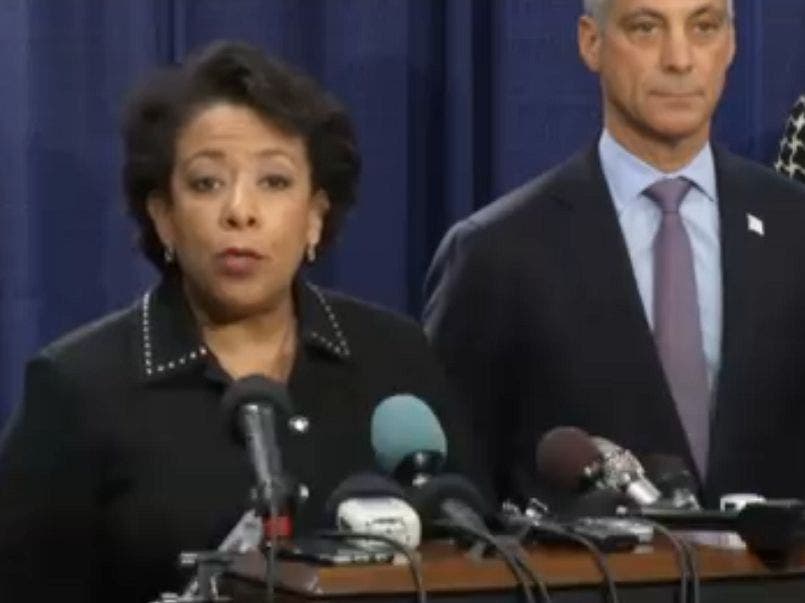
U.S. Attorney General Loretta E. Lynch and Mayor Rahm Emanuel discuss the findings of the Department of Justice's 13-month investigation that looked into the Chicago Police Department's use of force over the years during a press conference Friday, Jan. 13. (screen shot from video via the Office of the Mayor | City of Chicago)
ORIGINAL STORY:
CHICAGO, IL — The Chicago Police Department and Mayor Rahm Emanuel's administration are preparing for the release Friday of U.S. Justice Department's civil rights probe, which is expected to list a series of constitutional abuses by the force, two sources told the Chicago Tribune.
The results of the nearly yearlong investigation — prompted by city's handling of the Laquan McDonald shooting in 2014 — are expected to show a pattern of civil rights violations by officers in the department, the report stated. The probe, which has become the largest of its type by the feds, examined the use of force by CPD cops, especially as it pertained to racial and ethnic disparities, the report added.
Specific details concerning the report were not yet known. While it was unlikely the police department will be forced to adhere to required mandates, federal and city officials will probably agree to certain measures and guidelines to be followed, according to the Chicago Sun-Times.
RELATED: Drop Murder Case, Chicago Cop Accused of Fatally Shooting Laquan McDonald Asks Judge
Even before the probe's impending release, Emanuel and Police Superintendent Eddie Johnson have been rolling out efforts to improve city policing and the department's culture. Changes have included requiring all officers to wear body cameras, adding more street cops to the force and increasing training for officers.
Officials have been pushing for the investigation's release to happen before President Barack Obama leaves office next week, speeding up the report's timeline, which already was progressing at "a record pace," the Tribune reports.
RELATED: Laquan McDonald Shooting: How Did Chicago Mark the Tragedy 2 Years Later?
There is uncertainty about how President-elect Donald Trump will handle these types of probes and their recommendations, but his nominee for attorney general, Alabama Sen. Jeff Sessions, has objected to investigations critical to law enforcement, the report added.
Photo via Patch archive
Like What You're Reading? Stay Patched In!
Get more local news delivered straight to your inbox. Sign up for free Patch newsletters and alerts.