Politics & Government
Cook County Jail Monitoring Sewers For COVID-19, Cases Fall To 8
More than 1,600 inmates and more than 2,500 sheriff's office staff have been vaccinated so far, according to the sheriff's office.


CHICAGO — Rates of coronavirus infection in the Cook County Jail remain far lower than the wider community, but with rising numbers of new cases in Chicago and suburban Cook County, Sheriff Tom Dart warned the public of coronavirus complacency.
Eight out of the more than 5,600 people in custody at Cook County Jail were currently positive for COVID-19 as of Wednesday evening, according to the sheriff's office. All of them tested positive during the intake process, which means they had contracted the coronavirus before arriving at the jail.
The sheriff's office conducts more than 1,500 tests a week, with more than 1,200 detainees tested every week since February, according to its website.
Find out what's happening in Chicagofor free with the latest updates from Patch.
"The [Cook County] Jail successfully fought off the surge everyone experienced in the Fall and Winter, but we are one County, and each person's actions affect us all," Dart said in a statement Thursday. "Masks and social distancing are shown to work, and we continue to offer vaccines to every detainee and staff member."
Dart's office pointed to a study by researchers at Stanford and Yale universities published last month in the British Medical Journal. It determined jail officials' strategy of widespread testing of asymptomatic people and reducing the jail's population drastically reduced the number of cases in the jail studied.
Find out what's happening in Chicagofor free with the latest updates from Patch.
"Compared with what could have happened with only the implemented CDC-recommended interventions of phase 1, the model predicts a reduction of approximately 3100 symptomatic cases, 435 hospitalizations and 30 deaths over 83 days," the study found. "This suggests that the combination of interventions (depopulation, increased single celling and large-scale asymptomatic testing of incarcerated individuals) in addition to standard CDC COVID-19 mitigation strategies led to an 83% reduction in predicted symptomatic cases, hospitalizations and deaths."
During the first wave of the coronavirus pandemic in Illinois, the jail's population fell by nearly 30 percent, down to a record low of 4,000.
But recently, it has returned to pre-pandemic levels, limiting the ability of jail officials to keep inmates in single cells to maintain social distance.
EARLIER: Coronavirus Cases At Cook County Jail Down To 11, Sheriff Says
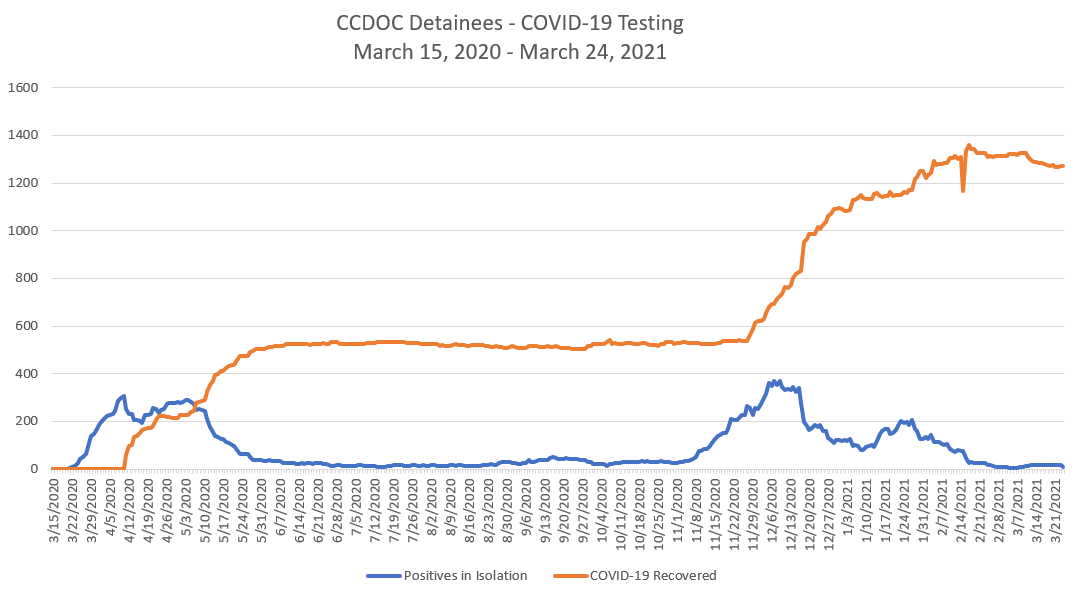
“When we work together and follow the recommendations of public health experts, we make great progress in defeating this pandemic,” Dart said. “We have done it before and we can do it again, but not without a renewed commitment to testing, following precautions and vaccinations.”
Cermak Health Services, the jail's health provider and a division of Cook County Health, has worked to educate detainees and sheriff's office staff on the importance of being vaccinated and administered doses on site, according to the sheriff's office.
More than 2,500 of the sheriff's office's approximately 5,550 employees have been vaccinated, and all have had an opportunity to receive a dose since those who live and work at correctional institutions were made eligible with the opening of Phase 1b of the state's vaccine distribution plan.
A total of 1,611 inmates have been jabbed at the jail as of Wednesday, according to the sheriff's office.
In addition to enforcing social distancing, mask use, increased cleaning and widespread testing, jail officials last month began twice-weekly COVID-19 surveillance testing of wastewater.
Bits of coronavirus RNA can be detected from wastewater about a week before a person will develop symptoms.
“So if they’re testing the wastewater and they start to see COVID but nobody in that area is symptomatic, we know we've got something going on and we need to target test in that building," explained sheriff's office spokesperson Matt Walberg.
Testing the water collected from the sewer lines at several spots around the jail's sprawling Little Village campus will also soon show which coronavirus variants are in circulation at the jail.
"It's really valuable. Wastewater surveillance on its own is helpful, but it's limited. Testing on its own is extraordinary helpful, but it's also limited," Walberg said. "But when you put those two ;things together, it helps you allocate resources for testing in a very targeted way."
Get more local news delivered straight to your inbox. Sign up for free Patch newsletters and alerts.