Seasonal & Holidays
Without Heat During IL's Extreme Cold: Here's What Officials Say To Do
An extreme cold warning is in effect. Experts share tips on what to do if your home's heating system fails during the cold.


With wind chills at dangerous levels, officials say residents should be prepared in case the heat goes out in their home.
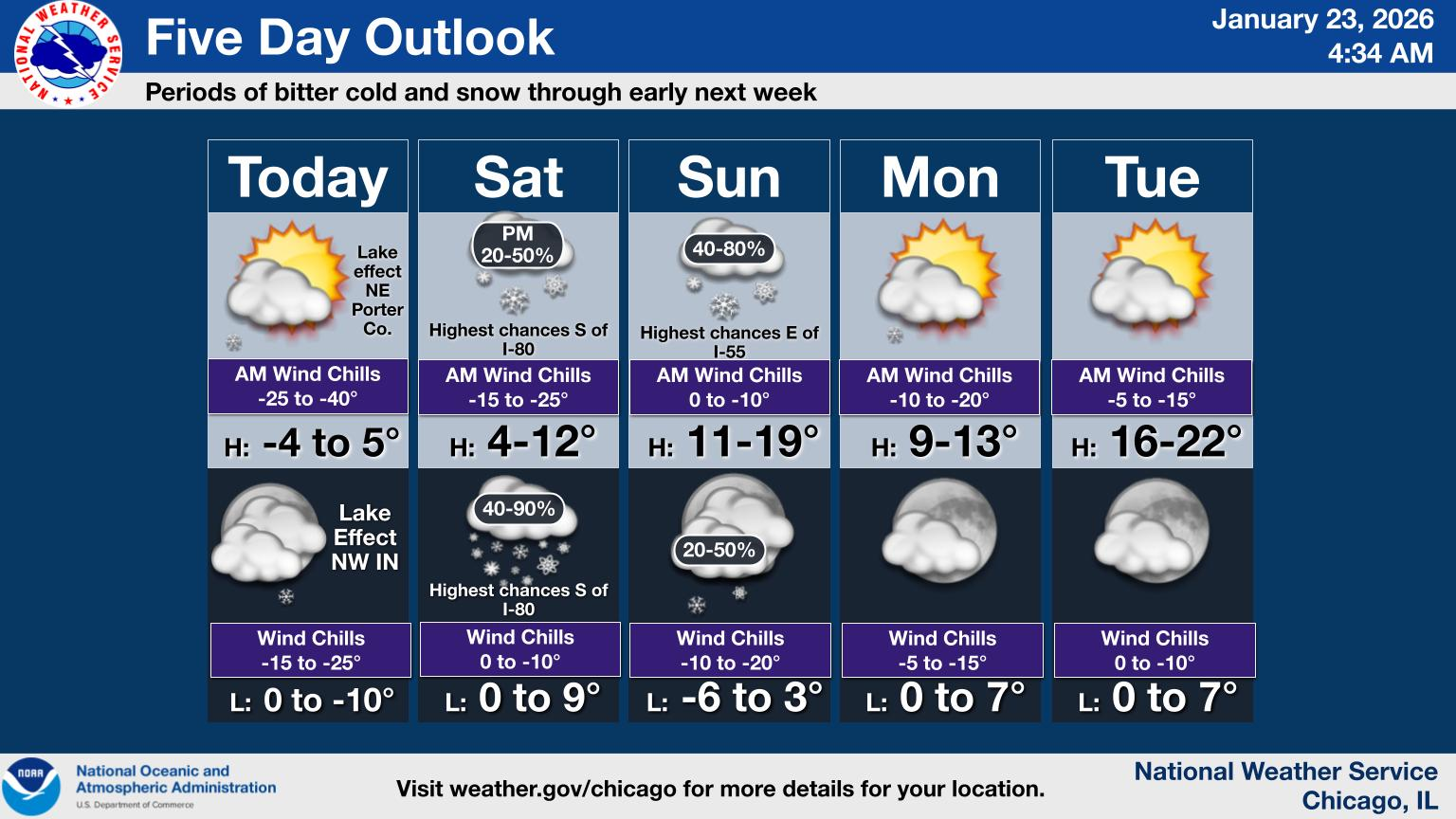
Chicago's extreme cold — which will hit the area hardest Friday with wind chills as low as -30 to -40 in the forecast — will remain for several days, with wind chill readings below zero in the forecast through Tuesday.
Typically, power grids can hold up after one day of cold weather, Douglas Giuffre, who leads U.S. power and renewables research for S&P Global Energy, told the New York Times.
Find out what's happening in Crystal Lake-Caryfor free with the latest updates from Patch.
RELATED: How Do IL Schools Decide To Close For Extreme Cold?: Officials Sound Off
But with a swath of winter weather, including arctic cold and heavy snow predicted from the Midwest to East Coast, energy resources could be taxed to their limits.
Find out what's happening in Crystal Lake-Caryfor free with the latest updates from Patch.
This has led grid managers to instruct the country's largest electricity providers to put off routine maintenance on power plants and lines to make sure resources are available during the arctic cold and snow storms that are in the forecast from the Midwest to the East Coast, according to the New York Times.
ComEd has been prepping for the extreme cold in the Chicago area. Ahead of Friday, the energy company implemented around-the-clock staffing, postponed all non-critical work and has generators and other equipment ready to go to assist with outages, said Thomas Dominguez, a spokesman for ComEd.
"Outages are most frequent when there are windy and icy conditions. But outages still occur during extremely cold temperatures, which is why ComEd takes steps to ensure it is ready to respond quickly to any customer interruptions," he said Thursday.
ComEd took other steps before winter hit. Crews inspected power lines and manholes to make necessary repairs as it readied for winter storms, according to a recent news release. In addition, ComEd has been investing in tree trimming and system upgrades to minimize the impact of storms, according to a new release.
“This is going to be a dangerous cold event that will spread across our entire system,” said David Perez, executive vice president and chief operating officer at ComEd. “Our teams are actively monitoring the system and are fully prepared to respond, with crews ready to restore any outages swiftly and safely.”
ComEd officials say that since 2011, when smart grid upgrades began, 24.7 million power outages "have been avoided" and overall reliability has improved "by more than 56 percent."
As of 9 a.m. Friday, ComEd crews were dealing with 19 total outages affecting 281 customers in the Chicago area, mainly caused by downed wires, according to the ComEd outage map.
What Health Risks Can Occur In Prolonged Cold?
Extreme cold increases the risk of several cold-related health conditions, local health officials said.
"People with pre-existing respiratory or cardiovascular conditions may experience worsening symptoms," said Nick Kubiak, public information officer for the McHenry County Department of Health. "The primary acute health concerns during periods of extreme cold are hypothermia and frostbite, both of which can be life-threatening if not recognized and treated promptly."
When it comes to losing heat in your home, hypothermia can develop after prolonged exposure to cold, which can mean temperatures under 60 degrees.
"There is no single timeframe (on when hypothermia will develop), as this depends on several factors, including the indoor temperature at the time heat is lost, the level of insulation in the home, outdoor conditions, and the age and health of the occupants," he said.
Warning signs can vary by age and infants and young children may have low energy, appear quiet or lethargic, feel cold to the touch and have bright red skin. Adults may experience intense shivering, confusion, drowsiness, slurred speech or clumsiness.
So, if your heat goes out and the indoor temperature dips below 60 degrees, this is when you should consider relocating to a water environment, such as a warming center. Especially, if the temperature cannot be safely maintained or restored, Kubiak said.
"Individuals at highest risk from cold exposure should prioritize relocating if their home becomes unsafe. This includes older adults, infants and young children, individuals with chronic medical conditions, and those with limited mobility or access to adequate heat," Kubiak said.
Where are warming centers located?
For those looking for local warming centers, you can call 2-1-1 to find out what is available near you. In Chicago, dial 3-1-1 to find the nearest city-run center.
Here is a county-by-county guide to warming centers:
- McHenry County warming centers
- Kane County warming centers
- Kendall County warming centers
- Lake County warming centers
- Cook County warming centers
- DuPage County warming centers
- Will County warming Centers
- City of Chicago warming centers
Fire Risks Associated With Extreme Cold
Alex Vucha, public information officer with the Woodstock Fire/Rescue District, said one of the biggest fire dangers during extreme cold comes when people try to heat a home using unsafe methods.
"This includes using ovens, grills, or generators indoors or too close to the home, which can lead to fires or carbon monoxide exposure," he said. "Overloading electrical outlets with space heaters is another common issue, as is placing heaters too close to combustible items like furniture, curtains, or bedding."
Fire risk also increases as people rely more heavily on supplemental heating sources, such as space heaters, fireplaces, wood-burning stoves and candles.
"Electrical fires are also more common due to increased demand on home heating systems and extension cords being used as permanent solutions," he said.
Ahead of Friday's extreme cold, residents should ensure their primary heating systems are working properly and that carbon monoxide and smoke alarms are functioning on every level of the home.
In addition, space heaters should be inspected, kept at least three feet away from anything combustible, and plugged directly into wall outlets, Kubiak said.
"People should also have an emergency plan in place, including a safe alternative location if heat goes out, and to be sure to check on elderly neighbors or anyone who may need assistance during prolonged cold weather," he said.
Energy Efficiency Tips
ComEd officials offers the following energy efficiency tips:
- Clear area around heating and cooling vents. Furniture, carpets, and other objects can block vents and prevent heated air from traveling. This blockage makes your heating system work harder and prevents rooms from warming up quickly.
- Clean or replace air filters once a month or as needed. Heating and cooling typically consumes the most energy in the average home. Dirty air filters make your furnace work harder to circulate air, which wastes energy and can increase your heating and cooling system costs.
- Weather strip windows and doors and seal cracks in your walls with caulk or foam. In most homes, the impact of air leaks on your energy use is similar to leaving a window open. Sealing air leaks to save you up to 15 percent on your heating and cooling costs.
- Set your thermostat at as low a temperature as possible to maintain personal comfort. The smaller the difference between the indoor and outdoor temperatures, the lower your overall cooling bill will be. Also, keep your house cooler than normal when you are away or sleeping, then raise the thermostat setting when you return home or wake up.
- When the sun is shining, open shades on south-facing windows and take advantage of natural light for warmth. Close the shades during the night to help insulate your home.
Stay Safe In The Cold
The Illinois Emergency Management Agency urges residents to practice cold-weather safety:
- Wear several layers of loose fitting, lightweight, warm clothing rather than one layer of heavy clothing.
- Wear mittens instead of gloves.
- Wear water-repellent clothing.
- Wear a hat.
- Cover your mouth with a scarf to protect your lungs.
- Make sure small children, infants, and the elderly stay warm. They are more vulnerable to the cold.
- Take advantage of warming centers, public park facilities, and heated stores and malls.
- Where possible, try to keep one room in your home heated to 68-70 degrees.
- Avoid drinking alcoholic beverages.
- Eat high energy foods and drink warm beverages.
- Beware of overexertion; shoveling snow or pushing disabled cars can be very strenuous and should only be done by individuals in good health.
Vehicle safety in cold weather:
- Make sure your car is in good operating condition before using it in extreme cold.
- Keep condensation (water) out of your gas tank by keeping the tank as full as possible.
- Maintain a storm kit in your car with items such as a cell phone and charger; blankets; extra clothing; jumper cables; a flashlight; high-calorie, non-perishable food; and matches or a lighter.
- Plan your trip carefully. If cold, snowy, or icy conditions exceed your ability or your car's ability, don't travel.
- Tell someone about your travel plans.
- Never leave the motor running in a vehicle parked in an enclosed or partially enclosed space, such as a garage.
RELATED: IL Cold-Related Death, Water Main Breaks, School And Court Closings Reported Ahead Of Dangerous Cold
Get more local news delivered straight to your inbox. Sign up for free Patch newsletters and alerts.