Politics & Government
Mayor Proposes Bypassing City Clerk With Appointed FOIA Officers
Evanston Clerk Devon Reid claims the change is "retaliation" for his lawsuit over access to emails and police body camera footage.


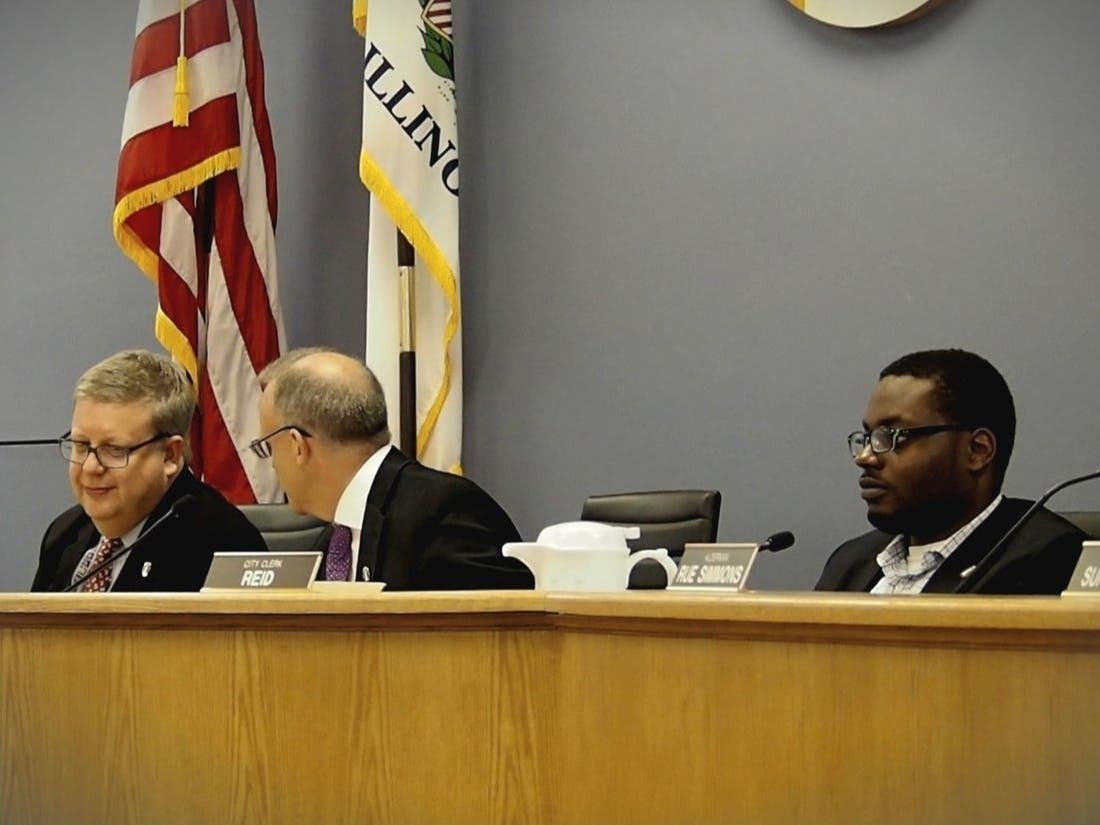
EVANSTON, IL — Aldermen are set to vote on a resolution to remove police and law department records from the jurisdiction of the elected City Clerk. Mayor Steve Hagerty introduced the proposal as a special order of business for Monday's meeting of the Evanston City Council.
Earlier this month, City Clerk Devon Reid filed suit against Evanston, City Manager Wally Bobkiewicz and Corporation Counsel Michelle Masoncup. He asked a judge to rule the city has been improperly keeping from his office Evanston police body camera footage and records city attorneys consider privileged.
Reid, who took office just over two years ago, is currently designated as the city's FOIA officer and is responsible for issuing responses to requests under the state's public records law. He claims Hagerty's proposal would weaken public accountability. If adopted, the policy change would further complicate answers to the unprecedented legal questions raised by Reid's lawsuit in Cook County Circuit Court.
Find out what's happening in Evanstonfor free with the latest updates from Patch.
Hagerty's memo does not mention the clerk's lawsuit. Instead, it cites data showing an increasing number of requests under the Illinois Freedom of Information Act from the year before Reid took office — 769 requests in 2016 — to the clerk's first full year in office — 1,394 requests in 2018.
The mayor suggested "designating additional FOIA officers will give the city more capacity to respond in a timely manner and is consistent with the city's past practice of having more than one FOIA officer." Previously, deputy clerks were formally declared FOIA officers, rather than the Clerk and his or her designee. The mayor has not responded to queries about his proposal. Reid described it as a "solution to a non-existent problem" that "wouldn't even solve that problem."
Find out what's happening in Evanstonfor free with the latest updates from Patch.
The new structure would move any requests for Evanston Police Department records to the department's records manager, who would be designated as a FOIA officer.
"FOIA requests that involve Law Department records or review of applicable exemptions will be processed by an Assistant City Attorney," the memo said. According to the new policy: "After a determination of legal compliance is made in conjunction with the Law Department, each FOIA Officer is responsible for closing a request assigned to him/her."
Reid said there was a public expectation that the person in charge of public records requests be an elected official solely accountable to the public as an advocate for transparency. He recounted times when each of the potential new FOIA officers suggested by the mayor had initially tried to block the disclosure of information that should have been released to the public.
"There've been a number of instances where information should be released. It was going to be denied. My office stepped in and ultimately got the information released," Reid said. "And that happens only because of our independence and the way we that see our role as FOIA officers and an advocate for the public interest."
In a request for records of "gang member identification criteria" collected by the Evanston Police Department's neighborhood enforcement team, the police and law department initially refused a request from a Loyola University law student. City officials claimed the records were exempt as drafts and would put people in danger even if their names were redacted. Reid wrote to the office of the Illinois Attorney General after the law student challenged the city's denial.
"The city's police records bureau has on many occasions refused to release responsive documents to the FOI officer. The above interpretation was provided by the legal department and as FOI officer I disagree. I believe the requested documents can be redacted and released," Reid wrote, asking the office of the public access counselor in former Attorney General Lisa Madigan's administration to advise Evanston's police and law on how responsive records must be provided to him.
In that case, the law department reversed course and provided nearly 800 pages of its gang member database going back to the 1990s with names and birthdays removed.
A more recent case concerned redacted emails provided in response to a request for information about letters of intent for the new Robert Crown Community Center. Reid said the law department had attempted to improperly cite personal privacy as a reason to redact the names of businesses before he pointed it out and they relented.
In another case in recent months, a member of the public was seeking the list of the city's 30 largest providers of sales tax revenue. The department head who supervises the employee who the mayor's proposal would appoint to "serve as the secondary FOIA officer for all remaining requests" recommended the city deny the request, according to Reid. But the clerk stepped in and established the list of businesses was not exempt, just the dollar amounts of what they provide to the city.
Reid said there was a public expectation in Evanston that there should be an independent review of records released through under state public records law, especially police records.
"It's what I ran on — that I would look at these kinds of records and ensure that things are being conducted on the up-and-up, legally, protecting folks' rights," Reid said. "I'm partially elected because I was able to stand up for my rights and the rights of other folks who look like me when I was falsely arrested for petitioning in downtown Evanston. I'm very well-versed in folks' rights and police encounters. So I think there's definitely an expectation that the clerk, the FOIA officer, that I have some duties there — and it protects the municipality from liability."
The clerk suggested that if he had reviewed the notorious dashboard mounted camera footage of the arrest of then-Northwestern University doctoral student Lawrence Crosby, taxpayers might have been saved the seven-figure settlement aldermen adopted earlier this year. Adding extra FOIA officers to bypass his office would "take away what would be a great public service," Reid said.

"Having an independent elected official having a set of eyes on these videos that are released via FOIA, the bodycam videos, to have an extra level of not only transparency, but to ensure we're not maliciously prosecuting folks. We've done this on more than one occasion," he said. "These videos are typically FOIA'd before a lawsuit happens, and it's just good to have an independent officer reviewing this and raising these issues before it rises to the level of a $1.25 million lawsuit that's settled."
The clerk said an elected official as the city's lone FOIA officer was the "gold standard" in transparency, but he was unable to immediately point to any other town that has a similar system. Hagerty's memo, on the other hand, pointed to several other suburban municipalities where police departments are responsible for handling their own records requests.
In September 2017, aldermen considered replacing Reid as FOIA officer in response to concerns he was allowing too much information to be posted online. Settings on the city's online public records management system were switched to private and the number of public records requests increased the following year.
"Let's be clear, this will put information that could potentially reveal unethical/illegal activity by city staff or elected officials, under the authority of an individual who either reports to elected officials or directly to the city manager," Reid said at the time. "Having an elected official who's willing to partner with the community to locate public records is a valuable arrangement that truly represents Evanston's progressive values."
In December 2017, the city adopted an updated policy that kept the clerk as the sole official FOIA officer. No member of the City Council seconded a motion from 1st Ward Ald. Judy Fiske calling for the law department to be designated as a FOIA officer along with Reid.
If a majority of aldermen agree with Hagerty's proposal at the May 27 meeting, the new policy could take immediate effect. The first hearing in Reid's lawsuit is set for June 12.
Earlier:
- Evanston City Clerk Sues City Attorney, City Manager Over FOIA
- City Pays $1.25 Million To Man Accused Of Stealing Own Car
- Evanston Reaches $1.25 Million Settlement In Lawrence Crosby Suit
- City Council Approves New FOIA Policy
- Aldermen Vote To Take FOIA System Offline, Reconsider Clerk's Role
- Emails, Police Report Detail Evanston City Hall 'Witch Hunt'
Get more local news delivered straight to your inbox. Sign up for free Patch newsletters and alerts.