Health & Fitness
'Believing You Are Right Even When You're Not'
Feeling like you know something feels the same as actually knowing something.


[Author’s Notes: The opinions and comments in this article are my own and should not, in any way, be construed as being the opinions of any organization with which I am afilliated or municipality, it’s staff, or any of it’s elected officials.]
I recently I listened to Stephen Colbert interviewing science evangelist extraordinaire Neil deGrasse Tyson from back in 2010. One of Mr. Colbert’s questions ... a fairly common philosophical one ... struck a chord with me. “Is knowledge always good?”
Find out what's happening in Genevafor free with the latest updates from Patch.
When this question of knowledge being good or bad is asked, it is frequently in relation to a technology that we sometimes think we might be better off without ... and many of you reading here have already conjured the image of a nuclear bomb. “Wouldn’t we be better off without nuclear weapons?” one might ask. Maybe. But, like many seemingly inscrutable questions, this one begins to fall apart when we begin to analyze the validity of whether it is appropriate to make such “good” or “bad” judgments on knowledge.
As Mr. Tyson points out; if we are judging our recently gained knowledge of nuclear physics because it precipitated a horrible weapon, then we should similarly be judging the merits of our other discoveries based on their unintended consequences. Discovering DNA has given us some of the greatest insights into disease and avenues to reduce suffering, yet it comes with ethical issues like designer babies and embryonic stem cell therapies. Our discovery of how to smelt iron ushered us into a new human era but yielded weapons of destruction never before dreamed of. Good and bad is not in having the knowledge, but in what we do with it. Indeed; we put ourselves at a disadvantage when we try to attribute such subjective values to knowledge.
Find out what's happening in Genevafor free with the latest updates from Patch.
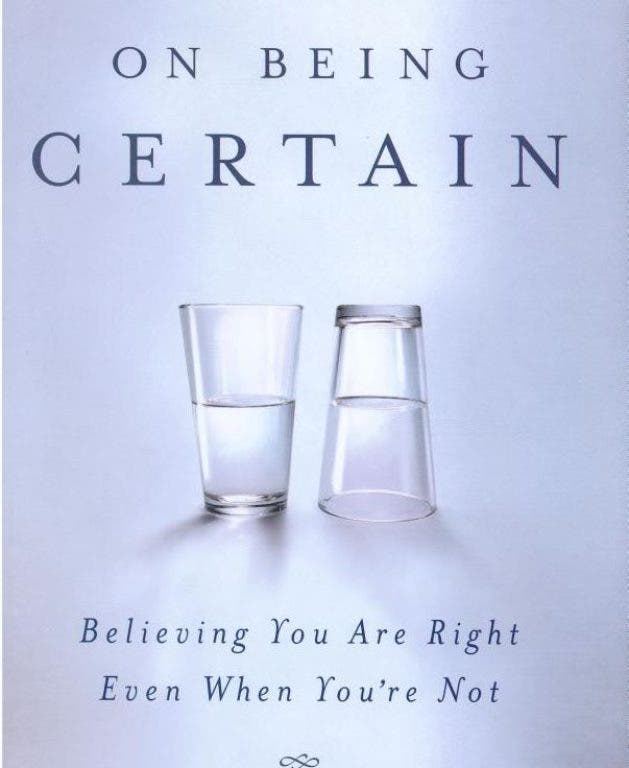
I have come to value more and more the fields of brain science that deal with human cognition and have found myself well-served by the enlightening book “On Being Certain: Believing You Are Right Even When You’re Not” by Robert Burton M.D.. (you can watch him lecture on his book [here]). In it he effectively describes the neurological underpinnings of [what he calls] the “Feeling Of Knowing” and he shows us how it is a “primary” emotion in the class of “fear” and “joy”. I sought this book out because I was puzzled how some people could be inexplicably confident in their “knowledge” of some things that they couldn’t possibly know...or even directly contradicted by evidence. This book shines an informative light on how we come to that feeling of knowing and how that feeling relates...and very frequently doesn’t relate...with facts or some reality.
The important takeaway is that the Feeling of Knowing may only be loosely related to some objective truth. This is illustrated in the book through a recounting of brain research and many [sometimes jaw-dropping] examples of just how unreliable our brains are at associating knowing with facts. One example:
The day after the shuttle Challenger exploded after take-off, psychologist Ulric Neisser asked 106 of his students to journal all the details that they could remember about the event, where they were and what they were doing when they heard of the news and then sign the journal. Two and one-half years later he had those same students recount the details of that day from memory. Fewer than 10% got the details correct and 25% gave dramatically different accounts! One student, when confronted with their original, wildly differing, handwritten account answered “That’s my handwriting, but that’s not what happened.”!
The science is presented for a popular audience and is not off-putting. We learn that the Feeling of Knowing is something that we seek as its own reward. Importantly, we can (and often do) stimulate that same brain center through other mechanisms other than assimilating objective facts and evidence. Meditation, prayer, psychoactive drugs and electrical stimulation are some of avenues by which we can “know” something independent from some reality. From the perspective of the human mind; feeling as though you know and actually knowing are one and the same. This goes a long way in helping us understand how people fall into inexplicable and rigid ideologies.
The reason I spend so much time on the book is because it greatly informs our response to “Is knowledge always good?”. Knowledge (or the Feeling of Knowing) is pleasant and is something that we seek out at a very primal level. Moreover; NOT knowing is a rather UNpleasant feeling...something that needs to be quenched. For example, the human animal is not satisfied with not knowing why the sun moves across the sky, so we make stuff up to answer the unknowable. In ancient times the Greeks convinced themselves that Helios the sun god was driving his flaming chariot. As someone once said, “We prefer a conspiracy theory to no theory at all.”
So, given the primal drive to achieve that Feeling of Knowing; I would say that knowledge is inevitable. With seven billion people and seven billion brains working continuously and independently on autopilot trying to answer questions; society has a fire hose of knowledge trained upon it. It would be naive to think that we could just turn off that impulse on the chance it might precipitate something unpleasant. Nor would we even be able to anticipate the unpleasantness until we already had the requisite knowledge.
Time marches on. Knowledge is what brought us from the dusty plains of Africa into the stone age and through the epochs to advanced medicine, air travel and smartphones. Would we be more or less happy without our accumulated knowledge? Would our earliest hunter-gatherer relative been able to enjoy that same life-satisfaction that we might today? Probably. Happiness is relative to the baseline of your existence.
So; Is knowledge always good? It doesn’t matter, we have no choice in the matter. Our task is to separate the false knowledge from the actual knowledge and then act thoughtfully and ethically with that knowledge. That’s no easy task.