Health & Fitness
WATCH: Fermi's NOvA Detector Is HUGE!
Fermilab is building an enormous plastic neutrino detector in Minnesota. Last week, I got a chance to see the detector in progress, and the complex process of bringing it to life.
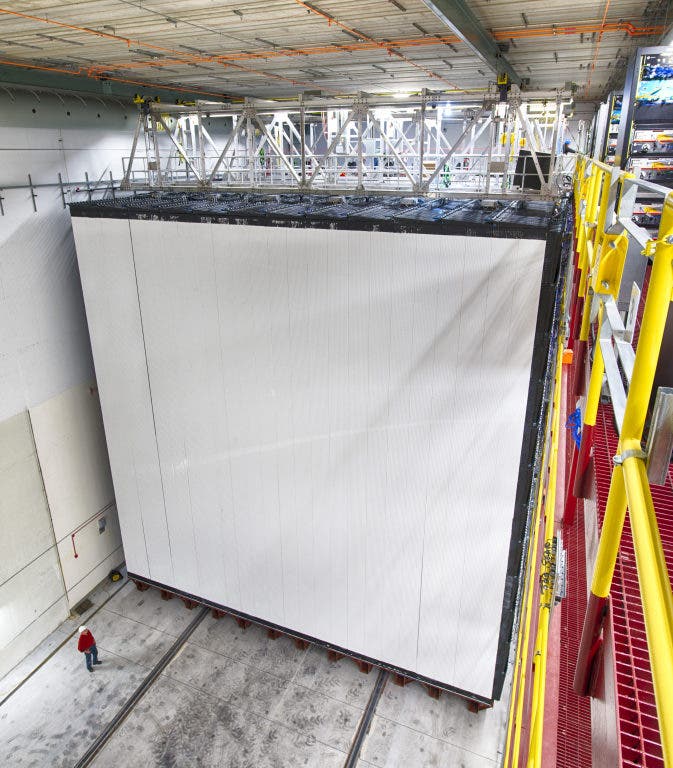
I’ve been talking and writing about our NOvA neutrino experiment for months. Last week, I finally got to visit the construction site in person. And let me tell you, this particle detector we’re building? It is HUGE.
We believe it’s going to be the world’s largest free-standing plastic structure. It’s called the NOvA far detector, and it’s under construction in a remote part of northern Minnesota. When this device is completed, we’ll fire a beam of neutrinos at it through the earth, aiming to learn more about these tiny particles and the role they play in our universe.
I’ve told people the statistics of the detector we’re building so many times that I’ve lost count. It’s being constructed in pieces — 28 plastic blocks that measure 50 feet by 50 feet by 8 feet, each block weighing 440,000 pounds, even before they’re filled with oil. The whole thing will be more than 200 feet long, and weigh more than three space shuttles.
Find out what's happening in Genevafor free with the latest updates from Patch.
Yeah, I’ve been talking about how big the detector-in-progress is. But nothing prepared me for actually seeing it.
I spent the last week in Minnesota, getting an up-close and personal look at the creation of this device, and trying to wrap my head around the vast and complex process of bringing it to life. I visited both the NOvA detector hall just outside Orr, near the Canadian border, and the factory in St. Paul where University of Minnesota students assemble the modules used to build the detector.
Find out what's happening in Genevafor free with the latest updates from Patch.
What struck me most about the process is how human it all is. The NOvA project includes hundreds of people from several states, and they all work together like meshing gears.
The parts for the detector come from all over — the fiber optic cable comes from Japan, the PVC extrusions used to make the modules come from Wisconsin, other plastic parts come from other suppliers — and they all converge on the module factory in St. Paul, where 250 undergraduate students, working in shifts of 10 hours or so a week, put them together with remarkable precision.
And when I say precision, I mean it. The modules have to be cut to exact specifications. The fiber optics must be snipped to the right length, within microns. Even the glue must be applied exactly right – there are two adhesives, one that holds the modules together, and another that acts as a watertight seal, keeping the first adhesive from coming in contact with the oil.
You’d think it’s a lot to trust to students, but these undergrads have truly taken ownership of the project. Every one I talked to was enthusiastic, not just about his or her part in the great NOvA machine, but about the importance of the work as a whole. They get it, and they’re excited about it.
When those modules leave St. Paul and arrive by truck at the NOvA detector hall, a more complex dance begins. The NOvA hall is largely underground and mostly wide open space, more than four stories high and half a football field wide. At one end is a massive pivoting machine, essentially a giant moveable steel table on wheels, and crews use large cranes to assemble the 50-foot-wide modules into blocks on that machine.
At the other end is the detector. Nine of the 28 blocks are now in place, so it fills up more than a quarter of the hall. It’s bigger than I will be able to convey to you in words. I felt impossibly small standing next to this thing. Assembling one of the blocks takes about two weeks, and then, amazingly, the crews move it into place – the block and the pivoter together weigh about a million pounds, and they drive them 200 feet and tilt the block vertical in about five minutes.
It’s an incredibly complicated process, and I’m astounded at how smoothly the whole thing operates. We talk about experiments like NOvA in abstract terms, focusing on the science of neutrinos and what the eventual data will tell us. But the human side of the story, the good old sweat and mechanical engineering side, is just as interesting.
It takes a lot of well-trained people working a lot of hours to pull something like this off, and watching it come together is impressive, to say the least. I’m glad I got the chance to see the construction of the far detector in progress, and to meet some of the people responsible for building it. My hat is off to them.
You can follow the progress of the NOvA far detector on our live webcam here.
Andre Salles is the media and community relations specialist at Fermi National Accelerator Laboratory. He can be reached by calling 630-840-6733, or emailing asalles@fnal.gov.