Schools
Explore the Uses of Artificial Intelligence in Science March 18
Explore the Uses of Artificial Intelligence in Science March 18 at College of DuPage
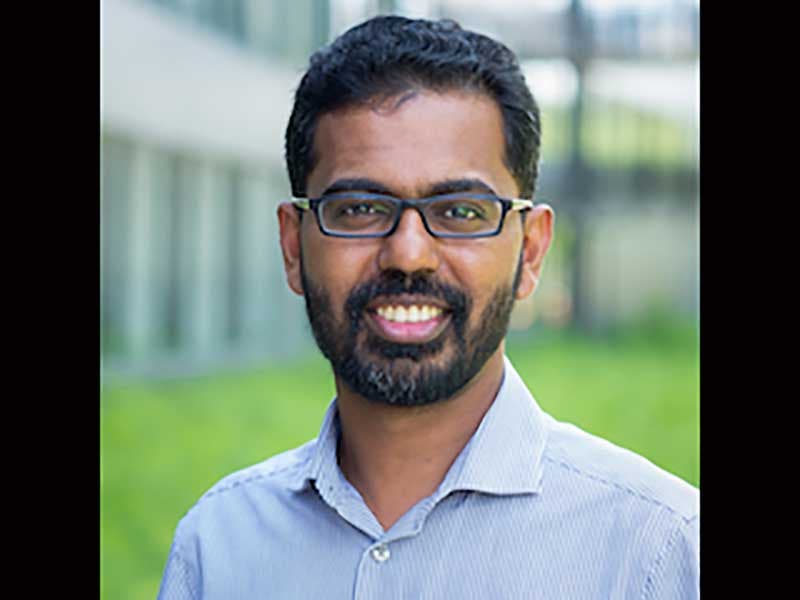
Argonne National Laboratory researcher Prasanna Balaprakash will discuss artificial intelligence’s impact on the development of advanced technologies at 4:30 p.m. Wednesday, March 18, in the Jack Turner Conference Center, Student Resource Center Room 2000, on the College’s Glen Ellyn campus, 425 Fawell Blvd.
This free event is part of the College’s STEMinar series.
A computer scientist in Argonne’s Mathematics and Computer Science Division with a joint appointment in the Leadership Computing Facility, Balaprakash leads the machine-learning team and co-leads the data-understanding team in the Institute for Resource and Application Productivity through computation, Information, and Data Science (RAPIDS) at the Laboratory.
Find out what's happening in Glen Ellynfor free with the latest updates from Patch.
Based on his work in the lab, Balaprakash said that artificial intelligence and machine learning are fundamentally changing the way scientists do research as well as our understanding of the world.
“In traditional problem solving, we think about the problem and figure out how to solve it,” he said. “Similarly, in traditional computing, we have to tell the computer how to solve a problem. When we run into complicated problems that we can’t find a solution for, we can be at a loss. With AI, we don’t do that. We just give the computer examples through data and the computer learns how to solve the problem.”
Find out what's happening in Glen Ellynfor free with the latest updates from Patch.
That being said, Balaprakash added that artificial intelligence has potential to greatly benefit humankind.
“As computing power becomes cheaper and we continue to generate more and more data, machine learning and artificial intelligence provide unprecedented opportunities to solve problems and create beneficial technologies or treatment plans for diseases like cancer or Alzheimer’s.”
Balaprakash earned his bachelor's degree in computer science engineering from the Periyar University in Salem, India, and his master's degree in computer science from the Otto-von-Guericke University Magdeburg in Germany. He received his Ph.D. in engineering sciences from CoDE-IRIDIA, Université libre de Bruxelles, Brussels, Belgium, where he received Marie Curie and F.R.S-FNRS Aspirant fellowships. A recipient of the U.S. Department of Energy 2018 Early Career Award, Balaprakash is a Fellow in the Northwestern-Argonne Institute of Science and Engineering at Northwestern University and holds a Scientist At-Large appointment in the University of Chicago Consortium for Advanced Science and Engineering. His research interests include artificial intelligence, machine learning, optimization, and high-performance computing focused on the development of scalable, data-efficient machine learning methods for scientific applications.
Seating for his event is limited and pre-registration is required for this event. Click here to learn more and to register.
The STEMinar Series at College of DuPage consists of free talks covering a variety of topics related to Science, Technology, Engineering and Math throughout the fall and spring semesters.
View videos of previous STEMinars at COD.
The goal of STEM at College of DuPage is to enhance the quality of STEM instructional and outreach programs and to help current and future students prepare for careers in STEM fields. COD offers a broad range of academic programs designed to provide students with the educational background and training needed to successfully pursue an advanced degree or career in STEM.