Politics & Government
Village Fights To Block Pension Benefits To Dead Officer's Son
Two courts have rejected Glenview and its pension board's claims that children of divorced parents are ineligible for full death benefits.


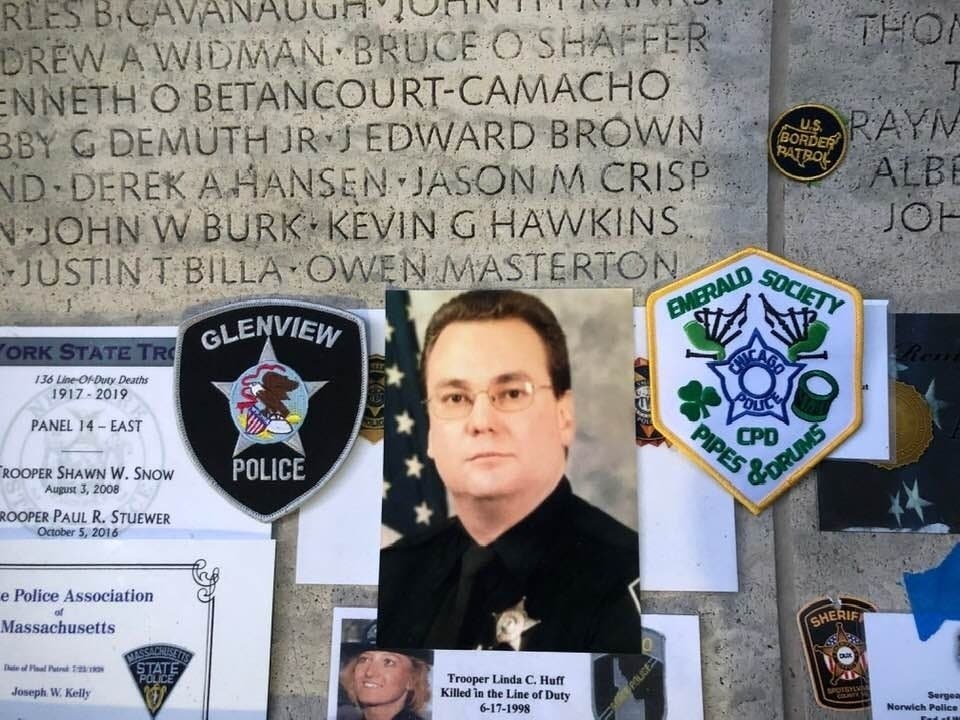
GLENVIEW, IL — A second Illinois court has rebuked Glenview and its police pension board for misinterpreting state law to deny survivor benefits to the son of an officer who died at work because he was divorced.
Even as the Glenview Police Department announced it was an honor to see the officer’s name added to the National Law Enforcement Memorial to those that have died in the line of duty, the village has continued to rack up tens of thousands of dollars in legal bills from outside attorneys in an effort to avoid paying full survivor’s benefits to the late officer’s son until he turns 18.
This month’s denial of an appeal by lawyers for the village and the board in the 1st District Appellate Court effectively upheld a March order from a judge in Cook County Circuit Court. That ruling reversed a 2018 decision by the Glenview Police Pension Board that found dependent children of divorced officers were ineligible to receive line-of-duty death benefits.
Find out what's happening in Glenviewfor free with the latest updates from Patch.
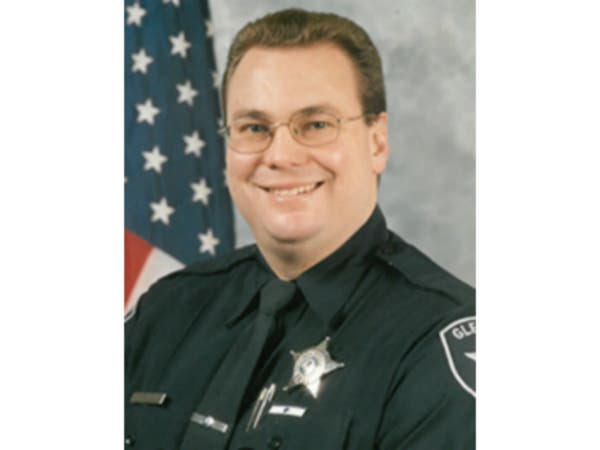
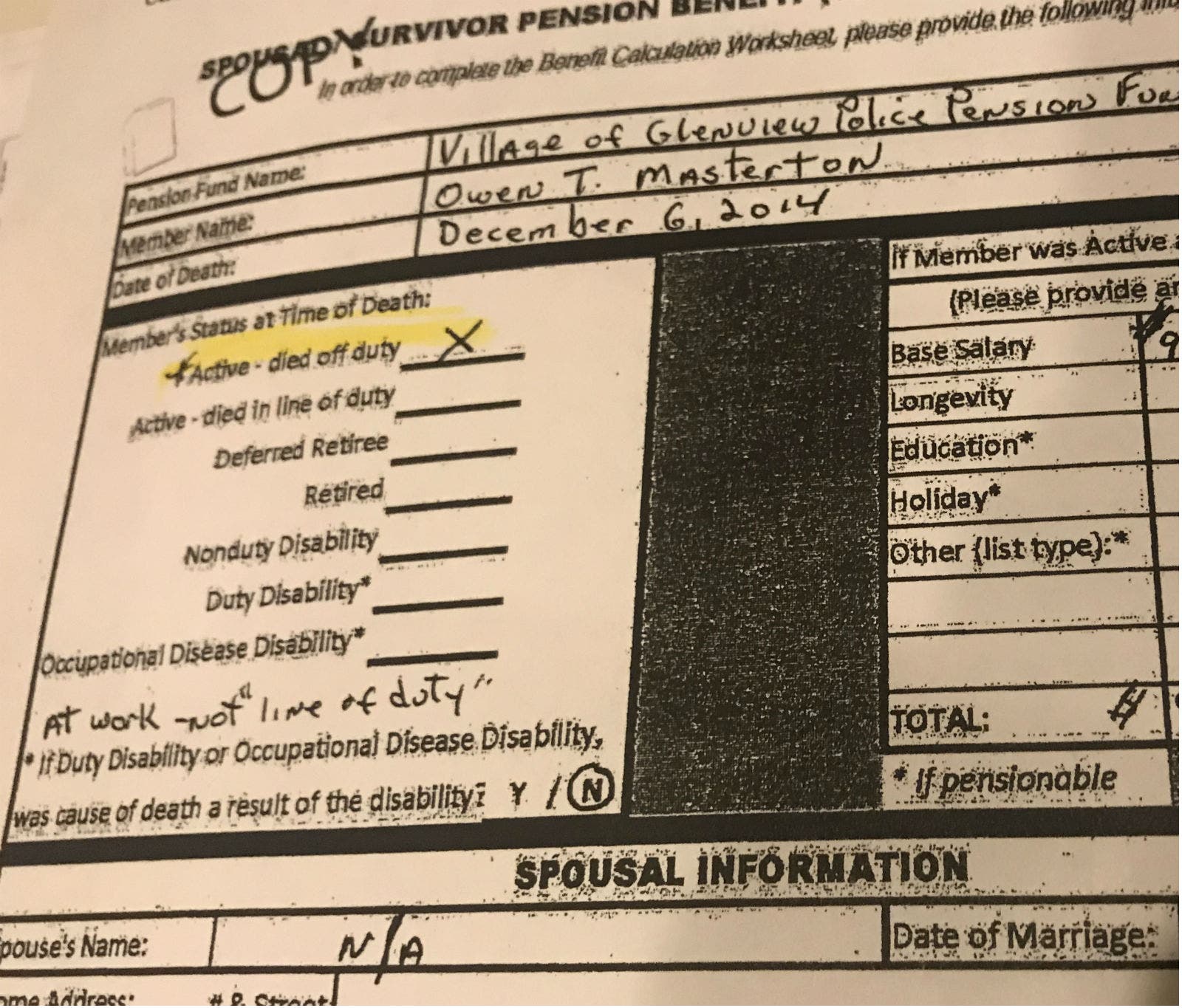
Officer Owen Masterton died at the age of 42 on Dec. 6, 2014, at the Glenview Police Department after beginning an overnight shift. That day, he had finished a 14-hour shift before attending a holiday party hosted by the department in the morning and afternoon. He suffered a fatal heart attack at roll call and was pronounced dead that evening.
At the time, Masterton had worked for the department for 19½ years, including as a firearms instructor, in the community relations unit and as an evidence technician. He had been divorced for less than a year from the mother of his 10-year-old son.
Find out what's happening in Glenviewfor free with the latest updates from Patch.
"He was a fine officer," Chief William Fitzpatrick said at the time. "He served this community for more than 19 years and was well respected among his peers."
According to pension code, survivors of officers with 20 years of service are entitled to full pensions, regardless of whether their death is deemed to have occurred in the line of duty. Any officer who dies as a result of performing their duty is due a full pension, according to the code. But survivors of police with between 10 and 20 years of service who die outside the line of duty are due only 50 percent of their pension. Specifically, the code says that any “police officer who suffers a heart attack or stroke as a result of the performance and discharge of police duty shall be considered as having been injured in the performance of an act of duty.”
But Glenview’s Police Pension Board never made a ruling on whether or not Masterton’s death was in the line of duty or not. In a 3-2 vote on Feb. 1, 2018, the board dismissed the matter, finding that Masterton’s son would have had to be a “surviving spouse” to qualify for death benefits. Trustees George Colis, Robert Francois and Michael Untiedt voted to dismiss. Board President Kevin Christell and Secretary James Foley dissented and called for a hearing on the merits of the case.
“It’s ridiculous that they would think that an officer who’s not married — it doesn’t matter how they get killed — the fact of the matter is that if they’re not married, Illinois wouldn’t consider that a line of duty death,” Kelly Masterton, the officer’s ex-wife, told Patch. “It’s ridiculous. It’s preposterous. Nobody would ever say that. Like somebody could get shot in the head and your first question is, ‘Oh, was he married?’”
The following month, the Department of Justice’s Public Safety Officers’ Benefits Office determined that Masterton’s death had been caused by a heart attack less than 24 hours after an on-duty situation involving nonroutine stressful physical law enforcement activity.
Later in March 2018, Masterton’s ex-wife filed a suit on behalf of their son asking a judge to reverse the pension board’s decision and find that the officer’s death was in the line of duty. It said the board’s decision was out of step with a clear reading of the law and the intent of the legislators who wrote it.
Under a hierarchy laid out in the statute, surviving spouses receive the benefits unless they remarry or die, in which case the pension payments go to any unmarried dependent children of the officer. If there’s no eligible spouse or child, the benefits go to the officer’s dependent parents.
“The court should understand very clearly what the board is suggesting: that the fact that this police officer died in the line of duty but was not married means that his surviving dependent child, who is under age and presumably is in far greater need of funds for his future having lost his father, is simply out of luck due to the legislature not repeating the same language [regarding order of succession for benefits],” argued attorney David Stepanich. Lawmakers could not have intended such an outcome, he wrote. “[T]he spirit and purpose of the Act dictate otherwise. How is one to tell a dependent child, who is after all dependent, the fact that his parents are divorced, another difficult fact of the dependent child’s life, that he is therefore not entitled to the same money that another child would be under the circumstances.”
In a later brief in support of his argument, Stepanich said it was clear what the legislature meant in the “Pension to Survivors” section of the code.
“It should not go without noting that as the Glenview Police Pension Board continues to attempt to put up roadblocks to deprive a minor child of benefits to which he may be entitled while he is still a minor, time is being lost and he is harmed by not having the additional funds available,” he said. “[T]he legislature’s reference to ‘survivors’ and line of duty benefits should be controlling and demolish the Glenview Police Pension Board’s cynical and specious argument.”
The judge agreed, finding last month that the pension board relied too narrowly on the use of the phrase “surviving spouse” in a portion of the Illinois Pension Code and sending the case back to the board for further proceedings.
“[T]he Board’s interpretation of Section 112 [of the Illinois Pension Code] appears to lead to manifestly unjust results. As it found, an officer such as Masterton who died (arguably) in the line of duty, with almost 20 years of service and children but with no spouse, would be entitled to only a 50% survivor’s pension, while an officer otherwise similar but with less than 10 years of service would receive a 100% pension. Similarly, an officer whose spouse predeceases him would see any children receive only half of the benefits an officer with a surviving spouse would otherwise receive,” wrote Cook County Associate Judge David Atkins in a March 22 opinion.
“The court presumes the legislature did not intend these results.”
The following week, the attorney for Masterton’s ex-wife wrote to lawyers for the board and village requesting a meeting and the consideration of line of duty benefits without the added cost of another contested hearing.
But instead, the village appealed the judge’s order, having its outside attorneys compile a 34-page brief arguing the pension board never had the authority to consider a change in survivor benefits because more than 35 days had passed — an argument the pension board already rejected and did not attempt on appeal — and also that line of duty survivor benefits cannot be awarded to unmarried children. The pension board also appealed after agreeing unanimously to do so at its May 9 meeting.
Paul Denham, an attorney for the village, asked the appellate court to reverse the circuit court decision, noting it “will considerably shorten this litigation and potentially save taxpayer-funded Defendants from significant costs in starting the pension investigation and hearing process over ‘from scratch,’” according to his petition for leave to appeal.
That petition was denied earlier this month. An attorney for the pension board did not immediately respond to a query about the board’s plans for a future hearing on the matter.
According to billing records, attorneys for the village and pension board had billed more than $40,000 in legal fees to fight the claim as of the end of March.
But that sum does not include money billed the lawyer for the pension board or the village’s outside attorneys from the Rosemont-based law firm of Clark Baird Smith to work on lengthy appeals briefs. It also does not include staff time of salaried village staff who have taken part in the matter after the village filed a motion to intervene in the pension board process.
"Our thoughts and prayers continue to be with Owen’s family," said Village Manager Matt Formica. "At the same time, the Village has a fiduciary responsibility to the taxpayers of Glenview to ensure that public safety pension benefits are provided in accordance with State law."
Earlier this month, Masterton’s name was added to the National Police Memorial in Washington, D.C. Glenview Police Cmdr. Pat Shuster accompanied the late officer’s son and ex-wife for ceremonies as part of National Police Week.
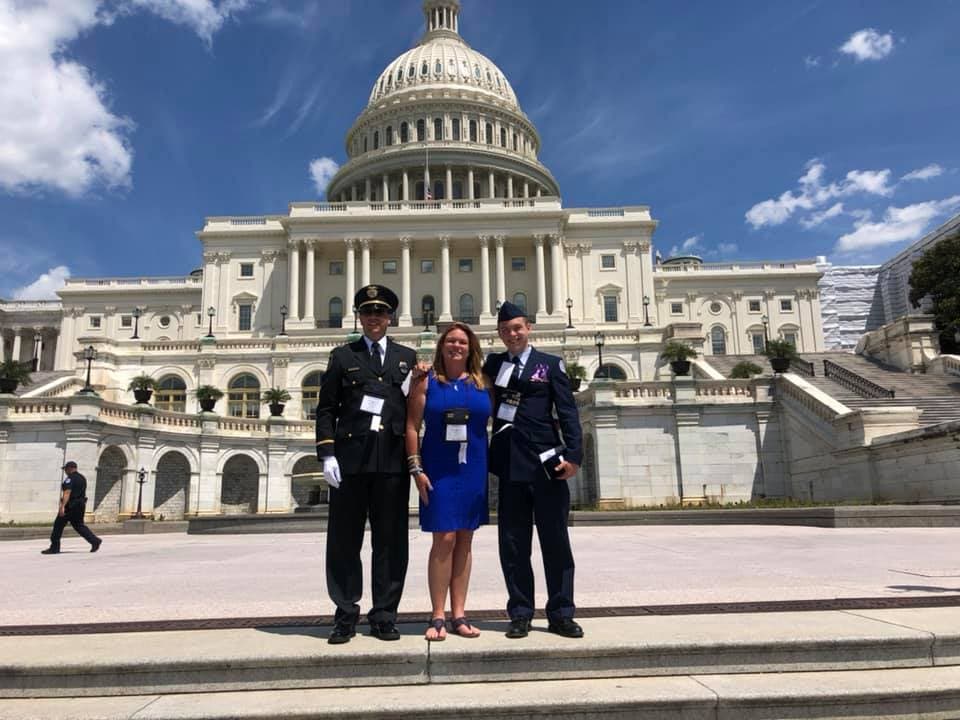
In a social media post, the department said it was “honored” to have Masterton added to the police memorial during National Police Week. It did not mention the efforts by the village and the pension board to deny survivors benefits to the officer’s son.
The difference between the full line of duty death benefit and the non-line of duty benefit provided to Masterton’s son comes out to about $371,000 from the pension board. Because the death was not considered on the line of duty, the pension is taxable, giving the son about 25 percent of what he would have received if his father’s death at the station had been considered to have occurred in the course of his duties, according to his mother. If he turns 18 before the matter is determined, he could still be eligible to receive the difference in benefits, leaving the village and board on the hook for the original amount on top of an as-yet undetermined amount in attorneys’ fees.
In addition to the loss of a full pension until age 18, the board’s ruling blocked Masterton’s son from receiving grants from nonprofit foundations who provide support to families of fallen police officers, including summer camps with specialized counseling for kids up to age 14 whose have a dead officer as parent, Ms. Masterton said. She believes the village and police department was unprepared for her ex-husband’s death because it has never recorded an on-duty death before. Formica, the village manager, confirmed Masterton was the first officer to die while on duty, and said he believed the pension board had never before awarded line of duty death benefits.
“Really, it seems like nobody knew what to do, like they didn’t have a plan because they assumed nobody would every die on duty and then after it happened nobody knew what to do,” she said.
The village did not provide any records of how much time Village Attorney Eric Patt has spent working on the case in a response to a request for the total amount of public money fighting over benefits to Masterton’s son, and village spokesperson Lynne Stiefel said Patt never attended a pension board meeting. But village staff did attend the relevant meetings of the pension board, according to minutes from the meetings posted in response to public records requests. At one hearing, Ms. Masterton said an attorney for the village suggested the board should dismiss the benefit request.
“He said the pension board ‘better remember who funds their pensions.’ And that was before they went into their closed meeting for the vote and all that,” she said.
The pension board’s attorney, Rick Reimer, has declined a request for an interview on the subject. Ms. Masterton recalled his explanation for why he advised the board to dismiss her claim.
“‘I have not directed them how to vote, but I have explained to them what will happen either way that they do vote.’” she said Reimer told her. “And he said, ‘I could have it just not be a vote, and I could tell them to all vote yes, but that would set national precedent and I don’t feel like doing that at this time.’”
Village President Jim Patterson chose not to comment on the matter, citing the fact it remained before the pension board, which is a separate public body from the village. He declined to say whether the village board approved spending more than $26,000 on outside attorneys, whether trustees voted to appeal the circuit court decision that rejected their argument or what message the village's legal intervention before the pension board — seeking to deny benefits to the minor child of an officer — sent to other public safety employees in the village.
Stepanich, the lawyer for Masterton's ex-wife and son, said he expected the village to continue to contest the benefits throughout a costly hearing process and seek to appeal that decision if it did not go their way. He admitted he would do the same thing if the board rejected the benefit request.
“I’ve told them that we will pursue every remedy as long as it takes in order to get this boy what the legislature wanted him to have,” Stepanich said.
“There’s a definite need for this matter to be heard. We need to be able to present our evidence. I would hope that they would say, ‘Look, this is not going away, we ought to just do the right thing.’ This is, after all, a guy who was sitting at roll call when he fell over and died of a heart attack. And I know that it’s not as sexy as running down the street after a robber or something like that, but he was on duty — everyone can see that — the question is whether he was in the ‘line of duty,’” he said. “We believe we can show it was because of his job.”
Get more local news delivered straight to your inbox. Sign up for free Patch newsletters and alerts.