Community Corner
IDNR: Bear Spotted In Gurnee Likely Same Bear Seen Near Antioch
A black bear spotted in Gurnee and then near Antioch in recent days has caused damage to deck furniture, is "likely hungry," police said.


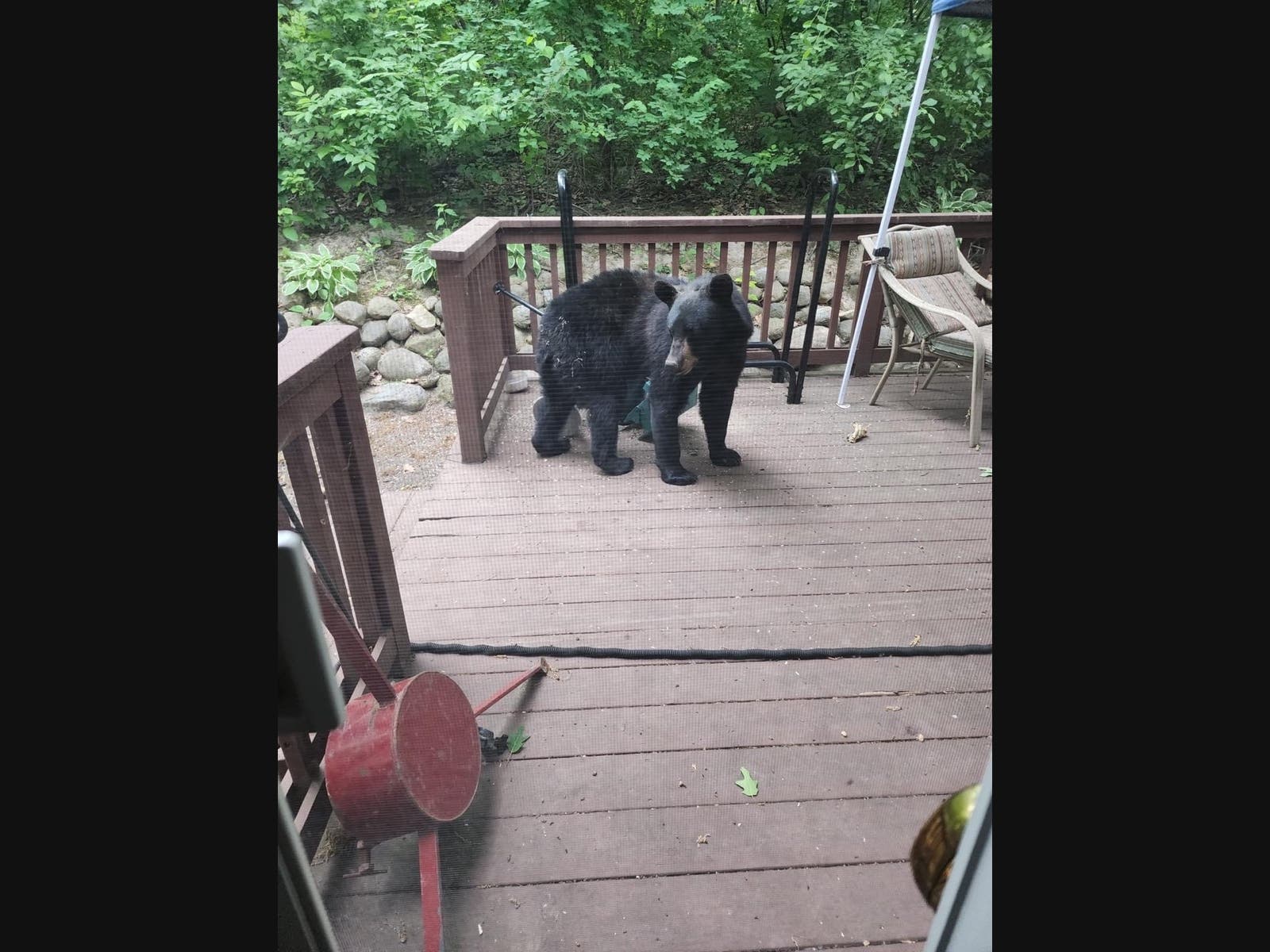
LAKE COUNTY, IL — The Lake County Sheriff's Office is urging the public to take precautions to protect themselves from a black bear that caused damage to deck furniture and potted plants at a home in Lake County over the weekend.
In a post Saturday night on Facebook, the Lake County Sheriff's Office shared a photo of the black bear, which was walking on a deck, and let residents know the Illinois Department of Resources had learned the bear is now in unincorporated Antioch. Christopher Covelli, deputy chief for the Lake County Sheriff's Office, said the bear caused damage to some chairs, a table, potted plants and other deck furniture at a home.
"The bear is likely hungry and looking for food," he said.
Find out what's happening in Grayslakefor free with the latest updates from Patch.
The last report of the black bear was reported early Sunday morning near Antioch and the bear's current location is unknown, said Jayette Bolinski, director of communications for the IDNR, on Monday.
The IDNR is recommending people who live in the vicinity of a confirmed bear sighting "secure their garbage cans and barbecue grills indoors and stop feeding birds for a few days," Bolinski said.
Find out what's happening in Grayslakefor free with the latest updates from Patch.
On Wednesday, authorities in Gurnee reported a black bear near Gurnee Mills. The Gurnee Police Department received reports of the bear after it was spotted in the area of Hunt Club Road and Route 132 that morning.
Officers responded to the area but did not find a bear, according to a post on the Gurnee Police Department Facebook page. A video that has been making its rounds online shows the animal running through the parking lot of a Kinder Care.
"Wildlife biologists believe the Antioch bear is likely the same bear that was seen in Gurnee last week," Bolinski said.
Officials do not want to drug or relocate the bear, but if a situation arises that requires those actions then authorities would work with the Federal USDA Wildlife Services to do so, according to police.
"Large visitors like the bear are becoming more common. We don't want the public to panic. We want them to be educated about our visitors and act accordingly," according to a Facebook post from the sheriff's office over the weekend.
Authorities offer these tips for anyone who may encounter the bear:
- Do not run
- Do not surprise the bear
- Make noise to ensure that the bear is aware of your presence
- A black bear is not likely to attack a person unless it feels trapped or provoked
- Respect the bear’s space, and do not approach the animal
- If the bear sees you, stand your ground; look as large as possible by standing up straight and putting your arms up in the air and slowly back away
- If possible, go inside a building or get into a vehicle
- Black bears display two types of behavior—defensive and offensive
- A bear may swat at the ground or surrounding vegetation, lunge toward you, vocalize, blow air out of its mouth, or pop its jaws
- These defensive behaviors are used to warn you to move away
- Slowly back away from the bear
- With offensive behavior, the bear will move towards you quickly
- If you have food with you, drop the food, and keep moving away from the bear
- If a black bear makes contact with you, always try to fight it off
- Do not play dead
Any bear sightings can be reported to the IDNR online.
This is not the first time a black bear has been spotted in Illinois.
Since 2008, there have been five reported sightings of black bears here, according to the Illinois Department of Natural Resources.
Black bears, once common in Illinois, were eliminated from the state by 1870, and there is currently no resident population of bears. But the potential exists for bears from existing populations in Missouri and Wisconsin to travel into the state.
Black bears have been protected by the Illinois Wildlife Code since 2015 and cannot be hunted, killed or harassed unless there is an imminent threat to person or property.
In June 2020, the Illinois Department of Natural Resources said a black bear entered Illinois from Wisconsin. Nicknamed “Bruno,” the black bear crossed through northeastern Illinois largely unbothered until June 21, 202o, when it crossed into Henderson County, where 300 people gathered “to view, follow and harass the bear,” the IDNR said.
Stefanie Fitzsimons, District Wildlife Biologist for the department, said at the time it was believed the bear was just passing through the state to find a mate.
"It's a novelty to see a bear in Illinois, and people want to see it for themselves, but they must remember that the outcome for this bear — whether IDNR must step in and take action to protect public safety — is completely dependent on how the public react to it," she added. "If the bear is left alone, it can continue its journey safely on its own."
At the time, conservation police warned they could make arrests if the public continued to harass the bear.
In 2014, a black bear was spotted in western Illinois and IDNR officials urged caution to suburban residents as it appeared the bear could enter Kane and Kendall counties.
"While the black bear sighted most recently has shown no aggressive behavior towards humans, it should not be approached," IDNR Director Marc Miller said at the time. "Help us keep this bear from being accustomed to people. Always observe wildlife from a distance."
Bear sightings can be reported to the IDNR online here. More information on black bears and what you can do if you see a black bear can be found on the IDNR website.
Get more local news delivered straight to your inbox. Sign up for free Patch newsletters and alerts.